Your wishlist is empty.
Secure Payment
30 days return

You've found a print you love, but it's still leaning against the wall because you don't know whether it belongs above the bed, opposite it, or on the narrow wall by the door. That hesitation is sensible. The wrong size or mood can make an otherwise beautiful bedroom feel unfinished.
The best prints for bedroom walls do more than fill blank space. They establish the room's emotional temperature, reinforce the bed as the visual anchor, and give everyday furniture a deliberate setting. Choose the feeling first, then the subject, size, material, and placement.
Stand in the doorway and ask one question: How do you want to feel when you enter this room? Don't start with a tape measure. A print can be perfectly sized and still feel wrong if it creates energy where you wanted rest, or visual clutter where you wanted simplicity.
A renter trying to recreate a boutique-hotel atmosphere needs a different image from a homeowner who wants the bedroom to feel like a permanent vacation. The first person might choose a restrained abstract in warm beige, ivory, and muted gray. The second could use a soft coastal scene with a clear horizon. Someone furnishing a first home may just need a personal focal point that stops the room from feeling generic.
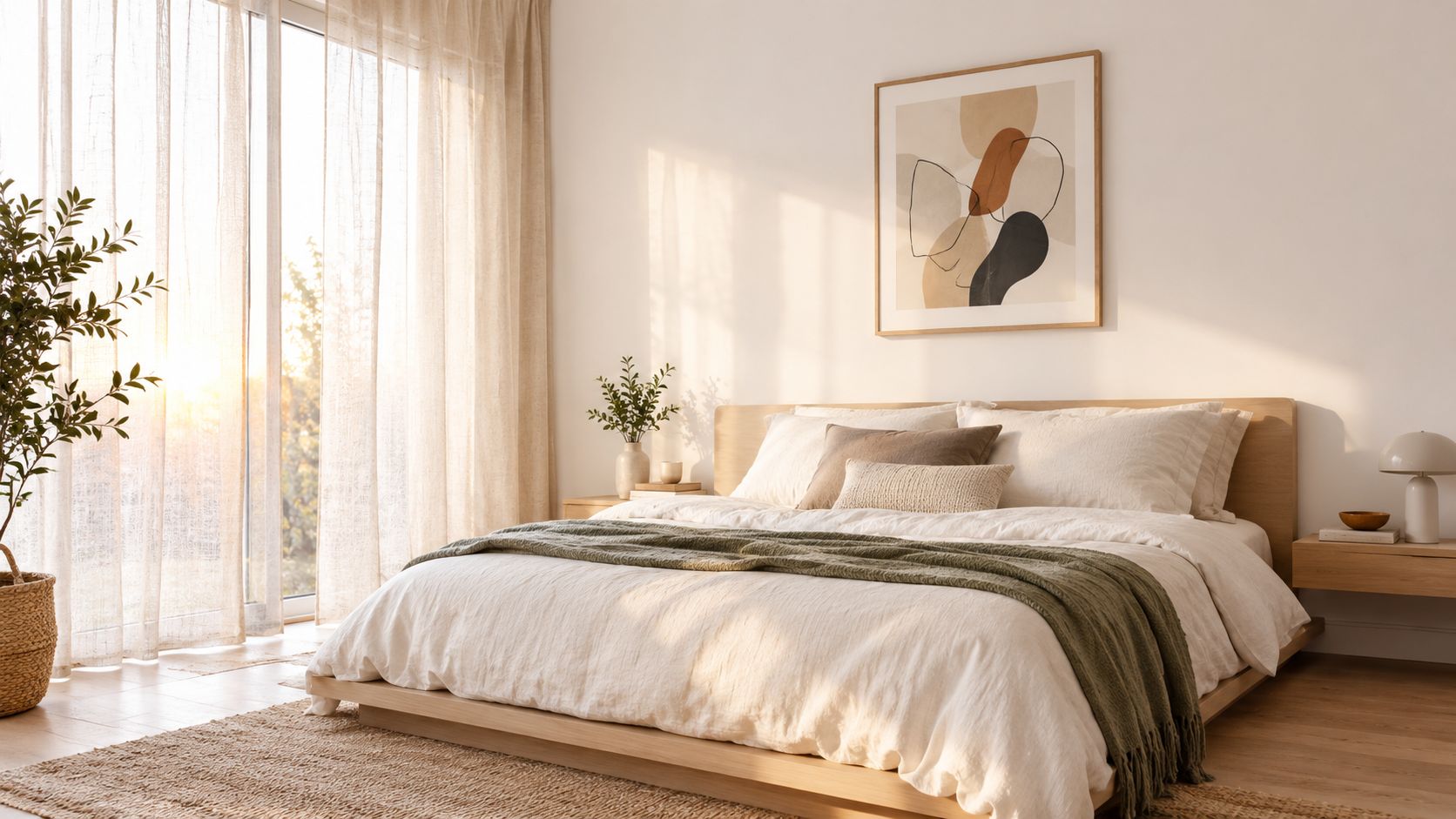
Biophilic design research connects nature-inspired bedroom visuals with emotional recovery and psychological well-being. Trend coverage for 2026 also points toward soft outdoor scenes, warm neutrals, Japandi minimalism, and gentle gradients, while Etsy's reported searches for wall-art decor rose 110% and searches for gallery prints rose 80%, as summarized in this research on bedroom visuals and well-being.
That doesn't mean you need to follow a trend. It means buyers increasingly treat bedroom art as a mood-setting decision rather than a leftover decorating task.
Practical rule: If you'd find the image distracting during the last few minutes before sleep, it belongs in a living room, hallway, or office instead.
Color matters, but composition matters just as much. A muted print with sharp diagonals and dense detail may feel busier than a brighter piece with a simple horizon. For a bedroom, I usually favor slow compositions, soft edges, open space, and visual movement that doesn't demand immediate attention.
Most bedroom art fails by being too small. A narrow print above a wide bed leaves the wall visually disconnected from the furniture, even when the artwork itself is attractive.
For above-bed placement, use the bed or headboard as your measuring reference. Expert sizing guidance recommends that the artwork or complete arrangement span 60–75% of the bed or available wall width, with the bottom edge approximately 6–12 inches above the headboard or furniture line. The visual center commonly sits around 57–60 inches from the floor, as outlined in this artwork-sizing guide.
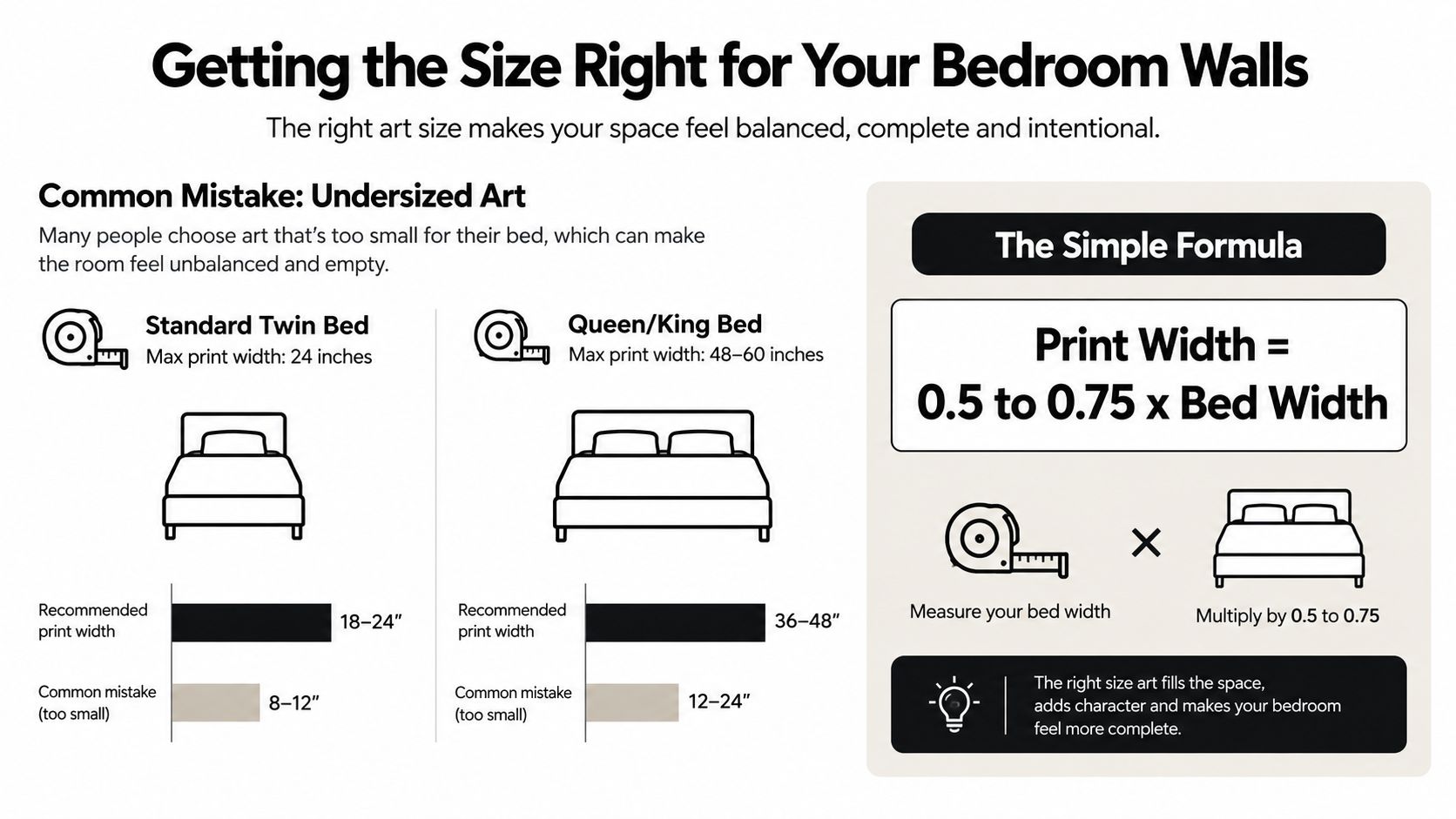
A queen bed is commonly 60 inches wide, so 60–75% gives you a target artwork span of 36–45 inches. A king bed is commonly 76 inches wide, producing a target span of roughly 46–57 inches. The number refers to the full visual width, not necessarily one canvas. A diptych or gallery arrangement can occupy the same span.
Use this sequence:
The same principle works for a dresser or console. Measure the furniture, not the entire wall, when the furniture clearly defines the zone. If a window interrupts the wall, use the uninterrupted section where the art will hang.
For a blank bedroom wall, artwork should cover approximately 60–75% of the available width, or about two-thirds to three-quarters of the furniture below it, according to this guide to wall-art proportions. That formula works for both a single print and a grouped arrangement.
Don't hang a small vertical print in the middle of a long empty wall just because the frame fits. Either enlarge the piece, add a companion, or move it to a narrower zone where its proportions make sense. For coastal themes and room-specific dimension advice, this resource on the best wall art sizes for coastal rooms offers another useful reference.
For ready-to-hang inspiration, browse Jessie's Home minimalist canvas wall art after you've calculated the target span. Measure first, shop second.
The format changes how the artwork behaves in the room. It affects glare, weight, visual formality, installation, and how easily you can replace the piece later.
Gallery-wrapped canvas is the easiest choice for a contemporary bedroom. The image continues around the edges, so there's no separate frame to source, and the surface avoids the glass glare that can appear opposite a window. Canvas also has a quiet texture that suits scenic, abstract, and botanical artwork.
Its limitation is commitment. A large stretched canvas has a strong presence, and changing the look means replacing the whole object rather than swapping a paper print inside an existing frame.
Framed prints under glass or acrylic feel more finished and traditional. A mat creates breathing room around detailed photography, vintage illustrations, and classic artwork. The frame can also connect the print to hardware, lamps, or furniture elsewhere in the room.
The drawback is reflection. Direct morning or afternoon light can make a glass-covered print difficult to see, and heavier frames require more secure hanging hardware. If you're uncertain about installation, consult a practical guide to hanging pictures before putting holes in the wall.
Float mounts sit between the other two options. The print appears to hover inside or above its frame, creating a clean edge without a traditional mat. This works especially well in modern bedrooms where you want definition without visual weight.
A pre-stretched, ready-to-hang canvas is the lowest-friction option. It arrives as one finished object, which makes it practical for renters, guest rooms, and anyone who doesn't want to coordinate printing, framing, and hardware separately. Jessie's Home's bedroom wall art collection includes ready-to-hang canvas formats across several subject styles.
The headboard wall gets most of the attention, but the bedroom is experienced from several sightlines. The wall opposite the bed is often the first view you see when you wake up, while side walls and corners can either support the main composition or make the room feel randomly decorated.
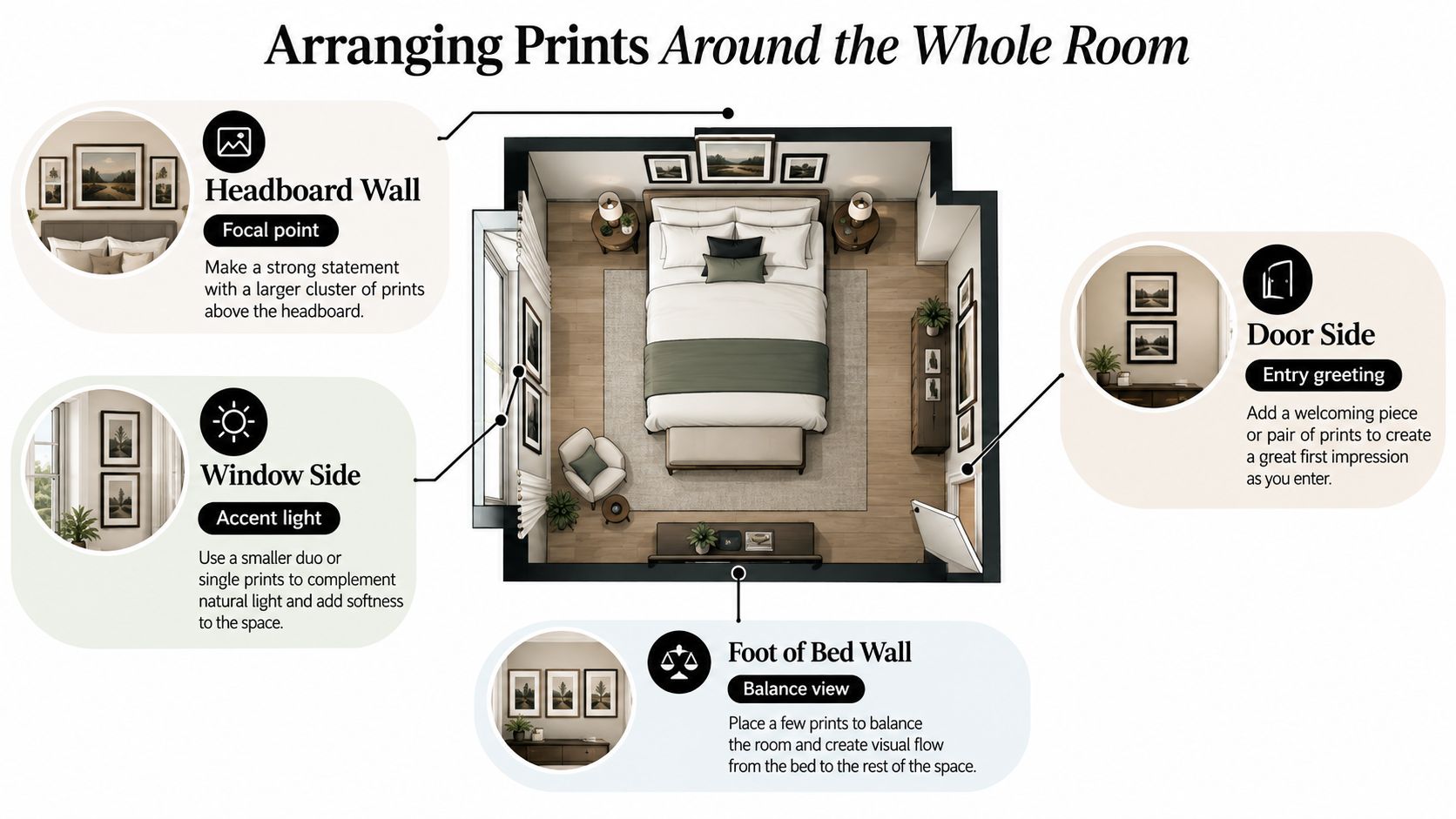
Headboard wall: Treat this as the focal point. Choose one broad artwork, one strong abstract, or a controlled gallery arrangement. A single piece feels calmer. A grouped display adds personality, but it should still read as one visual block above the bed.
Foot-of-bed wall: Choose something you'll enjoy seeing repeatedly. One impactful piece usually works better than a scattered collection. A simple pair can also work, provided the two prints share a color, subject, frame, or scale relationship.
Window side: Narrow walls favor portrait-oriented prints, small framed works, or a compact vertical pair. Keep the art clear of curtains and preserve the window as a light source rather than competing with it.
Door side: This is the entry greeting. Use a smaller piece, a vertical print, or a shallow shelf with a few carefully chosen objects. The art should welcome the room without trying to become its second focal point.
Corners: A floating shelf can add dimension without turning the corner into a second gallery wall. Lean smaller prints rather than anchoring a dense arrangement into an awkward angle.
The arrangement's outer width should still follow the same proportional logic. Art should occupy roughly 60–75% of a blank wall's width, or about two-thirds to three-quarters of the furniture below it, as explained in the earlier sizing guidance.
Cut paper templates to the size of each frame and tape them to the wall before drilling. On the floor, test the overall shape, then transfer it to the wall with painter's tape. This catches uneven spacing, an undersized cluster, and awkward relationships with lamps or windows before you commit.
Use 2–3 inches between frames for a tight, curated arrangement. Choose 4–6 inches for a more relaxed grid. Keep the outside edges intentional even if the internal shapes vary.
Low ceilings usually benefit from portrait-oriented artwork or a vertically stacked arrangement. Tall ceilings can support a wider horizontal piece or a gallery wall with more breathing room. Don't force symmetry if the architecture is irregular. Balance visual weight instead.
The paper-template method also protects renters from unnecessary holes. It's slower for ten minutes and faster for the entire project.
A major U.S. retailer currently lists over 2,000 bedroom wall art items, organized by room type, which reflects how widely the category is merchandised and how many styles shoppers compare. The variety is useful, but it also creates the main shopping problem: too many attractive options with no clear selection rule. This guide to choosing wall art for your home is helpful for thinking about the relationship between artwork, furniture, and room character.
Choose the subject according to the role you want it to play.
Soft scenes and botanical prints are my first choice for a restorative bedroom. Look for distant horizons, quiet water, open fields, or foliage with visible breathing room. These subjects add color and depth without making the wall feel argumentative.
Muted abstracts suit rooms that already have a strong furniture style. A canvas with layered sand, stone, olive, or blue-gray shapes can echo bedding and rugs without copying them. Avoid overly sharp geometry if the rest of the room is meant to feel soft.
Cityscapes and travel prints make the bedroom personal. They're ideal for someone who wants the room to reflect places, memories, or a sense of movement. Keep the composition edited. One skyline or coastal scene has more impact than several unrelated destinations competing across the walls.
Minimal line art is reliable in smaller bedrooms. A single neutral line on an open background adds personality without consuming the room visually. It also pairs easily with natural wood, white bedding, and simple lighting.
Personal photos, maps, and vintage illustrations can create a strong nostalgic layer. Prevent the result from becoming cluttered by repeating one frame finish and limiting the display to one wall zone. Personal art should feel curated, not like an inventory of everything meaningful you own.
For a large bedroom, a panoramic coastal print can carry the headboard wall with very little additional decoration. A piece such as Big Sur Golden Hour uses warm amber light, turquoise water, rust, gold, and burnt-orange cliffs in a vintage travel-poster style. That combination gives a neutral room a destination-focused identity without relying on a busy pattern.
For broader bedroom styling options, explore Jessie's Home master bedroom wall art by subject and mood. Avoid very dark, high-contrast, or densely detailed pieces when the room's priority is sleep. Those artworks may be excellent in a study or living room, but a bedroom rewards visual restraint.
Good placement won't protect a print from the room's daily conditions. Direct sunlight, humidity, dust, and heat are the main problems to manage.
Keep artwork out of strong direct sun whenever possible, especially on walls that receive intense morning or afternoon light. If the wall can't be avoided, choose canvas with a UV-protective coating or another print surface designed to resist fading.
Dust canvas with a dry microfiber cloth using light strokes. For glass or acrylic, use a slightly damp microfiber cloth and avoid spraying cleaner directly onto the frame or print edges. Dust can settle along the top edge, so clean the frame as well as the visible image.
Don't place artwork directly above a radiator, heater, humidifier, or another source of repeated temperature and moisture changes. Exterior walls and areas beside windows deserve extra attention in rooms with noticeable condensation.
Seasonal rotation keeps the bedroom feeling fresh and reduces the amount of time any one piece spends in the same light. Store unused prints upright or flat according to their format, away from dampness and pressure.
A well-maintained print remains part of the room's character instead of becoming another item you need to replace.
Jessie's Home offers artist-made canvas wall art and gallery-quality photo prints in ready-to-hang styles including scenery, coastal scenes, botanicals, skylines, and minimalist work. Browse Jessie's Home with your measured wall width and chosen mood in mind, then select a piece that gives your bedroom a deliberate finish.

Stylish game room wall decor ideas with real tips on themes, durable materials, lighting, and layouts. Practical advice for renters and homeowners.
Stylish game room wall decor ideas with real tips on themes, durable materials, lighting, and layouts. Practical advice for renters and homeowners.

Learn how to hang picture rail securely and style it perfectly. Get step-by-step installation tips, weight limits, and display ideas for your canvas art.
Learn how to hang picture rail securely and style it perfectly. Get step-by-step installation tips, weight limits, and display ideas for your canvas art.

Learn how to choose the right prints for bedroom walls — sizing, mood, framing, placement above the bed, and care tips. Practical guidance for every room.
Learn how to choose the right prints for bedroom walls — sizing, mood, framing, placement above the bed, and care tips. Practical guidance for every room.


