Your wishlist is empty.
Secure Payment
30 days return

You've just carried a new console into the room, positioned the couch, and switched on the LEDs. The setup works, but the wall above it still looks unfinished. That empty stretch beside the monitor or behind the poker table can make an otherwise comfortable game room feel temporary.
Good game room wall decor isn't only about filling space. It has to coexist with bright screens, speakers, controllers, occasional bumps, and long sessions in the same chair. The most successful rooms build their walls through small, reversible decisions: choose the right focal point, control reflections, soften sound, and use materials that suit the way the room functions.
Start by standing where people will sit, not where the wall looks most impressive from the doorway. Look toward the screen, the shelves, the dartboard, or the gaming desk, then notice which empty wall enters your peripheral vision. That view matters because decor that looks balanced from the entrance may feel distracting once a monitor is glowing in front of you.
Ask three practical questions before buying anything:
Most game rooms already have a visual anchor. It might be a monitor, a television, a pool table, a pinball machine, or a brightly lit arcade cabinet. Wall art should support that anchor rather than compete with it.
For example, a single bold canvas can finish the wall behind a couch while leaving the monitor wall clean. A compact group of framed prints can give a narrow gaming station personality without turning every surface into a display. If the room already has strong RGB lighting, quieter artwork often creates more balance than another glowing object.
Use paper templates, painter's tape, or lightweight mock-ups before drilling. Cut shapes that match the approximate size of your frames, tape them to the wall, and sit in the usual gaming position. Check the view with the monitor on and the room lights set to their normal evening level.
Practical rule: If a decoration looks exciting only when the room is empty, it may be too dominant for a room that needs to function during play.
This approach also protects your budget. You can test whether a neon sign feels too bright, whether a gallery sits too close to the screen, or whether the wall needs acoustic treatment before committing to a large purchase. A finished game room doesn't require one dramatic transformation. It needs a sequence of choices that makes the room easier and more pleasant to use.
Wall décor has moved from elite architectural ornament toward accessible interior styling. Historical accounts trace decorative wall elements to Ancient Rome, a later revival during the Renaissance, Baroque, and Classicism periods, and a modernist shift toward minimalism. Wallpaper followed a similar path from luxury material to a familiar finish used throughout homes, as described in this history of wall decoration in interior design.
That history helps explain why game room walls now carry more responsibility than a few posters. Wall art has become part of how people personalize living rooms, offices, basements, entertainment areas, and flexible guest spaces. A game room may need to feel immersive during play, presentable when guests arrive, and calm enough to share with the rest of the home.
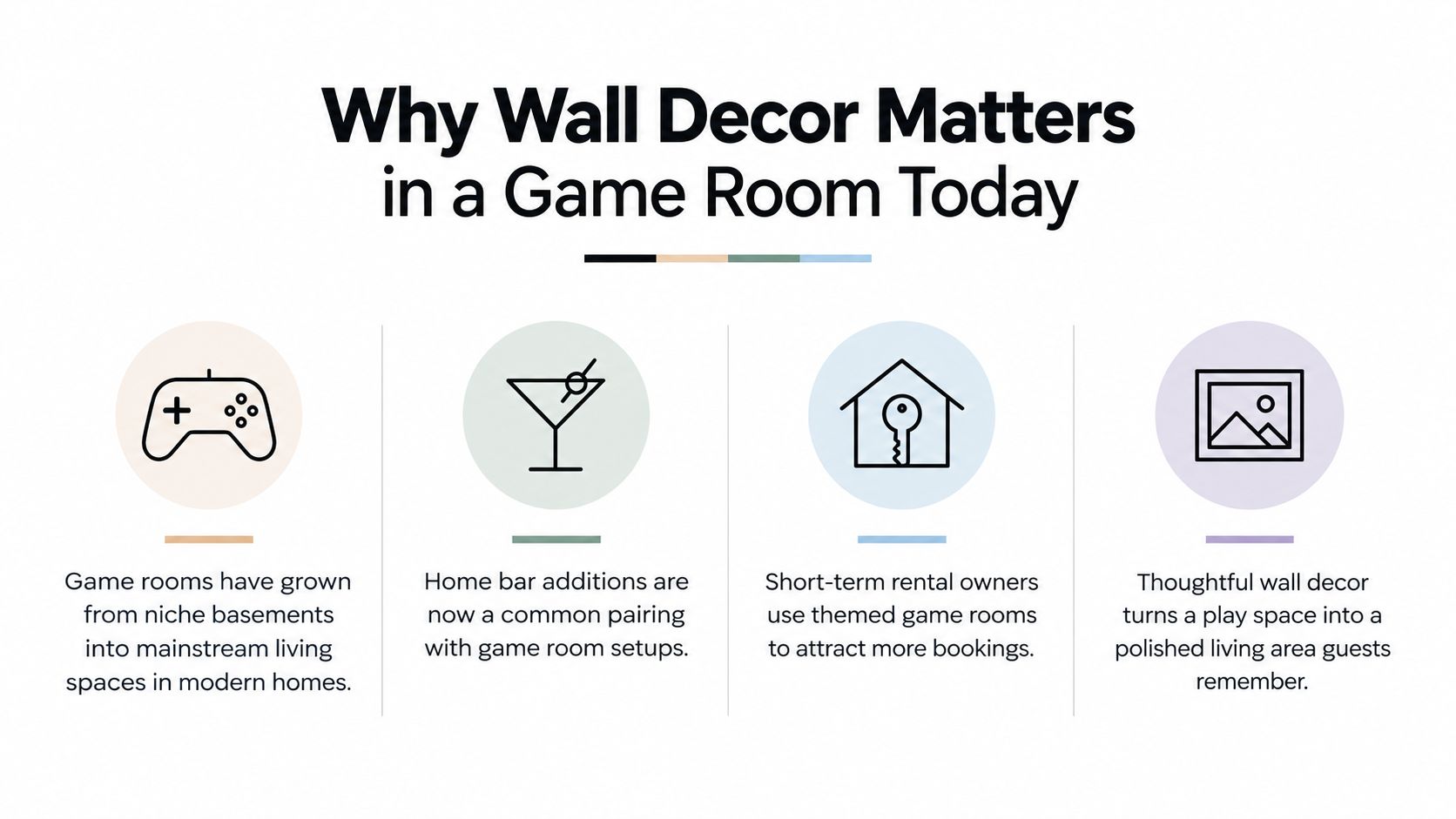
The broader wall décor category is already globally scaled. One estimate places the market at USD 66.18 billion in 2025, with a projection of USD 110.1 billion by 2034 and a 5.8% CAGR, while another projects USD 63.95 billion in 2025 rising to USD 90.77 billion by 2030 at a 7.2% CAGR. These forecasts differ, but both describe an established category with continuing expansion, not a niche accessory market. See the global wall décor market estimate for the cited forecasts.
Residential buyers account for 72.3% of market value in one forecast, which helps explain why game room pieces are often purchased as home-improvement and personalization products rather than specialist furnishings. Paintings represent 28.5% of the product mix in one report, and another identifies wall art as the leading product type. For buyers in the United States and Canada, North America is especially relevant because one source assigns the region over 40% of global revenue.
The practical result is simple. You can choose from materials designed for art display, home theater use, rental flexibility, or commercial durability. But more options also make it easier to buy a piece that looks good online and performs poorly beside a bright screen or in a lively room.
The material changes how a piece handles light, humidity, cleaning, and accidental contact. In a basement or garage game room, that choice matters more than a small difference in color.
Framed prints offer structure and a polished finish. Glass protects the print and makes cleaning straightforward, but it can reflect a monitor, ceiling fixture, or LED strip. Acrylic weighs less and is less likely to shatter, although it can still bounce light and may show surface marks if cleaned with the wrong cloth.
Canvas wraps create a softer, low-reflection surface. They suit large nature scenes, abstract compositions, and atmospheric views, especially on a wall opposite a screen. Their wrapped edges remove the need for a separate frame, but the exposed surface needs sensible placement if chairs, controllers, or moving players could brush against it.
Mounted posters are usually the most flexible choice for changing themes. A sealed or laminated surface can be wiped, while a lightweight backing makes installation easier. Unprotected paper is less forgiving around drinks, damp air, and frequent handling.
Powder-coated aluminium frames work well where you want a slim, contemporary profile. Sealed hardwood adds warmth, but the finish should be properly closed rather than left porous. Moulded composite frames can keep costs controlled and offer consistent shapes for a gallery wall.
Look for UV-stable inks when artwork will sit near a window or bright LED installation. A wipeable laminate makes sense for a social game room, but glossy coatings may increase reflections. A matte surface generally works better near monitors and televisions.
For a broader selection of canvas formats, you can explore canvas wall art and compare how different subjects and finishes might sit with your setup.
| Format | Durability | Glare Behaviour | Best For |
|---|---|---|---|
| Framed print with glass | Protective and easy to clean, but vulnerable to breakage if poorly placed | Can reflect screens and fixtures | Formal galleries and low-contact walls |
| Framed print with acrylic | Lightweight and safer in active rooms | Can still reflect, though a non-gloss finish helps | Rentals, family rooms, and flexible layouts |
| Canvas wrap | Resistant to ordinary bumps and visually soft | Usually produces less direct reflection | Walls opposite screens and large focal areas |
| Laminated mounted poster | Easy to replace and wipe clean | Depends strongly on the laminate sheen | Changing themes and hospitality spaces |
Don't choose a format by appearance alone. Hold a sample or print a small test image, position it near the intended wall, and view it with the gaming equipment switched on. The right surface is the one that remains legible without adding another bright distraction.
A strong theme gives the wall a point of view without forcing every object in the room to match. Choose one dominant direction, then let smaller accessories support it.
A neon sign spelling out a game name above a console setup creates an immediate focal point. Pixel art prints, retro cabinet graphics, and small blocks of saturated color work well with LED-heavy rooms. Keep the number of glowing elements under control if the monitor already provides the brightest light.
A row of movie or comic posters in matching black frames feels more intentional than a random collection of unrelated prints. Character art, collectible shelves, and franchise symbols can bring personality to a wall behind a sofa or along a social gaming area. For a compact fandom accent, you could browse Triforce decal designs and use a removable decal where a framed piece would feel too heavy.
A single oversized abstract canvas in muted tones can finish the wall opposite a screen without competing with gameplay. Monochrome frames, clean lines, and restrained accents suit monitor-heavy rooms because they reduce visual noise. This direction works particularly well when the desk, cables, and equipment already create plenty of detail.
Botanical prints, wood textures, or a forest mural behind the player can make a technology-filled room feel less clinical. Earthy greens, soft browns, and nature-inspired artwork pair naturally with warm ambient lighting. The approach suits cozy rooms and multipurpose spaces where the decor needs to remain comfortable even when nobody is gaming.
You can compare subjects designed for entertainment spaces in game room wall art. Think about the room's brightest surface before settling on a style. Neon and pop culture themes can clash with a monitor-heavy wall if every piece uses strong contrast, intense color, or built-in lighting. Minimalist and nature-led choices usually provide more visual breathing room.
A piece can look perfect in daylight and become a problem at night. Reflections appear when a frame, glossy poster, or bright sign sits in the viewer's line of sight, especially near a television or monitor.
Use matte frames, canvas wraps, or fabric prints around screens. Place bright artwork beside the display rather than directly across from it, and turn off individual fixtures while checking the wall from the gaming chair. Gallery guidance commonly places artwork and lighting geometry around a 30-degree angle from the wall to reduce direct specular reflection. The framed art lighting guidance explains the principle behind offsetting light from reflective surfaces.
Dimmable sconces can provide useful room light without shining directly onto the screen. An LED strip behind a floating frame or shelf adds a soft outline, while a backlit neon sign can serve as both decoration and low-level ambient illumination. Keep the power source and cable route tidy, because an attractive sign with a visible cable often looks less finished than a simple unlit print.
A media-focused art collection can help you compare pieces intended for screen-centered spaces through media room wall art. Choose the least reflective surface for the wall facing the seating position, then reserve brighter finishes for side walls.
Hard drywall, glass, and bare floors reflect sound. Dialogue and directional effects can become less distinct when those reflections overlap, while an energetic group can make the room feel tiring.
Wall-mounted acoustic panels, fabric-wrapped frames, bookshelves, and tapestries can break up those reflections without making the room resemble a recording studio. Industry guidance commonly recommends treating about 20% to 30% of total wall surface, with priority given to first-reflection points and walls parallel to sound sources. See this gaming room acoustic treatment guide for the placement logic.
Comfort matters: A wall that looks quieter can make a long session feel quieter too, especially when it reduces echo around speech and directional audio.
If speakers, a projector, or a large screen form the center of the room, a specialist resource on expert cinema room fitting can help you think through the relationship between display placement, lighting, and wall finishes.
A long wall behind a couch can handle more visual information than the wall directly behind a monitor. Start with the furniture, then choose an arrangement that gives the eye a clear place to land.
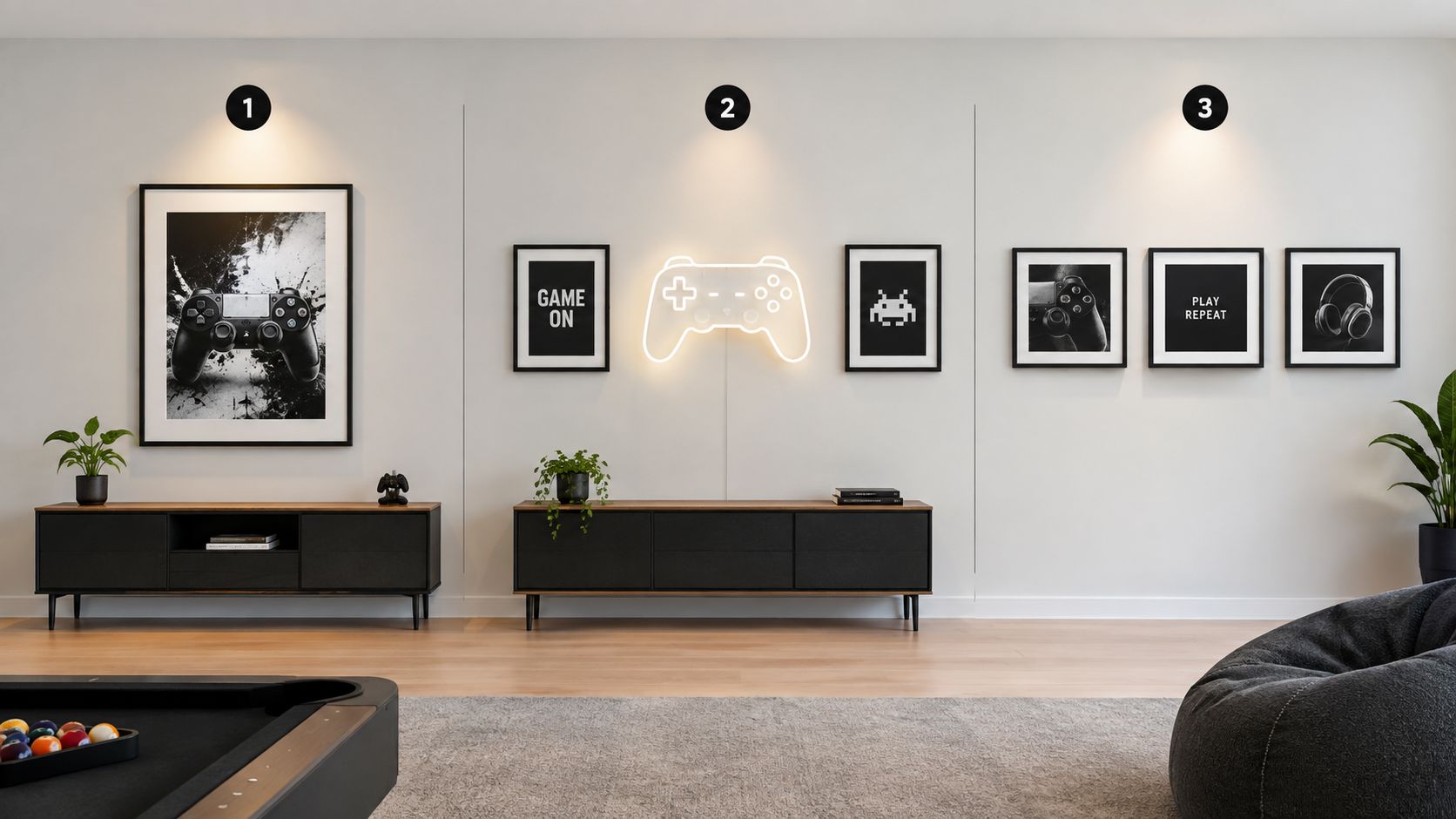
Place one large framed artwork or neon sign above the console, then add smaller supporting pieces on either side. The central element should carry the greatest visual weight, while the surrounding pieces echo its color or subject without matching it exactly.
Leave a comfortable hand-width between the anchor and its neighbors. If the group feels crowded when viewed from the gaming chair, remove one piece before making the whole arrangement larger.
Along a long wall behind a sofa or racing seat, use a horizontal run of matching frames at a consistent eye level. Four to six pieces can create rhythm, but the exact count matters less than the repeated frame style, even spacing, and shared visual theme.
Keep the gallery away from the screen's strongest sightline. A narrow band of art can define the seating zone while allowing the television or monitor to remain the room's primary focal point.
For an informal setup, group mixed-size artwork slightly off center and balance it with one tall element, such as a shelf or vertical poster. Put the largest item lower in the cluster, then use smaller pieces to step upward or outward.
The arrangement should feel balanced, not mirrored. Place the pieces on the floor first, photograph the group, and adjust the visual weight before lifting anything.
A short lead-in can help you judge the proportions in a real setup:
For any pattern, preserve breathing room around a display. A wall doesn't need to be completely decorated to look finished. Empty space helps separate art from the screen and keeps the room from feeling visually compressed.
A lease restriction or frequent guest turnover doesn't mean the walls have to stay bare. It means the hanging system should be part of the design from the beginning, not an afterthought.
Adhesive strips and removable hooks suit lightweight framed prints when the wall surface is clean, smooth, and compatible with the product instructions. Test one piece first, use the stated weight limit, and avoid placing a valuable frame above seating until you trust the bond. Museum putty can steady small objects in high-traffic corners, but it isn't a substitute for proper support on heavy artwork.
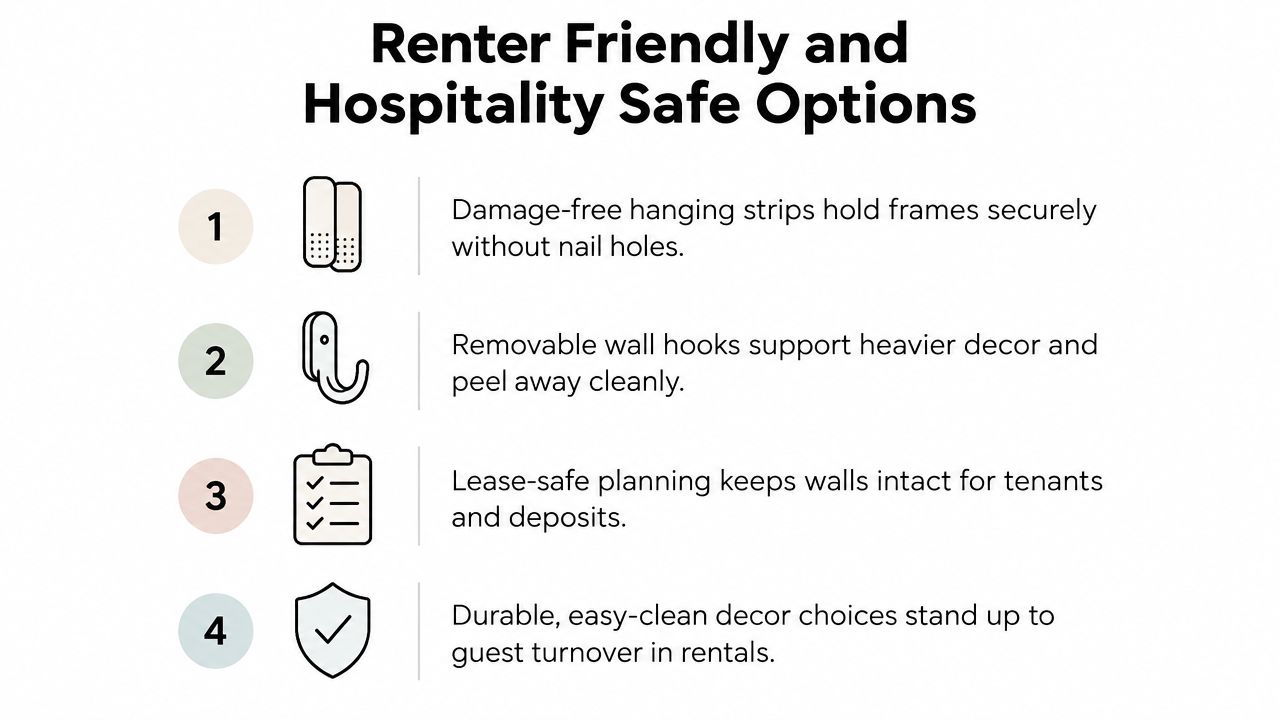
A pegboard or slatwall can hide existing flaws while creating flexible space for controllers, small shelves, signage, and lightweight art. Because the display attaches to the surface rather than requiring a new hole for every change, it works well for renters and hospitality operators who refresh themes or rearrange equipment.
Freestanding picture ledges offer another low-commitment option. Lean lightweight frames on the ledge, secure them against movement, and remove the entire display during checkout or inspection.
Hospitality spaces need pieces that are easy to clean, difficult to knock loose, and appropriate for the building's requirements. Check local fire-rating rules before installing fabric panels, tapestries, foam products, or illuminated signs in a commercial venue.
Skip heavy canvas above seating when a hard-mounted anchor isn't available. Avoid fragile glass in corners where guests carry drinks, and don't rely on an adhesive product just because the frame feels light in your hand.
For shared spaces: Favor lightweight, replaceable, wipeable pieces over irreplaceable objects that require special handling.
A renter-friendly wall can still feel personal. The trick is to design for removal, inspection, and reconfiguration rather than pretending the room is a permanent private installation.
Use this order before you buy:
The easiest next step costs almost nothing. Sketch the wall on paper, cut paper templates for your intended pieces, and tape them up for an evening gaming session. If the layout feels comfortable with the screen glowing, voices in the room, and people moving around, you're much more likely to enjoy the finished wall.
Jessie's Home offers artist-made canvas wall art and gallery-quality photo prints in styles ranging from abstract and minimalist to scenic, botanical, skyline, and pop art. Browse Jessie's Home to find a piece that fits your game room's theme, lighting, and seating wall, then test its placement before committing to the final arrangement.

Stylish game room wall decor ideas with real tips on themes, durable materials, lighting, and layouts. Practical advice for renters and homeowners.
Stylish game room wall decor ideas with real tips on themes, durable materials, lighting, and layouts. Practical advice for renters and homeowners.

Learn how to hang picture rail securely and style it perfectly. Get step-by-step installation tips, weight limits, and display ideas for your canvas art.
Learn how to hang picture rail securely and style it perfectly. Get step-by-step installation tips, weight limits, and display ideas for your canvas art.

Learn how to choose the right prints for bedroom walls — sizing, mood, framing, placement above the bed, and care tips. Practical guidance for every room.
Learn how to choose the right prints for bedroom walls — sizing, mood, framing, placement above the bed, and care tips. Practical guidance for every room.


