Your wishlist is empty.
Secure Payment
30 days return

You've found the perfect sofa, arranged the sectional, added a soft rug, and still the family room looks unfinished. The blank wall above the seating feels strangely small, while the television, toys, pet beds, and afternoon sun all compete for attention. Choosing wall art for a family room isn't just a matter of finding an attractive image. The piece has to fit the furniture, tolerate daily use, work with the room's lighting, and make sense alongside the practical chaos of home life.
The category is substantial. The global wall art market was estimated at USD 61.01 billion in 2025 and is projected to reach USD 99.15 billion by 2033, with residential spaces accounting for 70.5% of the market in 2025, according to Grand View Research's wall art market report. For homeowners in the U.S. and Canada, the audience is especially relevant because North America represented 47.8% of global demand in 2025 in that analysis.
At 7 p.m., the family room is doing several jobs at once. One child is stretched across the sectional with a tablet, someone else is looking for the remote, the dog has claimed the rug, and a movie is about to start. A framed print that looks elegant in a quiet showroom may feel too delicate, too formal, or just too visually weak once it sits above a large sofa and beside a television.
A formal living room can support art chosen almost entirely for atmosphere. A family room needs visual strength and practical resilience. The artwork should hold its own against broad furniture, survive ordinary bumps and cleaning, and remain appealing when the room shifts from relaxed conversation to play space or movie zone.
Practical rule: Choose family room art as part of the room's working layout, not as an accessory added after everything else.
That change in mindset affects the subject, format, finish, and placement. A sprawling sectional usually needs a wide horizontal canvas or a carefully planned grouping. A media wall may need one strong piece nearby rather than several small frames competing with the screen. If the room has children or pets, avoid placing fragile glass, narrow ledges, or easily knocked objects within reach of the seating and circulation paths.
Canvas is often more suitable than thin paper for a busy room because it creates a substantial, ready-to-hang surface without requiring a delicate freestanding frame. A protected print also makes more sense near windows than an unprotected decorative image that can lose its impact under repeated sun exposure.
The subject matters just as much. Abstract scenery, botanical forms, coastal views, and restrained cityscapes tend to blend naturally with everyday seating, throws, and rugs. Highly personal or formal imagery can work, but it should support the room rather than make a casual space feel staged.
Market data supports this residential, ready-to-install direction. Another wall art market analysis from Fortune Business Insights estimated the global category at USD 66.89 billion in 2025, with a projected USD 145.49 billion by 2034. Its broader findings reinforce a practical point: framed prints, canvas, and related formats are mainstream home purchases, not specialist décor reserved for galleries or formal rooms.
A small artwork above a large sectional looks accidental. The fix is mathematical, not mysterious.
Start by measuring the usable width of the furniture beneath the artwork. For a standard sofa or console, use the full visible width. For a sectional, measure the seating run that sits directly below the wall, not every inch of the L-shaped configuration if part of it turns away from the artwork.
The core rule is simple: artwork should measure roughly two-thirds to three-quarters of the furniture's width. The living room wall art sizing guide from KunstPlaza supports this proportion and also recommends centering the artwork at about 57 to 60 inches from the floor.
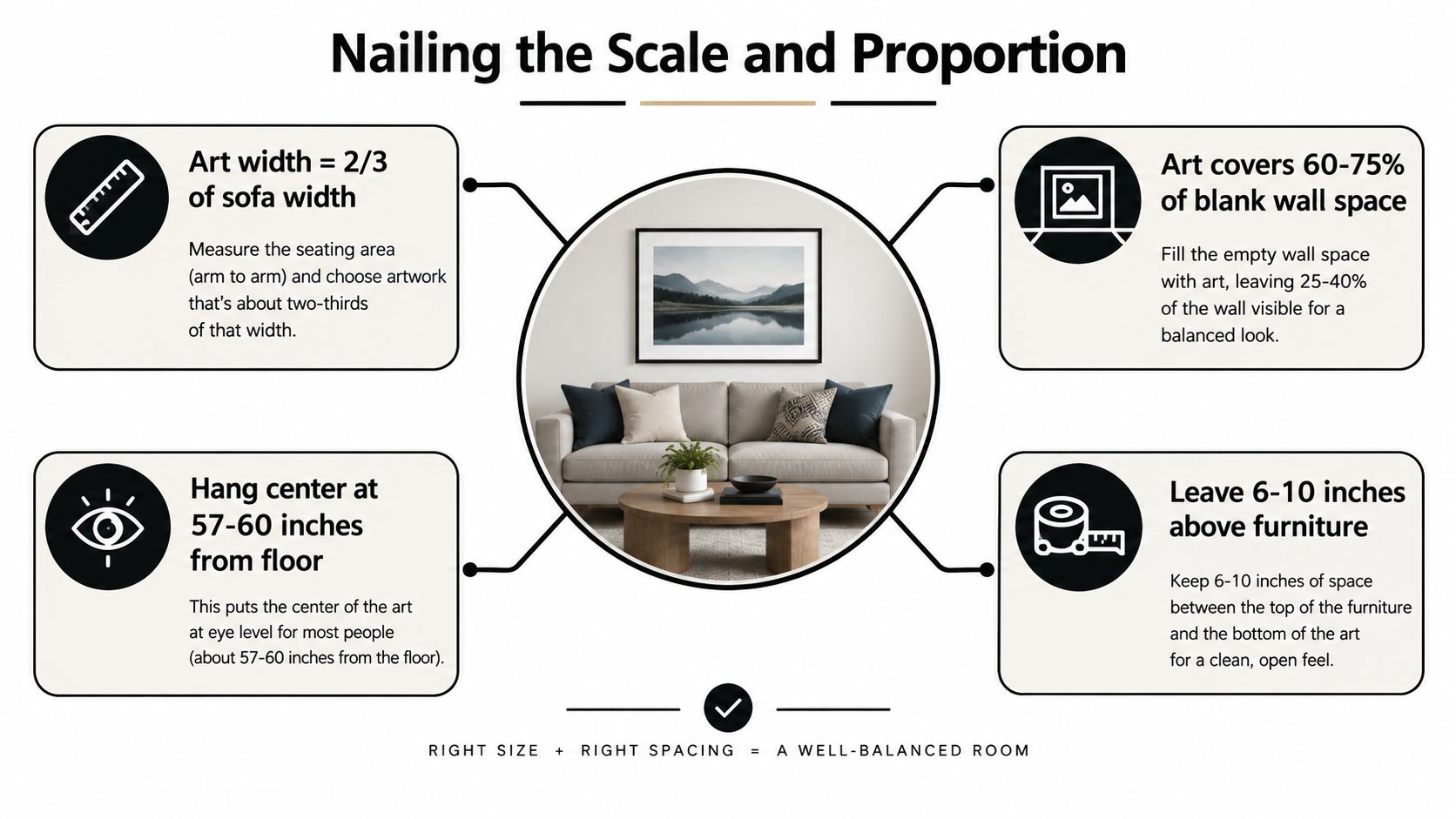
Use this process:
Leave breathing room around the arrangement. A gap of 6 to 10 inches above the furniture usually keeps the artwork connected to the sofa or console without making it look cramped. If the furniture is unusually low, move the artwork down visually while preserving a comfortable clearance. If the ceiling is high, don't automatically push the art upward. Family rooms are viewed mostly from seated positions, so the composition should serve seated eye level rather than empty space near the ceiling.
The center-height rule is a starting point, not a reason to ignore the furniture. Measure to the center of the artwork, not its top edge. For a gallery wall, find the center of the complete composition and hang that point at the appropriate viewing height.
Family room art faces three predictable problems: accidental contact, airborne dust and pet hair, and light exposure. Material selection won't make a piece indestructible, but it can determine whether the artwork continues to look polished after years of normal use.
For a busy room, look for premium cotton-blend canvas, fade-resistant inks, a protective UV coating, and a solid wood stretcher frame. Canvas has a flexible, textured surface that suits large formats and avoids the fragile feel of an unmounted paper sheet. A sturdy wood frame helps the piece stay taut and square, while a protective coating gives the printed surface another layer between the image and everyday handling.
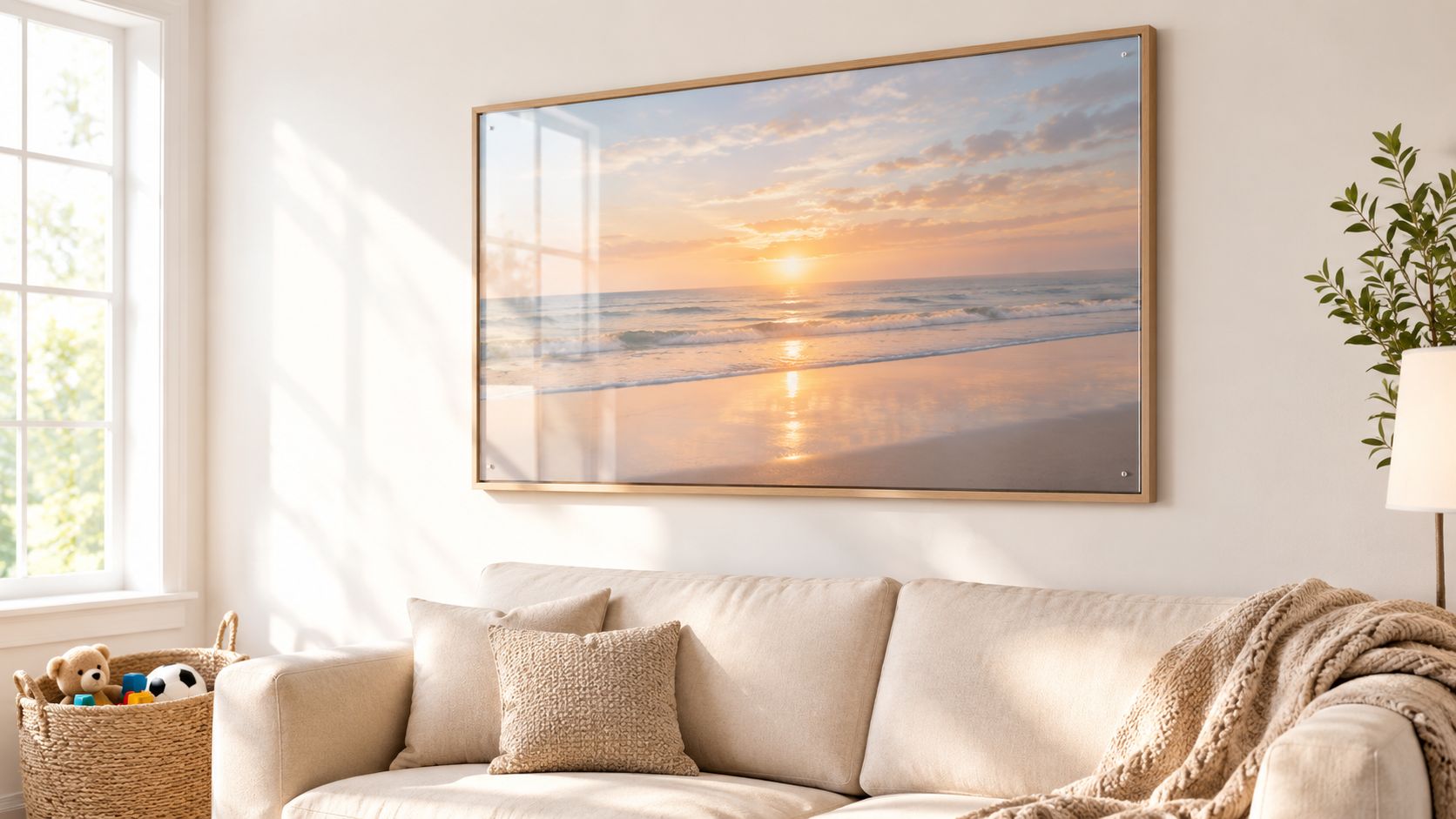
Don't stop at the image preview. Check the construction details before you buy:
The same principle applies to the surrounding room. If you're selecting upholstery, rugs, or flooring at the same time, this guide to low-maintenance interior materials offers useful context for building a space that can handle regular living without constant special care.
Jessie's Home produces artist-made pieces on premium cotton-blend canvas with fade-resistant inks, solid wood frames, and protective UV coating. You can review the construction and available formats in the canvas wall art collection.
Keep artwork away from direct contact with chair backs, active play routes, heat vents, and areas where a pet repeatedly brushes against the wall. A secure hanging system matters as much as the canvas itself. Heavy pieces need properly rated hardware, and the wall type should determine whether you use a stud, anchor, or another suitable fixing.
Sunlight deserves special attention. Even protected prints can fade under sustained high exposure, so use window treatments or select a wall that receives softer, indirect light.
A family room art choice has to survive more than visual scrutiny. It must hold adults' attention while remaining calm beside toys, blankets, books, pets, and a large screen. Choose the subject and palette together, then test how they work with the room's existing materials.
Start with the sectional, rug, and largest fixed elements. A neutral sectional with a patterned rug can support a quiet abstract scene. A plain sofa with restrained accessories can take a stronger botanical, coastal, or geometric statement. The artwork should introduce a fresh note while repeating at least one color or shape already in the room.
Use this comparison to set the direction:
| Room condition | Stronger art direction | Why it works |
|---|---|---|
| Patterned rug and textured throws | Neutral abstract or soft scenic view | It quiets the composition while echoing the room's warmth |
| Plain upholstery and simple accessories | Colorful abstract or geometric work | It supplies energy without adding more furniture |
| Coastal materials and pale wood | Beach, water, or atmospheric coastal scene | It reinforces the relaxed setting without making the room look themed |
| Dark media console and black accents | Art with controlled charcoal, navy, or deep brown | It connects the heavier visual elements |
| Mixed colors already in the room | Limited-palette botanical or skyline image | It gives the eye a calmer focal point |
Pull two or three existing colors from a rug, cushion, curtain, or nearby object. Select artwork that uses those tones in different proportions rather than matching them exactly. A slightly warmer or cooler version creates cohesion without making the room feel manufactured.
Subject choice should support the room's emotional job. Abstract scenic views and botanical prints create a settled backdrop. City views add structure and a sense of place. Pop art and vivid geometry create a focal point, but they need clear visual space around them. If the sectional already carries colorful cushions, highly saturated artwork can make the room feel noisy.
Use the seating position as the final test. Meaningful art belongs in the main sightline, with details large enough to read from the sofa. Avoid tiny subjects hidden behind lamps, furniture, or a sectional arm.
For a more energetic direction, browse colorful abstract canvas wall art. Compare each piece's dominant colors with the rug and upholstery before committing. The goal is a deliberate room that still feels comfortable on an ordinary evening, with the lights low and the sofa in use.
A beautiful canvas can fail if it reflects into the television, sits in direct sun, or competes with every other focal point on the media wall. Placement should follow the room's sightlines first, then the decorative plan.
Begin from the main seat. Look toward the wall while sitting, not standing. Check whether the artwork is visible around the television, whether a window creates glare, and whether a floor lamp or tall plant interrupts the composition.
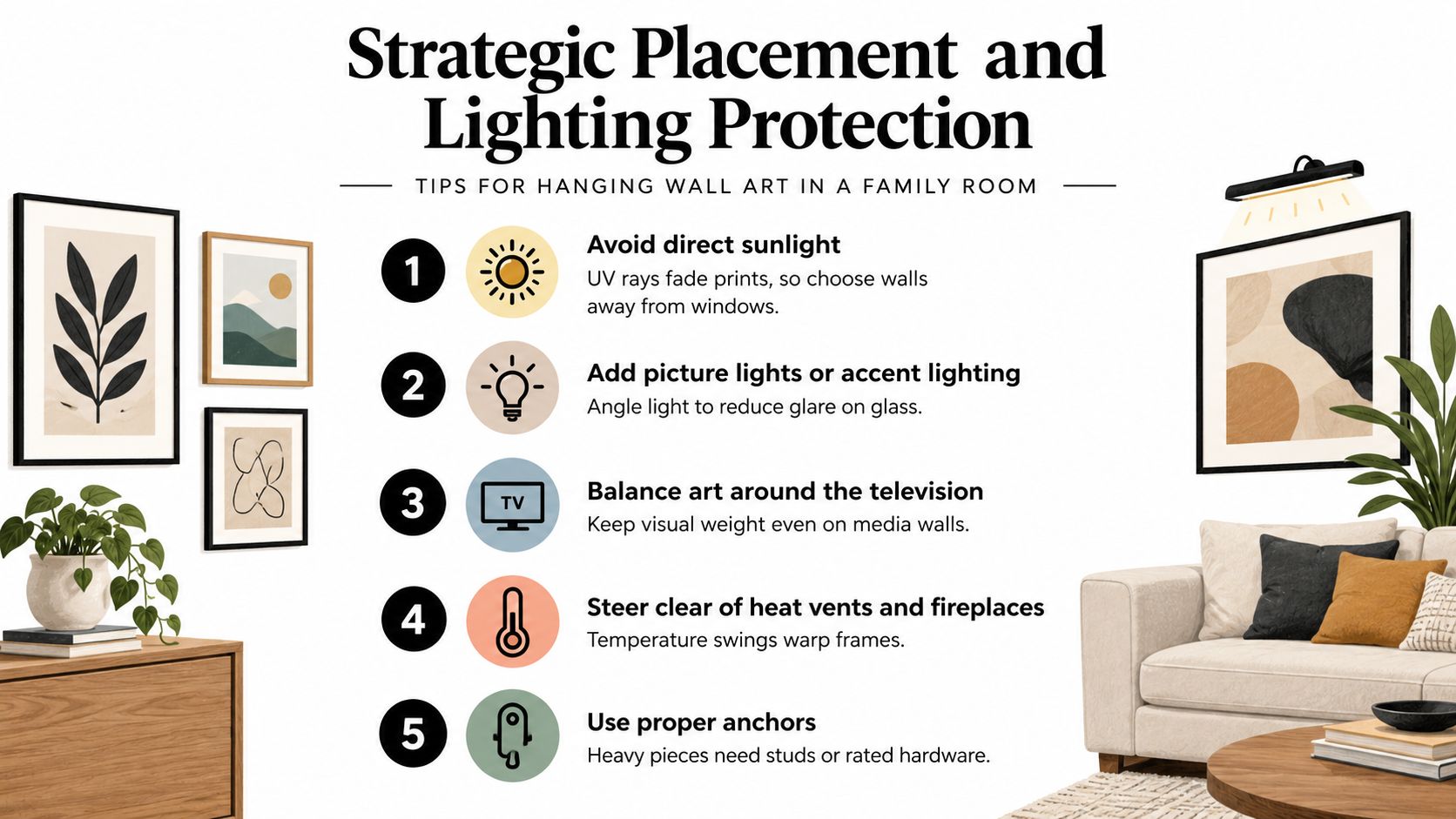
If the artwork hangs near a television, don't place it where a picture light or window reflection will shine directly across the screen. Shift the light source, change the angle, or choose a neighboring wall that balances the television without competing with it.
For artwork lighting, aim the beam at approximately 30 degrees from vertical. This angle reduces glare and bright hotspots, according to William Artists' guidance on lighting art in living spaces. High-CRI LED lighting rated at 90+ CRI improves color fidelity, so the canvas looks closer to its intended colors rather than overly yellow or dull.
Low-UV, low-heat illumination is the responsible choice for long-term display. Avoid hot bulbs, direct afternoon sun, and fixtures that press heat against the frame. If the wall is near a fireplace or heating vent, move the art away from the strongest temperature changes.
Lighting decision: Light the artwork so you can see its colors from the sofa, but never so aggressively that the surface becomes the brightest object in the room.
A television is visually dense and rectangular. Balance it with artwork that has comparable mass, either on the same wall with careful spacing or on the adjacent wall. Don't scatter several tiny pieces around the screen without a clear edge or center. That creates visual static.
Use proper anchors for the artwork's weight and your wall construction. Before drilling, mark the center point, confirm the furniture clearance, and test the composition with paper templates. This small preparation prevents unnecessary holes and makes it easier to spot a scale problem before installation.
A family room with a broad empty wall can handle one oversized statement piece or a gallery wall. Choose based on daily use, furniture scale, and how much maintenance you will accept. Toys, pet hair, dust, and furniture changes expose the weaknesses of a poorly planned arrangement.
An oversized canvas creates one clear focal point and usually suits a substantial sectional. Measure the sectional's full visual width, then choose artwork that relates to it rather than judging the piece against the empty wall alone. One large work also means one alignment decision, fewer dust-catching edges, and less hardware for children or pets to bump. Its clean shape supports the current preference for single-statement living room art and warm, neutral abstract work discussed in Rose & Stone Studios' 2026 trend coverage. In a busy family room, that restraint keeps the wall from competing with the seating, television, and floor activity.
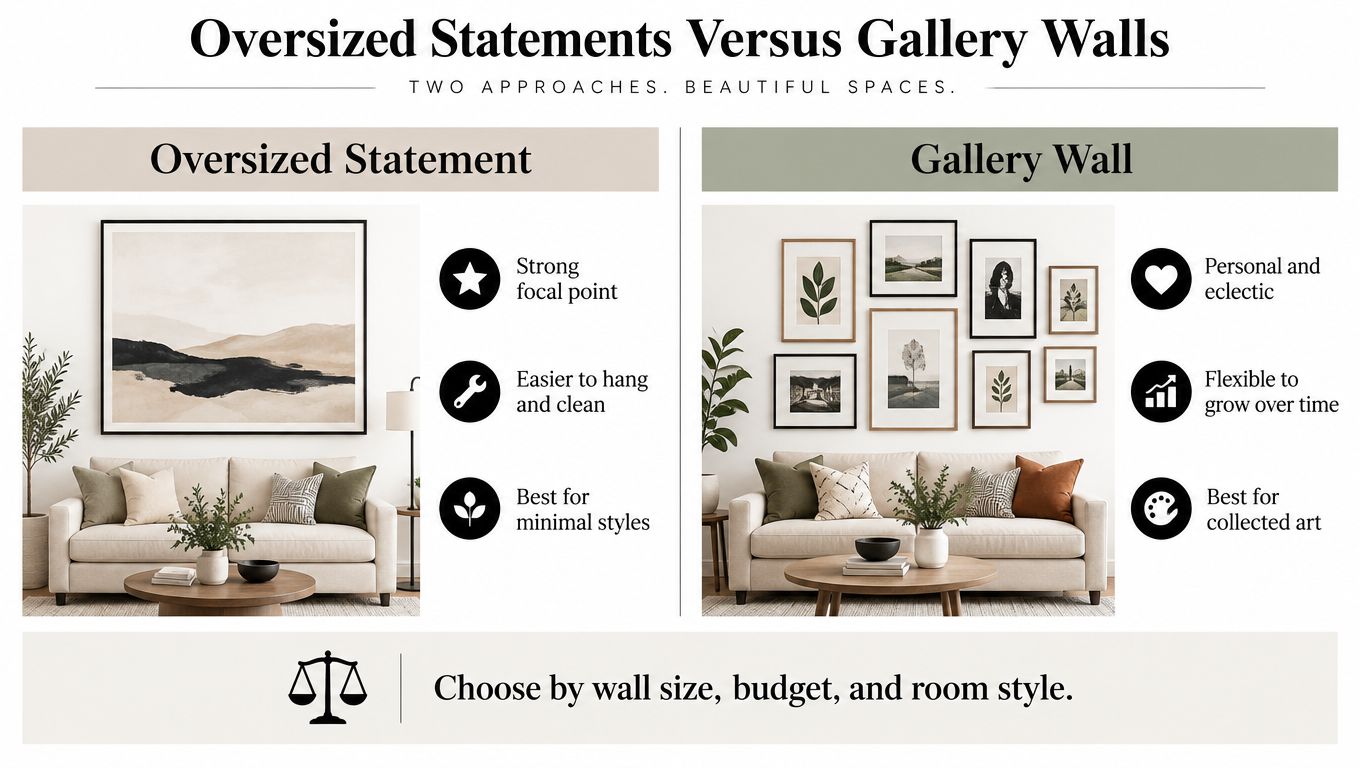
| Oversized statement | Gallery wall |
|---|---|
| Creates one dominant focal point | Builds a collected, personal composition |
| Needs one primary alignment decision | Needs consistent spacing and repeated measurements |
| Has fewer dust-catching edges | Adds frames, surfaces, and hardware |
| Works with restrained styling | Supports eclectic, evolving collections |
| Is harder to replace as your taste changes | Lets you swap or add individual pieces |
Choose an oversized work for a broad wall, substantial sectional, or room already full of visual activity. Choose a gallery wall when you own related pieces, want a more personal collection, or need to work around windows and architectural breaks.
Build the arrangement on the floor first. Keep gaps consistent, align the outer edges, and measure the complete group as one artwork. Do not automatically place the largest frame in the center. An offset anchor gives the composition movement while preventing one image from swallowing the smaller works.
A gallery wall needs a clear visual rule. Repeat a palette, subject family, frame finish, or shape so the collection looks intentional. For a simpler broad-wall solution, review the living room wall art collection, and judge each option by its complete installed width, frame depth, and surface durability, not by the thumbnail alone.
Take a tape measure before opening another décor tab. A family room wall becomes easier to solve once you reduce the choice to scale, material, light, and placement.
Record the usable width of the sofa, sectional run, or media console. Calculate two-thirds and three-quarters of that measurement, then shop within the resulting range. For a blank wall, compare the artwork's width with the wall's open area rather than the entire architectural wall if windows, doors, or shelving interrupt it.
Decide whether the room needs a horizontal canvas, a vertical piece, a diptych, a triptych, or a gallery wall. A sectional usually benefits from a broad composition. A narrow wall beside a television may need a vertical work or a compact arrangement that doesn't compete with the screen.
Look for:
Stand in the main seating position at different times of day. Note direct sun, window reflections, and the television's viewing angle. If the wall receives harsh light, use shades or select a less exposed location. For accent lighting, choose low-UV, low-heat LEDs with 90+ CRI and aim the beam at roughly 30 degrees from vertical to reduce glare, following the lighting guidance cited earlier.
Cut paper to the artwork's full dimensions and tape it to the wall. Check the side margins, the space above the furniture, and how the piece relates to the television, fireplace, doorway, or window. Mark the composition's center and hang that center around 57 to 60 inches from the floor, adjusting only when the furniture or architecture clearly requires it.
Don't fill every wall. One strong statement above the sectional may be enough, while a nearby wall can remain quiet or carry a smaller, related piece. Family rooms need visual pauses as much as they need decoration.
Choose art that can handle the room you have, not an imaginary showroom. Measure first, inspect the materials, control the light, and let proportion determine the purchase.
Jessie's Home offers artist-made canvas wall art and gallery-quality photo prints in styles ranging from abstract and scenic to botanical, skyline, coastal, and pop art. Browse the collection for ready-to-hang pieces produced on premium canvas and delivered across the U.S. and Canada, then visit Jessie's Home to find a work that fits your family room's scale and daily life.

Discover how black and white minimalist art transforms any room with calm, contrast, and timeless style, plus tips on prints, framing, and placement.
Discover how black and white minimalist art transforms any room with calm, contrast, and timeless style, plus tips on prints, framing, and placement.

Discover watercolor abstract art techniques, learn how prints differ from originals, and get styling tips for your home. A complete guide for wall art lovers.
Discover watercolor abstract art techniques, learn how prints differ from originals, and get styling tips for your home. A complete guide for wall art lovers.

Explore the beauty of modern landscape art and how to choose prints that transform your home. From trends to room-by-room styling tips, this guide covers it
Explore the beauty of modern landscape art and how to choose prints that transform your home. From trends to room-by-room styling tips, this guide covers it


