Your wishlist is empty.
Secure Payment
30 days return

You're standing in an empty hallway with your phone open to a dozen wall-art ideas, and somehow the same subject keeps stopping your scroll: a painting of a spider. You like the linework, the web, the strange balance of delicacy and tension, but you're wondering whether the piece will make your home feel stylish or unsettling.
That hesitation is useful, but it shouldn't make the decision for you. Spider art combines natural geometry, cultural symbolism, and a controlled dose of the uncanny in one image. Choose the right palette, scale, and treatment, and the subject can feel as calm as botanical art, as structured as geometric design, or as dramatic as a classic portrait.
A spider gives an artist an unusually strong composition before the first brushstroke lands. Its legs radiate outward, its body creates a clear visual center, and a web adds lines that can either organize empty space or create intricate movement. That built-in structure explains why the motif works across scientific illustration, gothic painting, minimalist line art, and abstract pattern-making.
The subject also has a deeper artistic history than novelty décor suggests. Between 1859 and 1862, Hilda Olson created 454 detailed spider illustrations under the guidance of zoology professor Alexander von Nordmann. The Finnish Museum of Natural History brought this archive back into public view in 2025, reinforcing that spider imagery has a documented scientific and artistic legacy reaching into the nineteenth century. The Metropolitan Museum of Art's discussion of spider webs offers useful context for that history.
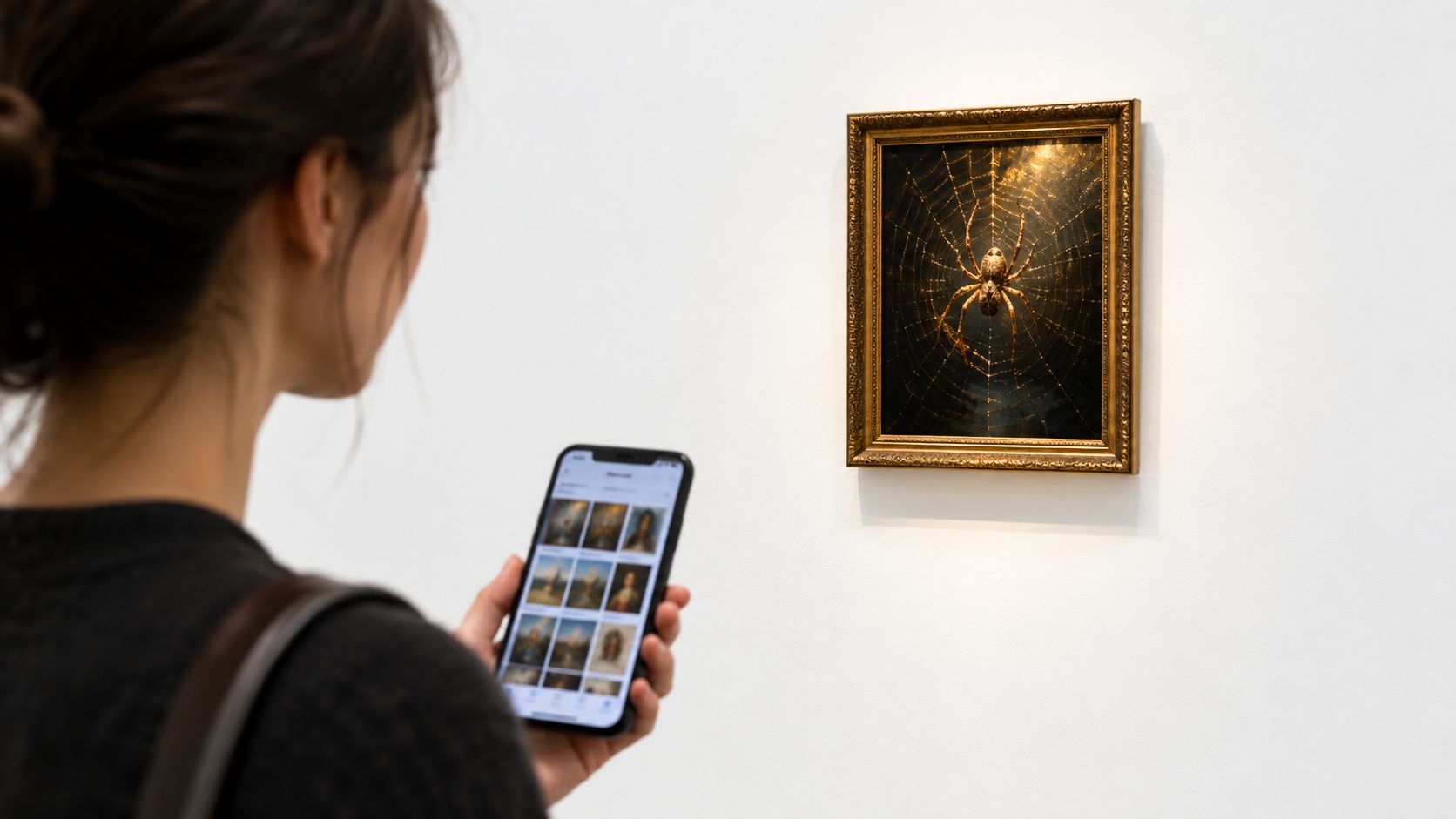
A well-chosen piece can anchor a wall that already has competing textures, bring quiet drama to an otherwise muted palette, or add organic detail beside smooth modern furniture. The spider doesn't need to dominate the room. Often, a restrained silhouette or a softly lit web does more for an interior than an aggressive, hyperreal close-up.
The strongest choices usually have one clear job:
Your taste is the filter, not fear. If you keep returning to spider art, pay attention to what attracts you. It may be the symmetry, the craftsmanship, the quiet tension, or the connection to the natural world. The best painting of a spider for your home will amplify that reaction instead of forcing a theme you don't want.
You don't need to recognize an artist's name to identify the style that belongs in your home. Start by looking at how much the image asks you to notice the creature itself. Some works are careful studies. Others use the spider as a shape, a symbol, or a fragment of a dream.
This style treats the spider as a subject for close observation. You'll see precise anatomy, carefully rendered legs, web structures, leaves, and habitat details, often against a neutral or lightly textured background. It works especially well in a study, library, traditional hallway, or room with wood furniture.
Choose this look if you want the art to feel curious rather than theatrical. A cream ground, restrained inkwork, and a narrow dark frame can make the piece resemble a field-guide plate without turning the room into a themed display.
Gothic spider art leans into atmosphere. Deep backgrounds, candlelit highlights, ornate webs, old-paper textures, and dramatic shadows create a mood that belongs in rooms with velvet, antique wood, brass, or charcoal paint.
The danger is obvious. If the image relies on skulls, graveyards, exaggerated fangs, or theatrical horror styling, it can feel seasonal rather than enduring. Use this style selectively, and let the room's existing materials carry some of the drama.
Minimalist work reduces the spider to a few confident marks. A single line may form the legs and web, while a silhouette can create a graphic focal point with almost no visual noise. This is the safest choice for Scandinavian, modern, small-space, and rental-friendly interiors.
Raw canvas, white paper, black ink, and a light wood frame keep the subject neutral. The result reads as intentional design, not a scare gesture.
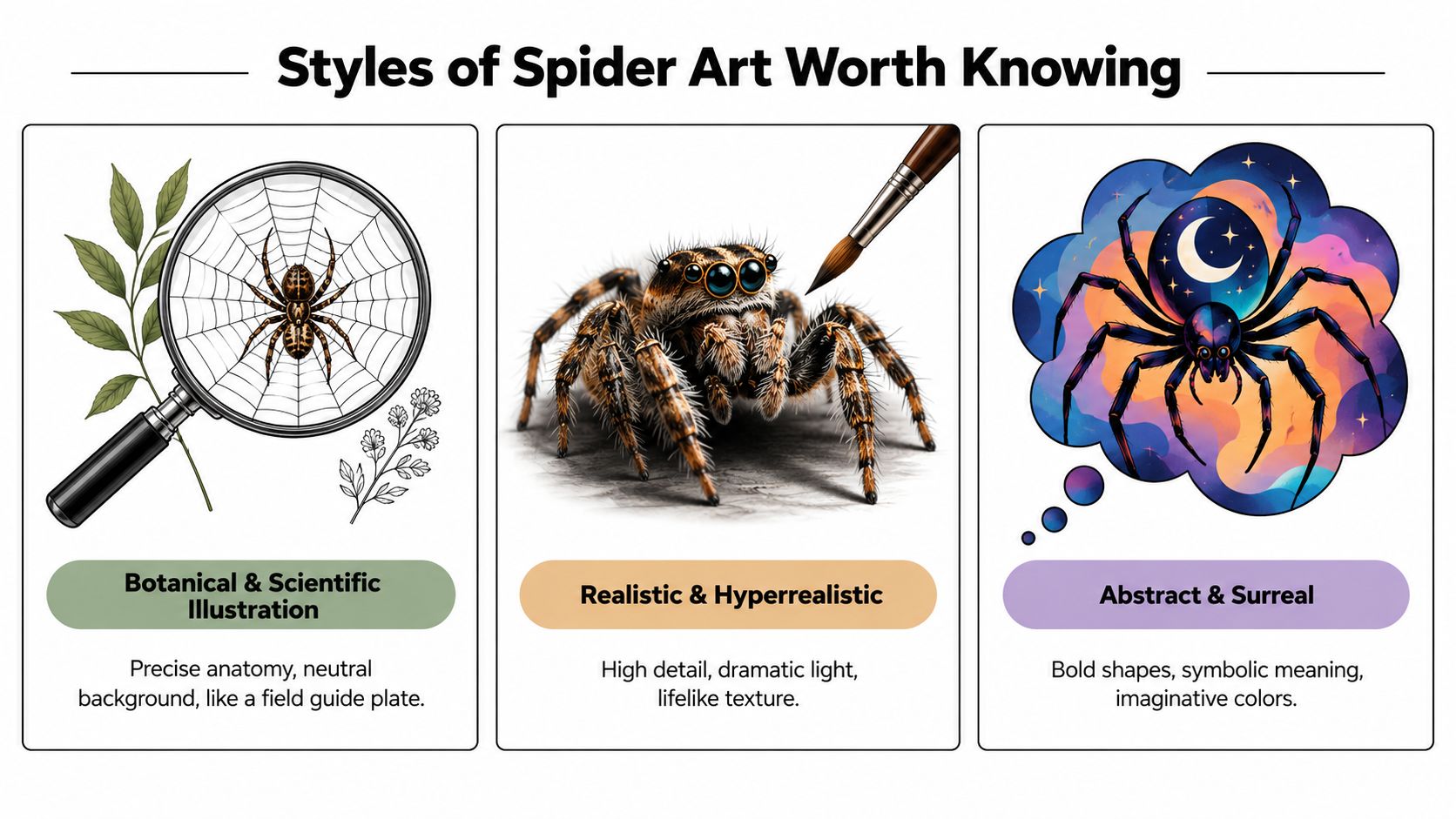
Abstract spider art may keep only the radial structure, repetition, or web pattern. In a contemporary loft, that can work better than a literal creature because the artwork behaves like a composition first and a spider reference second. Bold blocks of color, fractured forms, and repeated lines make the subject feel conceptual.
Painterly realism takes the opposite route. Oil-style texture, strong light, and a carefully staged spider can read like a classical still life, especially beside traditional furniture. For buyers drawn to high-detail canvases, realism canvas wall art offers a useful reference point for comparing that visual language.
The styles most likely to travel well across changing décor are botanical studies, restrained realism, minimalist linework, and abstract geometry. Highly literal horror imagery dates faster because it depends on a narrow mood.
A spider painting doesn't carry one fixed message. Its meaning changes with the image's posture, lighting, color, surrounding objects, and the viewer's own associations. The same web can suggest careful construction to one person and entrapment to another.
The most useful positive reading is the creator and weaver. Spiders build patiently, repeat precise actions, and turn a fragile material into a functional structure. That symbolism makes spider art a strong fit for writing rooms, studios, craft spaces, and home offices. A web can stand for work that accumulates through attention rather than speed.
Spider imagery can also feel protective. A web placed around a doorway, window, or central figure may suggest a filter between the home and the outside world. That interpretation fits folk-art traditions and gives the subject a warmer role than the usual predator narrative.
A softly drawn web with open spacing can feel like a veil or shield. A dense web covering a trapped figure suggests confinement instead. The motif hasn't changed, but the story has.
The darker lineage includes poison, omen, decay, and Halloween-coded associations. Deep crimson, black backgrounds, sharp lighting, and enlarged anatomical details push the work toward warning or menace. If that's the mood you want, embrace it deliberately. If you want a calmer result, choose pale backgrounds, natural greens, warm browns, or diffused light.
Some Asian folklore connects spiders with fortune and prosperity, while gothic traditions often place them alongside graveyards, abandoned houses, and mortality. Those readings can coexist without making the artwork confused. A spider painting can acknowledge fear while still honoring patience, fertility, creativity, or protection.
For a deliberately seasonal or darker interpretation, Halloween canvas wall art shows how color and surrounding imagery can steer a piece toward theatrical atmosphere. For everyday decorating, keep the symbolism less literal.
Design rule: Decide what you want visitors to feel first, then choose the spider image that supports that feeling.
Room placement changes the message. A spider painting above a sofa becomes a conversation piece. The same painting beside a bed becomes part of the atmosphere you live with at close range. Match the artwork to the room's pace, not just its available wall space.
In a living room, choose a medium-scale figurative or abstract piece above a sofa, sideboard, or console. A softly lit spider, a web built from elegant lines, or an abstract radial composition creates focus without demanding a horror-themed interior. A tiny neutral sketch will disappear above a wide sofa, while oversized horror realism can make the entire seating area feel staged.
Bedrooms need restraint. Delicate linework, muted colors, dreamy surrealism, and generous negative space feel intimate rather than threatening. Avoid an enlarged spider rendered with wet-looking texture, glaring eyes, or heavy shadows unless you want the piece to dominate your bedtime environment.
A home office can handle more structure. Geometric web art and controlled realism signal concentration and creativity without competing with a monitor. In an entryway or narrow hall, a smaller, bolder work can establish the home's tone immediately. That's the place for a striking silhouette or sharply composed web, because guests encounter it briefly rather than living beside it for hours.
| Room | Best Spider Art Fit | What to Avoid |
|---|---|---|
| Living room | Medium figurative, abstract, or softly lit realism above a sofa or console | Tiny sketches over broad furniture, oversized horror realism |
| Bedroom | Muted linework, delicate studies, dreamy surrealism | Aggressive close-ups, harsh contrast, crowded webs |
| Home office | Geometric web designs, restrained realism, disciplined compositions | Highly chaotic imagery that competes with screens |
| Entryway or hallway | Compact silhouette, bold linework, striking botanical study | Artwork too subtle to register from a distance |
Scale still decides whether the choice looks considered. Before buying, measure the furniture below the artwork, mark the wall with paper, and check the sightline from the room's main approach. For a reliable installation sequence, use this guide to hang a picture perfectly step by step.
For a broader living-room pairing, living room wall art can help you compare the spider piece with neighboring subjects and styles. The goal isn't to isolate the motif. It's to make it belong.
The spider itself doesn't determine the mood. Treatment determines the mood. A delicate watercolor can suggest patience and craft, while a high-contrast oil painting in an ornate frame can summon fate, warning, or old-world drama.
Take a detailed watercolor spider on a leaf in a thin natural-wood frame. The anatomy remains visible, but the pale wash, soft edges, and botanical setting make the work feel observant. In a reading nook, it supports quiet attention. It doesn't ask the viewer to be afraid.
Now change only the presentation. Put a sharply illuminated spider against a black ground in a gilded antique frame. The same subject becomes more formal and ominous. That version could hold its own in a dining room with dark wood and brass, but it would overwhelm a nursery or a light, casual bedroom.
A minimalist single-line spider web on raw canvas creates another interpretation. The spider may be barely literal, but the repeated lines communicate order, balance, and deliberate construction. That makes the piece a natural fit for a modern office or Scandinavian-style living room.
Consider a softly lit realistic spider resting on a leaf. In an entryway, it can read as a guardian at the threshold, a small natural emblem watching over what enters the home. In a child's bedroom, the same image may become a gentle nature study if the colors are light, the scale is modest, and the spider isn't rendered as a threat.
The practical test: Cover the frame, background, and surrounding objects in the product image. If the spider alone feels too frightening, the piece probably depends on shock rather than design.
The strongest purchase aligns three things: the symbolic reading you like, the visual language of the room, and the emotional response you want during ordinary daily life.
Start with your use case, not the romance of the word “original.” A print makes sense when you're testing the subject, decorating a rental, planning a seasonal rotation, or furnishing several rooms with visual consistency. An original earns its place when you want a permanent focal point, visible surface texture, or a work that feels singular rather than repeatable.
Measure the furniture below the art before browsing. As a practical design rule, aim for the artwork to span roughly two-thirds of the furniture's width, then adjust for the room's proportions and whether you're hanging one piece or a grouped arrangement. Mark the proposed dimensions with painter's tape. This exposes scale problems before they become return problems.
Large prints offer more visual impact for the same spending level, while small originals can bring richer surface detail to a focused wall. A signed limited run sits between the two, giving you a more collectible feel without requiring the full commitment of a one-of-a-kind work.
Paper prints usually need a quality frame and mat board. The mat creates breathing room around delicate legs and web lines, while the frame determines whether the art feels contemporary, traditional, or decorative.
Canvas prints and originals can work well without glass. A gallery-wrapped edge gives a clean modern finish, while a float frame adds definition without covering the painted surface. Don't choose a frame after the fact if the artwork has a strong mood. A dark ornate frame can push a neutral spider study into gothic territory.
Fine spider legs, silk threads, and tiny anatomical marks need a surface that holds detail cleanly. Higher-GSM cotton or linen canvas generally gives delicate work a more substantial foundation, but construction quality still matters more than a specification viewed in isolation. Look for even stretching, clean corners, sharp printing or brushwork, and a finish that doesn't bury thin lines under excessive gloss.
Prints are the sensible first step for many buyers because they make it easier to experiment with scale and placement. Originals suit statement locations and collectors who care about texture, provenance, and the physical evidence of the artist's hand. Choose the format that supports how you'll live with the piece, not the format that sounds most impressive.
Spider art often gets rejected before it gets judged. Buyers see the subject, imagine a Halloween prop, and move on to safer botanical leaves or abstract arches. That reflex can leave a room polished but forgettable.
Most “creepy” spider paintings become more elegant once you examine the actual design choices. Muted color, open composition, soft lighting, and controlled detail can make the subject feel grounded rather than gloomy. A web offers the same structural benefits as a grid, a branch, or a geometric pattern, while the creature adds a little tension that keeps the wall from becoming anonymous.
The common mistake is treating spider art as a novelty. Novelty depends on an obvious joke or theme. Good spider art has shape, rhythm, texture, and an emotional register that can remain relevant long after a seasonal display comes down.
Use this quick filter before you dismiss a piece:
Final buying principle: If you'd hang the same composition without the spider, you probably like the design. The spider is then adding personality, not carrying the entire idea.
Stop filtering out every painting of a spider during the browsing stage. The right one can give a quiet room a memorable focal point, make a modern space feel more organic, and signal that your taste isn't limited to predictable subjects.
Jessie's Home offers artist-made canvas wall art and gallery-quality photo prints for rooms that need more personality, including nature-inspired and contemporary styles that can frame a spider motif without making it feel gimmicky. Visit Jessie's Home to browse the collection, compare room-ready formats, and find a piece that gives your wall the right amount of edge.

Discover how black and white minimalist art transforms any room with calm, contrast, and timeless style, plus tips on prints, framing, and placement.
Discover how black and white minimalist art transforms any room with calm, contrast, and timeless style, plus tips on prints, framing, and placement.

Discover watercolor abstract art techniques, learn how prints differ from originals, and get styling tips for your home. A complete guide for wall art lovers.
Discover watercolor abstract art techniques, learn how prints differ from originals, and get styling tips for your home. A complete guide for wall art lovers.

Explore the beauty of modern landscape art and how to choose prints that transform your home. From trends to room-by-room styling tips, this guide covers it
Explore the beauty of modern landscape art and how to choose prints that transform your home. From trends to room-by-room styling tips, this guide covers it


