Your wishlist is empty.
Secure Payment
30 days return

You pull two framed prints from above the sofa, replace them with a snowy scene, and suddenly the living room feels ready for December. Then January arrives, the seasonal pieces go into the attic, and you assume they were disposable decorations rather than part of the room's design.
That's the wrong way to think about holiday wall art. A seasonal artwork swap is one of the easiest ways to change a room's palette and atmosphere without repainting, replacing furniture, or committing to a permanent themed scheme. The right piece can work like a capsule wardrobe for your walls, selected for a particular season but restrained enough to return to storage without leaving the room visually confused.
Holiday wall art gives you a fast, low-commitment refresh. Replace a neutral scenic print with a winter forest, a restrained typographic print, or a botanical wreath, and the room changes character immediately. You haven't bought a new sofa or redesigned the gallery wall. You've changed one visual anchor.
That flexibility matters in rented homes, compact apartments, offices, guest rooms, and hospitality spaces. A framed print on a picture ledge or a ready-to-hang canvas can add seasonal character without drilling into a wall or introducing decorations that compete with the furniture. It also lets you keep the rest of the room stable. Your neutral upholstery, oak furniture, and year-round art still do their jobs.
The broader market supports treating these pieces as real wall art rather than throwaway novelty. The global wall art market was valued at USD 66.89 billion in 2025, is projected to reach USD 70.94 billion in 2026, and is projected to reach USD 145.49 billion by 2034, with a projected 9.39% CAGR from 2026 to 2034, according to reported wall art market figures. Canvas is estimated to hold 45.11% of the wall art market in 2026, which helps explain why seasonal designs increasingly appear as substantial, gallery-style canvases rather than only small paper decorations.
Think in terms of a small, coordinated collection. One winter scene might replace the largest living-room piece. A smaller evergreen print could rotate onto an entryway ledge. A quiet star or botanical design might bridge the period between Christmas and New Year without making the room feel stuck in a single holiday.
Quality makes this approach worthwhile. Museum-grade canvas is typically specified at 400 to 450 GSM, compared with standard canvas at 250 to 320 GSM, and the heavier substrate offers greater thickness, texture depth, durability, and structural stability, as explained in canvas print standards. That matters when you'll handle, store, rehang, and remove the piece repeatedly.
Seasonal timing is compressed, so plan your collection before the first week of December. Observed Etsy listing data found that 49% of Christmas wall decor listings were published between September and November, while 62% were published between September and December, with November the busiest publishing month, according to seasonal selling calendar data. Holiday art works best when you choose it deliberately, not when you grab whatever remains after the room is already decorated.
The strongest holiday wall art doesn't all look like a Christmas card. Start by identifying the mood your room already has, then choose a motif that supports it. Traditional evergreens and red berries suit a warm, layered interior. A snowy architectural print feels more natural in a minimalist room. A dark blue, silver, and white composition can bring winter atmosphere without adding visual clutter.
Traditional Christmas imagery works well where people gather and where a seasonal focal point feels welcome. Use evergreens, woodland scenes, plaids, nutcrackers, or a simple “Merry” or “Noel” typographic design in an entryway, living room, or dining room. Keep the composition selective. One strong tree or wreath usually looks more polished than a wall filled with competing holiday symbols.
Winter themes have a longer useful life. Snow-covered vistas, frost botanicals, bare branches, stars, and moonlit scenes can remain relevant after Christmas Day. Champagne, muted gold, midnight blue, and soft ivory are especially effective for a New Year transition because they suggest celebration without relying on overt Christmas language.
Hanukkah art can be equally refined. Menorahs, dreidels, Star of David geometrics, and blue-and-silver palettes read cleanly against white, beige, pale gray, and natural wood. Choose a design with enough negative space if the room already contains patterned textiles or a busy collection of objects.
The same principle extends beyond December. A coastal winter print can suit a beach house during the off-season, while late-autumn botanicals can carry a room from November into winter. For another seasonal rotation, you could explore Halloween canvas wall art and use the same frame or ledge system throughout the year.
| Holiday Theme and Motif Reference | Best Room | Palette Note |
|---|---|---|
| Evergreens and woodland scenes | Living room or entryway | Forest green, cream, brown, muted red |
| Plaids and traditional typography | Dining room or foyer | Warm neutrals with one strong accent |
| Snowy landscapes | Living room, office, or bedroom | White, gray, blue, and soft taupe |
| Frost botanicals | Bedroom or hallway | Ivory, sage, pale blue, and charcoal |
| Menorahs and geometric Hanukkah art | Dining room or living room | Blue, silver, white, and natural wood |
| Stars and midnight motifs | Office or transitional display | Navy, black, silver, and warm gold |
| Coastal winter scenes | Guest room or beach house | Sand, slate, faded blue, and white |
Don't start with “What looks festive?” Start with “What already belongs here?” Warm-toned rooms can handle rust, cranberry, brass, and deep green. Cool-toned rooms usually look better with icy blue, silver, charcoal, and white. If your home follows warm minimalism, choose a pared-back winter image rather than forcing bright red into every room.
Seasonal art looks intentional when its proportions relate to the furniture below it. The two rules that matter most are eye-level placement and furniture relationship. In a hallway or above a console, place the center of the piece 57 to 60 inches from the floor. Above furniture, position the center approximately 6 to 10 inches above the top edge of the furniture or artwork below it.
Use painter's tape to mark the proposed frame before you order. Stand across the room and check whether the piece feels connected to the furniture, not stranded above it.
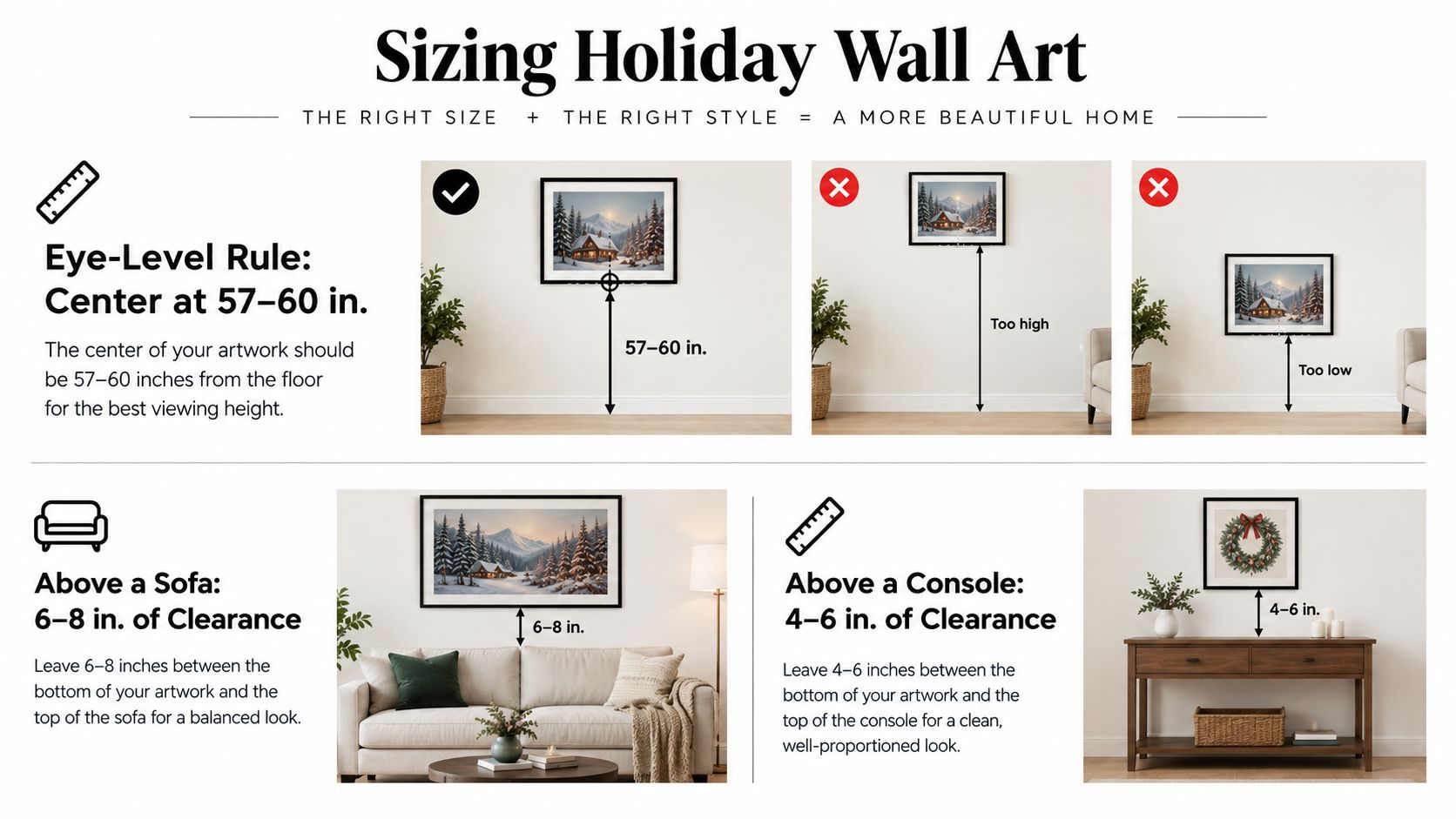
For scenic pieces, proportion also affects how the image reads from a distance. These tips for selling landscape art are useful for understanding why horizon placement, visual balance, and scale matter when selecting a scenic view for a room.
Style completes the decision. Minimal typography and single-subject art feel modern. Painterly scenes and vintage book-inspired imagery suit traditional rooms. Abstract geometrics bridge both styles. Frame width changes the result too. A 1.5-inch gallery frame feels substantial and architectural, while a 0.5-inch thin frame looks lighter and more contemporary. For more room-specific browsing, see living room wall art.
A living room that needs one strong seasonal focal point calls for canvas. A dorm room, rental wall, or picture ledge that changes often usually works better with a paper print. Choose the format around how the piece will be displayed, handled, stored, and reused, not only around its holiday subject.
Canvas suits a hero piece in the living room, entryway, or dining room that stays up for several weeks. Its textured surface and finished presence can stand alone without a separate frame, and it handles ordinary decorating more confidently than lightweight paper. In a kitchen or bathroom, canvas offers a more forgiving option when humidity is a concern, but ventilation and placement still matter. A stiffer, museum-grade canvas resists the edge curl and distortion that become irritating when you remove and rehang art repeatedly.
Paper prints make seasonal rotation easier. They weigh very little, take up less storage space, and can rotate behind one standard frame. That arrangement works well for a sizeable holiday collection without mounting every design on its own stretcher. It also keeps changing displays simple in rentals, dorms, and homes where the wall art changes often.
| Attribute | Canvas | Paper Print |
|---|---|---|
| Best use | Hero pieces and frequently handled displays | Quick rotations and larger seasonal collections |
| Appearance | Finished, textured, substantial | Crisp, lightweight, often more frame-dependent |
| Storage | Store in an archival sleeve or protect the surface | Store flat with acid-free tissue or in an archival folder |
| Swapping | Replace the complete artwork | Rotate behind one standard frame |
| Humidity tolerance | Generally more forgiving than paper | Needs stronger protection from moisture |
| Frame requirement | May work frameless or in a frame | Usually benefits from a frame or mat |
| Sunlight strategy | Pair with UV protection | Use matte paper and UV-protective glazing where needed |
Use a matte finish in bright rooms to reduce reflections from windows and overhead fixtures. A gloss finish adds depth in darker, north-facing rooms, but it creates glare when a window or lamp faces the artwork directly.
Strong daylight requires a clear protection plan. Museum guidance commonly targets about 50 lux for prints and photographs, while UV-filtering glass or acrylic can block roughly 97% to 99% of UV rays, according to art fading protection guidance. Fading is permanent. Keep light-sensitive pieces away from direct sun, or choose UV-protective coatings and glazing.
Buy the format that matches how often you will hang it, rather than choosing only by upfront price. For substantial seasonal displays, browse canvas wall art.
Seasonal decorating becomes tedious when every rotation requires new holes, complicated hardware, and a hunt for the original arrangement. Build the hanging system once, then make the art interchangeable.
Command strips are the default for lightweight pieces, especially in rental homes. Standard strips hold roughly 3 to 4 pounds per pair, while heavy-duty versions hold roughly 8 to 10 pounds per pair, so check the actual frame weight before choosing the hardware. A small 16x20-inch canvas may need one pair, while a heavier frame may need two or a different hanging method.
Picture ledges are even more flexible. One rail can hold three to five pieces, allowing you to slide seasonal art in and out without touching the wall. Put a year-round scene at the back, add a holiday print in front, and keep a small object such as a ceramic tree or brass star beside the frames. The permanent piece provides continuity while the seasonal piece supplies the change.
For framed work, use two D-rings or sawtooth hangers rather than relying on a single central point when the frame allows it. Place the hardware approximately one-third of the way in from each side. That distribution helps prevent tilting when you remove and rehang the artwork.
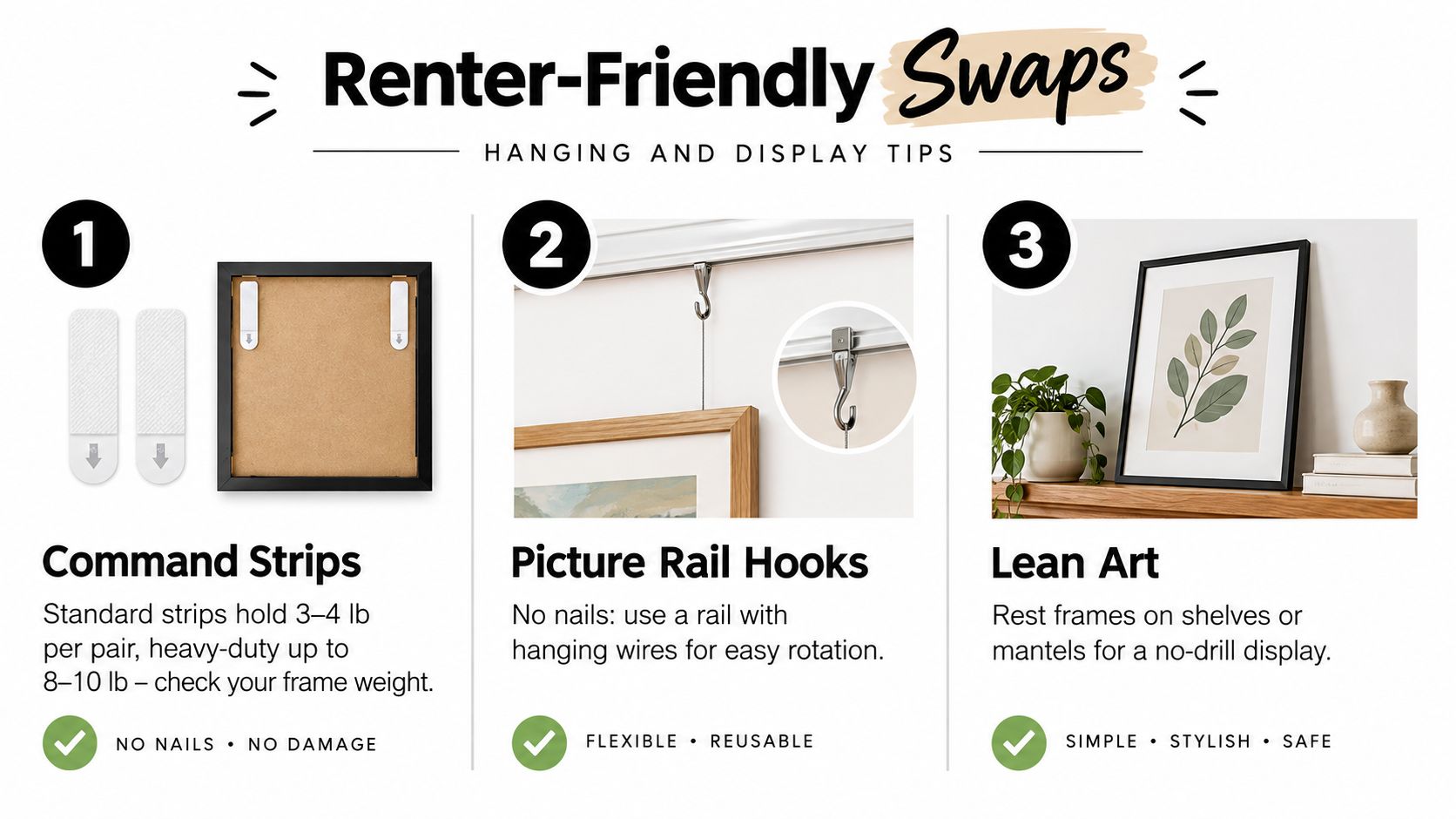
Practical rule: If a piece is only displayed seasonally, choose hardware that makes removal as easy as installation.
Adhesive hooks generally leave less wall damage than nails, but follow the manufacturer's surface, weight, and removal instructions. Let the adhesive bond properly, and don't place a valuable or heavy frame above a bed or seating area unless the mounting system is suitable.
For a more visual demonstration of swap-friendly displays, use this video as a reference:
Before taking anything down, photograph the full arrangement straight on. Save the image with the season's name, then use it as a map during the January teardown. You'll restore the year-round layout instead of trying to remember whether the smaller print sat left or right.
A holiday gallery wall should look edited, not decorated by accumulation. Keep most of the wall's visual language permanent and let one or two seasonal works provide the change. An 80/20 balance, approximately 80 percent year-round art and 20 percent seasonal art, usually reads as intentional rather than novelty-driven.
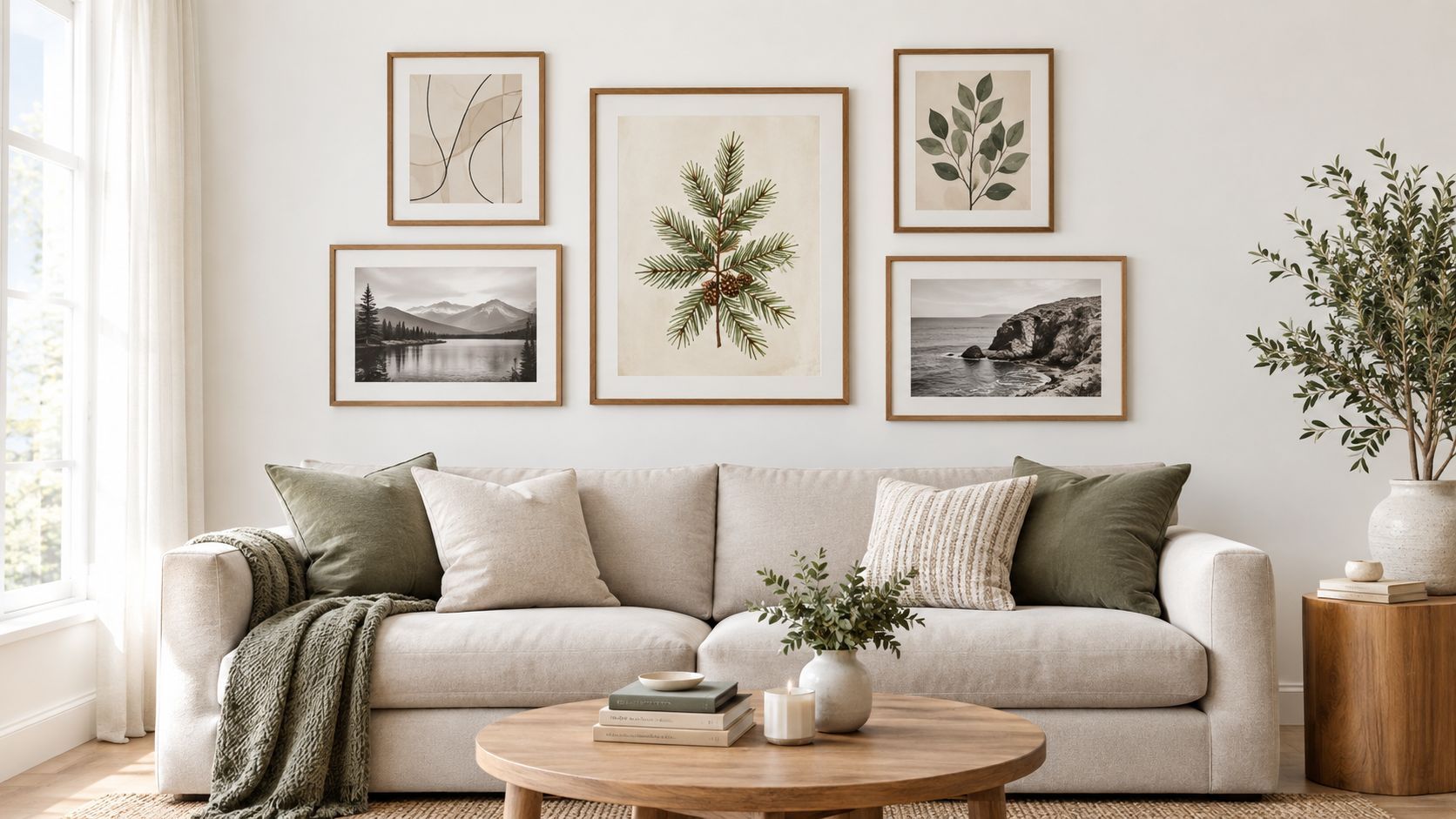
Color creates the bridge. If the holiday piece contains muted cranberry, repeat that color in a nearby abstract, cushion, or ceramic object. If it uses icy blue, connect it to a neighboring photograph or blue-gray frame. The viewer should notice a related palette before noticing that one artwork is seasonal.
Frame finish matters just as much. Keep the holiday piece in the same black, oak, brass, or white frame language as the existing gallery. A Christmas print in an ornate gold frame can look disconnected if every other piece uses slim black profiles. Reframing a seasonal print is often more effective than adding more decoration.
Maintain the gallery's established spacing. A 2 to 3-inch gap between pieces usually keeps the composition coherent, even when the seasonal artwork is smaller or larger than the piece it replaces. Don't squeeze a new print into an opening just because it fits physically. Use a mat, ledge, or adjacent small work to make the scale feel deliberate.
The easiest system is a designated seasonal slot. Choose one position on a picture ledge, shelf, or gallery grid, then keep its outer boundaries stable throughout the year. The artwork changes, but the architecture of the display doesn't.
You can also place one winter piece beside two year-round works, or replace the central image while leaving the surrounding photographs untouched. Avoid creating a complete holiday tableau on one wall. One wreath, one tree, one menorah, or one star motif per viewing angle is enough.
A seasonal piece should interrupt the room's story briefly, not replace the story altogether.
Subdued winter palettes, nature motifs, architectural scenes, and personalized designs often integrate more smoothly than loud red-and-green graphics. That makes holiday wall art useful for modern living rooms, offices, hospitality settings, and renter-friendly interiors where a permanent themed transformation would feel excessive.
Seasonal wall art makes a thoughtful gift because the recipient gets to reopen it every year. Give a new homeowner a single 16x20-inch winter scene for the console, a couple a pair of coordinated coastal off-season prints for above the bed, or an entertainer a small rotation of Hanukkah, Christmas, and New Year designs.
The presentation should protect the artwork from the moment it leaves your hands. For framed pieces, place acid-free tissue between the glass and artwork, add foam corner protectors, and use a rigid mailer for shipping. Store canvas in an archival sleeve that protects the surface without pressing directly against the printed face.
Don't use the attic or garage. Heat can warp stretcher bars, while humidity can curl paper and damage backing materials. A flat position in a climate-controlled closet is safer, with heavier objects kept off the artwork.
A rotating frame makes a seasonal collection more practical. Keep three or four prints in standard sizes, then change only the artwork while the frame remains in place. You can also rotate canvases through a single ledge, or reframe a holiday canvas in neutral oak so a winter scene becomes year-round art in a child's room or guest bedroom.
For a personalized gift outside the traditional art category, a bar or entertaining space could also suit custom pub signs for home bars. The same rule applies, choose something that fits the recipient's room and can remain useful after the holiday season.
Jessie's Home offers artist-made canvas wall art and gallery-quality photo prints, including seasonal pieces and designs organized by room, style, subject, and place. Visit Jessie's Home to choose a swap-friendly canvas or print that can refresh your room now and still work with your year-round collection later.

Discover how black and white minimalist art transforms any room with calm, contrast, and timeless style, plus tips on prints, framing, and placement.
Discover how black and white minimalist art transforms any room with calm, contrast, and timeless style, plus tips on prints, framing, and placement.

Discover watercolor abstract art techniques, learn how prints differ from originals, and get styling tips for your home. A complete guide for wall art lovers.
Discover watercolor abstract art techniques, learn how prints differ from originals, and get styling tips for your home. A complete guide for wall art lovers.

Explore the beauty of modern landscape art and how to choose prints that transform your home. From trends to room-by-room styling tips, this guide covers it
Explore the beauty of modern landscape art and how to choose prints that transform your home. From trends to room-by-room styling tips, this guide covers it


