Your wishlist is empty.
Secure Payment
30 days return


You're standing in the hallway with a tape measure, holding a print that looked wild on a phone and looks stiff on the wall. The chest is cut off, the antlers kiss the frame, and the bull reads like a catalog sample. A bull elk picture only earns its place when the biology in the frame matches the room. Season, age, and antler stage say what the animal is. Style, crop, and print size decide whether the wall can carry that signal.
Say you just hung that print and stepped back. The background is a flat green wash, the bull looks posed, and nobody planned shoulder line or antler clearance. You bought a stock frame, not a wild animal.
The animal in most of these pictures is the Rocky Mountain elk, one of North America's largest deer. The U.S. National Park Service reports that approximately 1 million elk occur across North America, from British Columbia, Alberta, and Saskatchewan south through the Rocky Mountains to New Mexico, and west to California, Oregon, and Washington. That span is why the same subject feels at home in a Denver cabin and a Toronto study.
Antlers are the maturity signal. A heavy, branched rack reads as a healthy adult. Spikes read as a young bull.
Three choices sit in front of you:
Take them in that order. Compare styles, read season and age in the antlers, match the room, set composition and print size, then confirm the source and the final dimensions before you pay.
Five treatments show up again and again, and each one wins on a different wall.
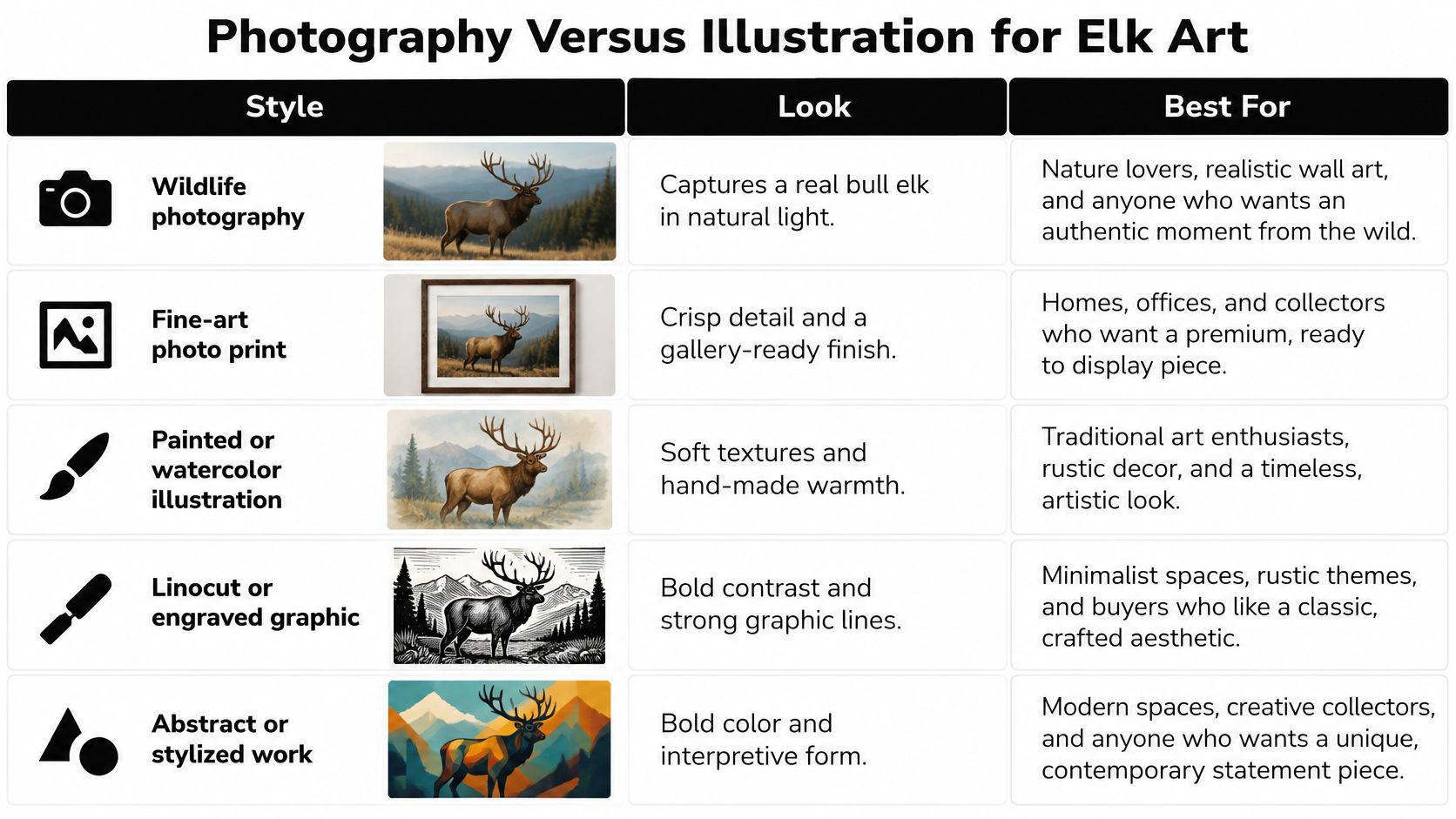
| Style | Main strength | Main limit |
|---|---|---|
| Wildlife photography | Real hide texture, antler detail, and true scale | Shows every flaw and soft focus; needs high resolution |
| Fine-art photo print | Moody, editorial atmosphere | Tight crops can hide antler spread |
| Painted or watercolor illustration | Soft edges and color control | Anatomy and scale depend on the artist's skill |
| Linocut or engraved graphic | Bold line and strong contrast | Fine antler detail is simplified |
| Abstract or stylized elk | Works as a color accent | Less recognizable as an elk |
A photograph is a window onto a real meadow. Hide texture, tine edges, and body scale stay honest, which is also the risk. Soft focus, a blown highlight on the rump, or a crop that slices the beam all show. A tight editorial crop can make a powerful bull look clinical, like a specimen card.
An illustration is a remembered meadow. The artist sets anatomy, mood, and color. Watercolor softens edges. A linocut or engraving trades fine tines for bold line and high contrast. Abstract work can hold a room with one color, and it can also stop reading as an elk at all.
Practical rule: If the wall should feel like a place you've stood in, choose a photograph at high resolution. If the piece should carry color or a graphic statement, choose illustration.
That split is visible in hybrid work too. Artistic Water Buffalo in Habitat - Canvas Wall Art keeps a photoreal face while amber, teal, rust, and violet run across the body like watercolor, with the same colors repeated in the water. Jessie's Home prints this kind of file as photography canvas wall art on cotton-blend canvas. Which of the five styles belongs in a given room comes down to frame weight and palette, not the species name on the label.
Antlers grow and shed each year, so their stage gives a bull elk picture a seasonal setting. Bulls regrow antlers in spring, carry velvet through summer, strip it around late August or early September, and usually shed in March or April, according to the Oklahoma Department of Wildlife Conservation field guide. Read that stage as a biological cue, not just a visual detail.
| Antler stage | Typical months | What the image signals |
|---|---|---|
| Regrowth | Spring | New, soft growth beginning |
| Velvet | Summer | Antlers still growing beneath blood-rich velvet |
| Polished | Late August to September | Hardened, bare antlers before or during the rut |
| Shed | March to April | Antlers shed, with bare pedicles |
| Yearling | Any season | A young bull with single spikes and no branching |
A velvet rack shows active growth. Its surface appears soft and dark, and the tips have not hardened. A polished rack is bare, pale, and sharp, suggesting the period before or during the rut. A bull with bare pedicles in March or April has shed its antlers.
Antler size alone does not settle age. Look at the whole rack and the bull's build.
Read the caption alongside the rack. Velvet points to spring or summer growth; polished antlers place the image before or during the rut.
For a fall scene in a lodge, check the antler stage before choosing a sharp portrait. A velvet image signals active growth, while a polished rack fits the season associated with the rut. The animal's age cues and seasonal stage shape the picture's mood as much as its crop or color.
Choosing elk art for a room is like choosing a coat for the weather. The piece has to suit the climate of the space, not just the animal you like.
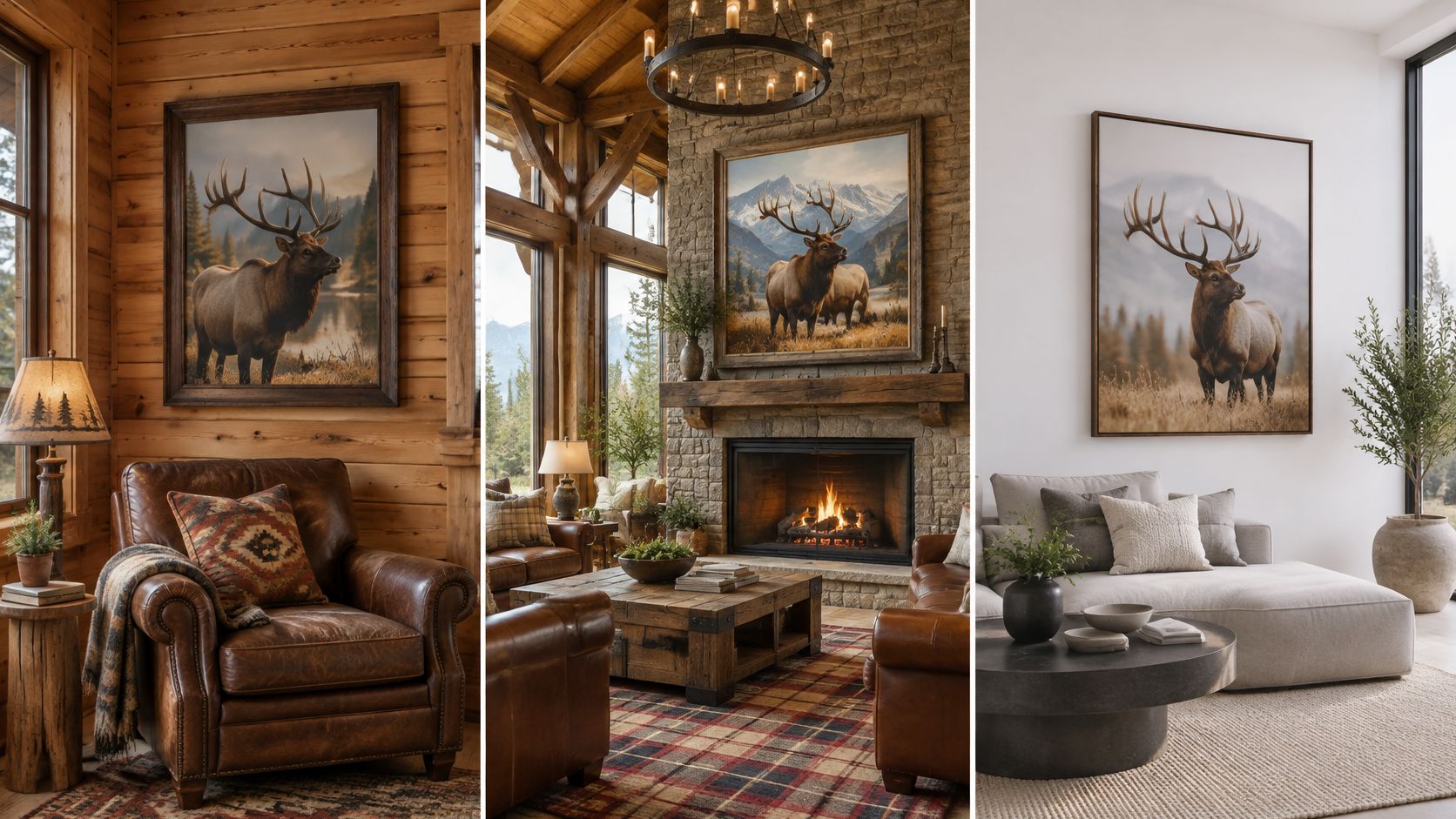
| Room style | Frame and palette | Image style that fits | Composition note |
|---|---|---|---|
| Rustic | Reclaimed or aged wood; warm earth tones | Muted meadow photo or painted bull at dusk | Keep the bull in a natural setting |
| Lodge | Dark wood, leather, stone, plaid | Large fine-art forest or snow scene, oil-look painting | Go larger; the bull should anchor the wall |
| Modern | Clean lines; neutrals, thin black frame or unframed canvas | High-contrast black-and-white photo or graphic single-color bull | Use a tight crop and open space around it |
Rustic rooms run on warm wood and earth tones. A muted meadow photo or a painted bull at dusk sits in an aged or reclaimed frame without fighting the grain. Keep habitat in the frame. A bull floating on white looks pasted onto the wall. Ready-to-hang options in canvas wall art for rustic homes follow that warmer, natural setting.
Lodge rooms are darker and heavier: wood, leather, stone, plaid. In a space like this, a large forest or snow photograph, or an oil-look painting in a thick frame, earns the wall. Go bigger. A small print disappears between beams and a stone hearth.
Modern rooms want clean lines, neutrals, and a thin black frame or bare canvas. A high-contrast black-and-white photo, or a single-color graphic bull, holds the wall without adding another wood tone. Leave open space around a tighter crop so the rack doesn't collide with the frame.
A hallway, office, or clinic uses the same test with a calmer palette. Less contrast, a lighter frame, and no scene so dark it swallows a small wall.
Before you lock the frame, compare furniture styles for each room so the sofa, chairs, and case goods aren't pulling a different direction than the print.
Match the image's color temperature and the frame's weight to the furniture, not to the animal.
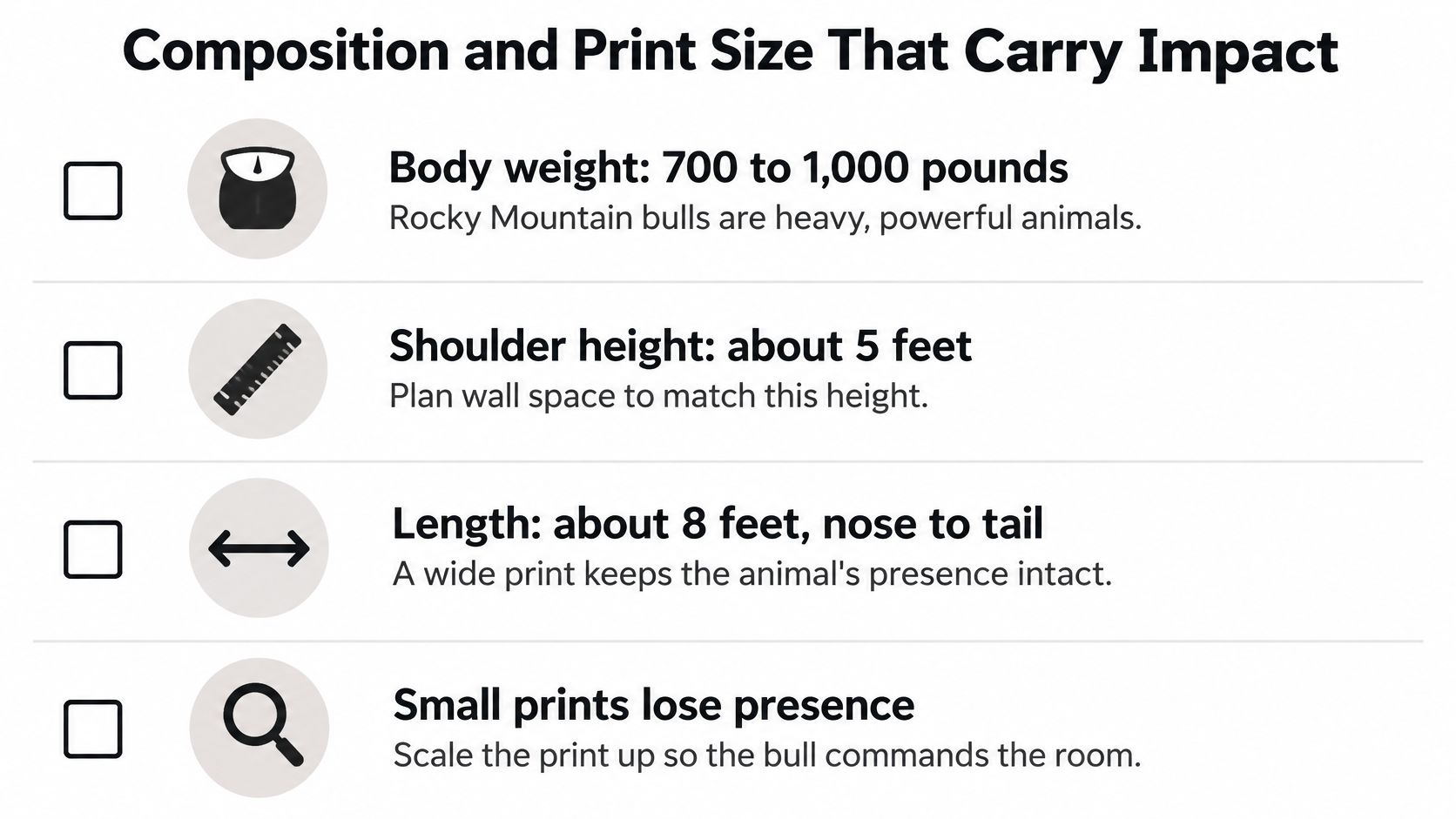
Scale is the reason a pretty file still fails on a wall. Rocky Mountain National Park's elk page notes that Rocky Mountain bulls commonly weigh about 700–1,000 pounds, stand approximately 5 feet at the shoulder, and measure around 8 feet from nose to tail. A postcard-sized print throws that mass away.
Elk use higher country in warmer months and drop toward lower ground in winter as snow and forage change. An open meadow, a valley floor, or a forest edge gives you ground under the feet, so shoulder height and chest depth stay readable. A bull shoved into dense brush hides all three, plus the antler profile.
Ask for a side or three-quarter view, with the antlers clear of brush and of each other. Don't crop the rack. On the Yellowstone elk page, a mature set commonly measures 55–60 inches in length and approaches 6 feet in total width. Clipping the tines deletes the maturity cue you paid for.
A single piece should run about two-thirds the sofa width, with the bottom edge 6–8 inches above the sofa back. A 72-inch sofa takes a print about 48 inches wide. Wider sofas need wider prints, not a bigger mat around a small image. Large canvas wall art is the format that can hold an 8-foot animal without shrinking it to a thumbnail.
| Sofa width | Bottom edge above sofa back |
|---|---|
| 60 in | 6–8 in |
| 72 in | 6–8 in |
| 84 in | 6–8 in |
| 96 in | 6–8 in |
Run this check before you order:
The taped rectangle is what you compare to the file's crop in the last pass.
A bull's season, habitat, and antler stage make the image more than a portrait. They help you judge whether the animal appears undisturbed and whether the picture suits the room. Ask how the photographer made the image. A long lens can fill the frame from a distance; approaching the animal for a close-up can disturb it.
During the September–October rut, bulls bugle, defend harems, and may fight. The National Park Service guidance recommends keeping at least two school-bus lengths, about 75 feet, away when photographing elk. It also sets a 25-yard minimum and advises visitors never to approach or pursue an animal for a photograph. If an elk moves off or looks distracted, reject the listing's claim that the image shows a responsible close encounter.
Look for a caption that names the season and habitat and describes how the photograph was made. “Rut, valley meadow, long lens from the road” gives useful context. “Amazing close encounter” does not tell you whether the photographer kept a safe distance. For a bull elk picture, prefer a specific account of the setting and approach over dramatic wording.
Use the earlier wall-measurement and crop checklist, then focus on details the listing can confirm:
Reject listings that leave the photographer's approach unclear, crop the antlers, or do not state their return terms and print materials. Jessie's Home offers artist-made canvas wall art and gallery-quality photo prints, including wildlife subjects, with premium cotton-blend canvas, fade-resistant inks, wood frames, and 30-day returns. Browse Jessie's Home for a bull elk picture whose season, crop, and scale suit your wall.

Choose a bull elk picture that fits your wall: compare photography and illustration, pick the right print size, and match rustic, lodge or modern rooms.
Choose a bull elk picture that fits your wall: compare photography and illustration, pick the right print size, and match rustic, lodge or modern rooms.

Modern, abstract, landscape and scripture ideas for Christian wall art in the living room, with sofa sizing, gallery wall layouts, tips for mixing faith art with your decor and well-known...
Modern, abstract, landscape and scripture ideas for Christian wall art in the living room, with sofa sizing, gallery wall layouts, tips for mixing faith art with your decor and well-known...

Staircase wall decor ideas that fit a sloped wall: four layouts, a step-by-step hanging method built on a 57 to 60 inch line above each nosing, plus sizes, landing, hallway...
Staircase wall decor ideas that fit a sloped wall: four layouts, a step-by-step hanging method built on a 57 to 60 inch line above each nosing, plus sizes, landing, hallway...


