Your wishlist is empty.
Secure Payment
30 days return

You've found the wall. Maybe it's above the sofa, behind your desk, or in the hallway that still feels unfinished. Your shopping cart already contains several Michelangelo reproductions, but choosing one suddenly feels loaded. Is the canvas too cheap? Is the paper too formal? Does a dramatic Sistine Chapel scene belong in a modern room, or are you committing a design crime against a Renaissance master?
The decision gets easier once you stop treating it like an art-history exam. Michelangelo art prints are design objects, and the right purchase depends on image quality, format, scale, framing, licensing, and the room where you'll live with it. A reproduction can be museum-minded, fine-art focused, or decorative. None is automatically wrong, but they serve different purposes.
The first problem is language. Online listings use terms such as “museum quality,” “gallery wrapped,” “archival,” “fine art,” and “premium canvas” with wildly different levels of detail behind them. One seller may explain the scan, ink, and substrate. Another may use the same language for a thin poster printed from a small file.
The second problem is cultural pressure. Michelangelo's images carry enormous historical weight, so buyers often feel they need to choose with scholarly authority. You don't. You need to choose an image that works on your wall, at your viewing distance, under your lighting, and within your budget.
Practical rule: Buy the reproduction for the room you have, not the museum visit you wish you could recreate.
Michelangelo's frescoes were painted onto freshly laid wet plaster. The pigments had to bond chemically and physically before the wall dried, so the original work is inseparable from its architectural surface and chapel lighting context, as Fresco Arte's explanation of Michelangelo's fresco technique describes. That history matters because a print can't reproduce the physical wall, scale, atmosphere, or changing light. It can only translate the image.
Suppose you're considering a detail from The Creation of Adam. A small paper print with crisp tonal transitions might suit a study. A large canvas could create a warmer, more relaxed focal point in a living room. A poster may be perfectly adequate for a temporary rental or a dorm, especially if you're more interested in the image than long-term permanence.
The wrong choice usually isn't the “wrong” Michelangelo work. It's a mismatch between quality and purpose. Buyers get frustrated because product pages rarely state whether an item is a museum-style reproduction, a licensed fine-art edition, or decor-first wall art.
Historical reproduction methods translate rather than duplicate the original. Engraving, photography, and digital printing can flatten scale, change viewing distance, and turn color modeling into line or compressed tonal values, according to the Library of Congress reproduction discussion. That makes resolution, scan precision, and finish more important than a dramatic product description.
The useful question is simple: What job should this print do in your room? Once you answer that, the product category becomes much easier to identify.
In buyer language, a Michelangelo art print is any printed reproduction of an authenticated Michelangelo work or a detail from one. That broad definition includes serious fine-art reproductions and inexpensive posters. The image's historical importance doesn't guarantee the print's physical quality.
A museum-style reproduction usually starts with a high-resolution scan or carefully photographed source. It uses pigment-based inks, which are generally chosen for long-term color stability, and it's printed on archival paper or canvas. A decorative poster may use a lower-resolution file, dye-based inks, lightweight stock, and minimal information about the source.
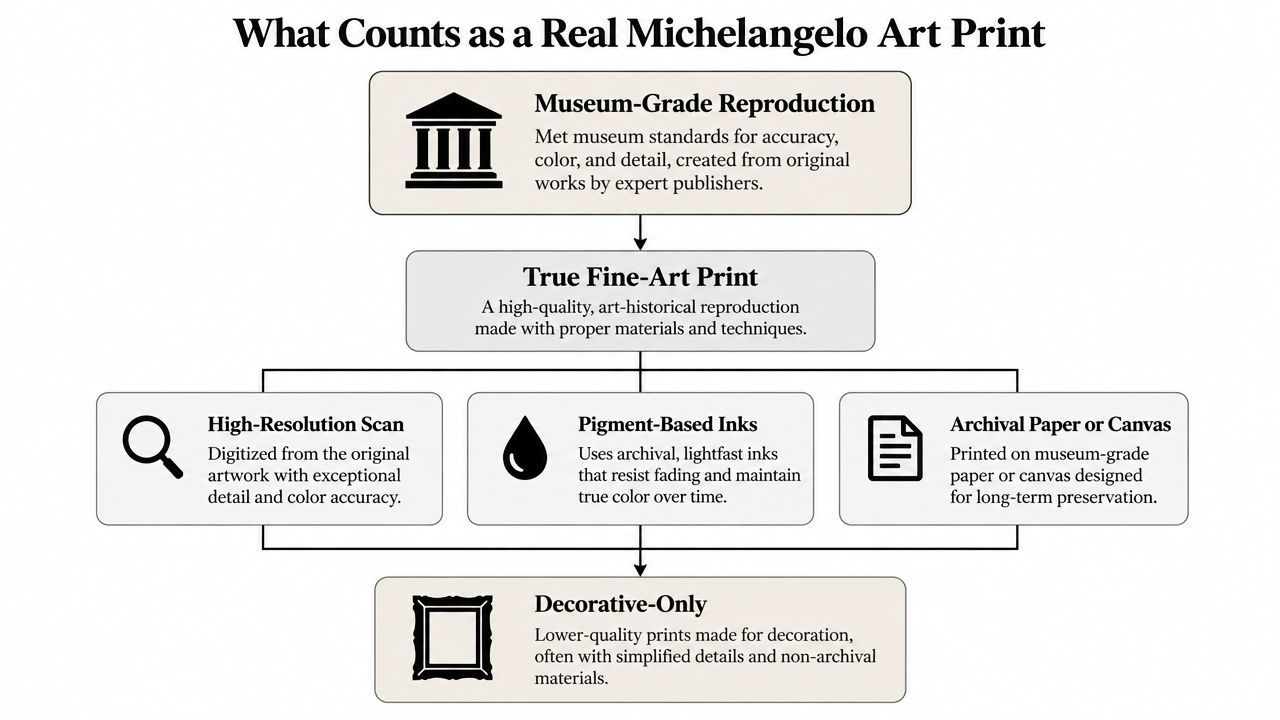
Museum-style paper reproductions are the detail-first option. Look for a named source institution, a high-resolution scan or professional photography, pigment inks, archival paper, and a clear description of the image's crop. Paper is especially good for subtle contours and tonal transitions.
Giclée canvas reproductions put the image on woven material, usually with the artwork wrapped over stretcher bars or placed inside a frame. A credible listing should identify the canvas type, ink system, protective finish, stretcher construction, and whether the edges are printed or mirrored.
Decorative posters prioritize affordability and visual impact. They're not bad. They're useful when you want a temporary statement, a large image at modest cost, or an easy way to test a composition before upgrading. Just don't confuse “poster” with archival fine art.
Search the product page for these details:
Ultra-low pricing on a very large canvas deserves scrutiny, especially when the seller provides no information about the file, ink, canvas, or construction. Missing attribution, distorted proportions, aggressive sharpening, visible pixelation, and stock photos that hide the frame edges are also warning signs.
The best print isn't necessarily the most expensive one. It's the one whose quality claims are specific enough to evaluate.
Paper and canvas create noticeably different experiences, even when they use the same source image. Paper preserves a sharper, more graphic impression. Canvas softens reflections, adds surface texture, and often feels more integrated with furniture and textiles.
| Factor | Paper Print | Canvas Print |
|---|---|---|
| Surface look | Crisp, smooth, detailed | Textured, warm, softer |
| Protection | Usually needs glazing and a frame | Can be finished and ready to hang |
| Framing | Frame and mat can add structure | Gallery wrap or frame works well |
| Wall character | More formal and precise | More relaxed and substantial |
| Best use | Study, gallery wall, office | Living room, office, hospitality space |
| Main trade-off | More vulnerable without protection | Texture can soften fine detail |
Choose paper when the image depends on fine contours, delicate tonal modeling, or a clean gallery presentation. A paper print also gives you more control over mat width, frame color, and glazing. The downside is that you'll need to protect it from dust, handling, moisture, and light with a proper frame.
Canvas is more forgiving in a lived-in room. Its surface absorbs some glare, and the material can disguise minor wall irregularities that a glossy framed paper print would emphasize. A deep-sided canvas can also look finished without an additional frame, although a thin black or wood floater frame often gives it a more deliberate edge.
If you want the sharpest image, choose paper. If you want the easiest warm wall statement, choose canvas.
For a study, library, or narrow hallway, I'd choose a well-framed paper reproduction. It rewards close viewing and gives the work a quieter, more considered presence. For a living room, office reception area, or hospitality setting, canvas makes sense when you want the artwork to feel substantial without introducing a heavily ornate frame.
A poster is acceptable when the artwork is exploratory or temporary. Upgrade to archival paper or canvas when the image will anchor a room, sit in a high-traffic area, or remain on the wall for years. Spend money on the substrate and image source before paying for decorative extras such as elaborate packaging or an unnecessarily expensive frame.
If you're leaning toward canvas for a relaxed interior, browse canvas wall art to compare how different subjects and formats behave as finished wall pieces. Treat it as a visual reference, not a reason to force every Michelangelo image onto canvas.
Michelangelo prints now sit at the intersection of fine-art reproduction and everyday interior design. Buyers aren't only looking for a scholarly facsimile. They're also looking for a ready-to-hang focal point that brings historical authority into a living room, office, rental, restaurant, or hotel.
The broader art reproduction market is estimated at USD 53.26 billion in 2026 and projected to reach USD 89.78 billion by 2034, while paintings and drawings are expected to represent 75.06% of the market in 2026, according to Fortune Business Insights' art reproduction market overview. The related art print market is valued at USD 8.2 billion in 2025 and forecast to reach USD 12.4 billion by 2034, from the same source.
Those figures don't mean every seller offers the same product. They explain why shoppers encounter such a wide spread of formats, finishes, edition language, and manufacturing quality. Digital scanning has made high-quality source files more accessible, but marketplaces also contain inconsistent color profiles, poor enlargements, and listings that give buyers little technical information.
| Tier | Typical Format | Price Range (USD) | Best For |
|---|---|---|---|
| Decorative | Poster or basic canvas | Varies by seller | Temporary styling and low-commitment rooms |
| Fine-art reproduction | Archival paper or giclée canvas | Varies by seller | Buyers prioritizing detail and materials |
| Licensed or museum-style edition | Carefully sourced paper or canvas | Varies by seller | Buyers who want stronger provenance and presentation |
A tier label alone doesn't prove anything. Judge the seller's documentation, product photography, return policy, and explanation of the source image. A premium price can reflect licensing, careful color work, framing, or edition handling, but it can also reflect branding without corresponding material quality.
For current decor references beyond Renaissance subjects, Jessie's Home's trending wall art collection can help you compare how historical imagery might sit beside contemporary palettes and formats. The practical lesson is to shop by construction and intended use, not by marketplace ranking.
Market saturation gives buyers more choice, but it also makes licensing and source verification essential. Two listings may show the same Michelangelo detail while offering very different rights, files, paper, inks, and quality control.
Michelangelo died in 1564, so his original artworks are in the public domain. That doesn't mean every photograph, scan, digital file, or museum reproduction is free for anyone to copy and sell.
The legal distinction is easiest to understand this way: the artwork can be public domain while the reproduction image has separate conditions. A museum may control access to its photography. A newer digital scan may carry license terms. A gallery may claim rights over its color-managed file, watermark, layout, or branding.
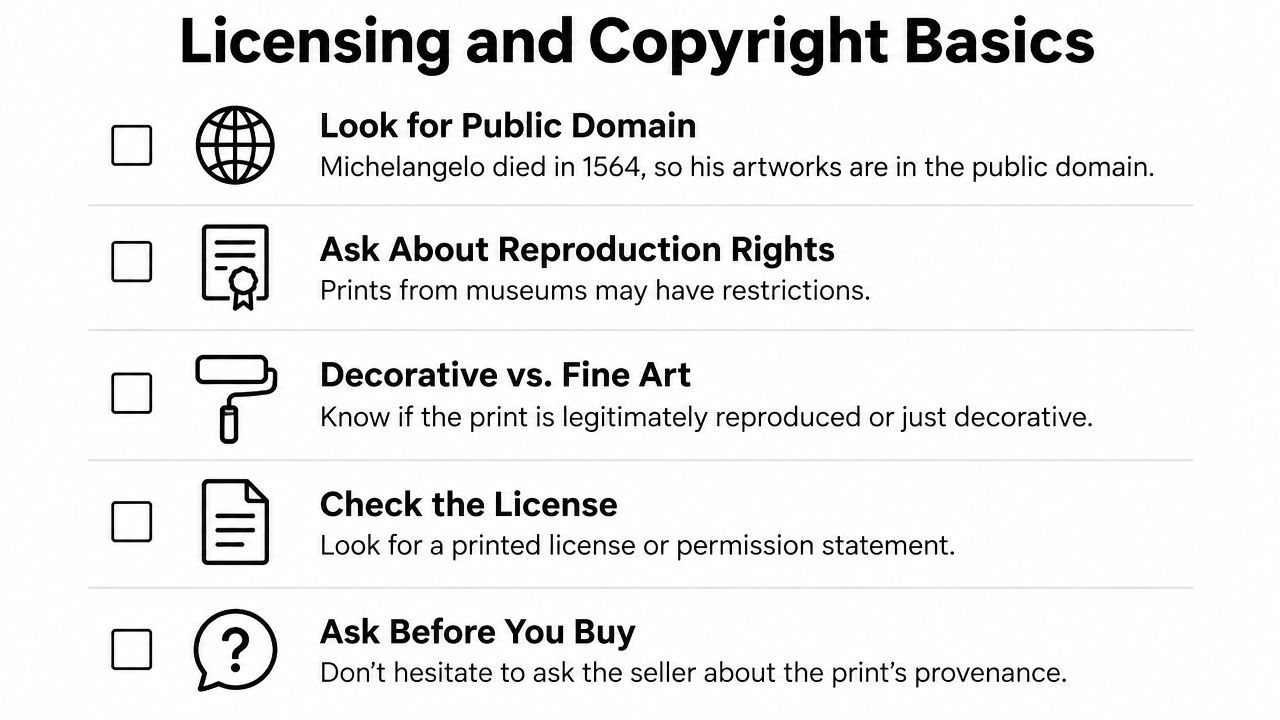
Openly licensed files from institutions such as the Met may come with stated terms, while other museum or gallery images may have restrictions. Read the specific notice attached to the file or reproduction. Don't assume that a museum name automatically means unrestricted use.
If you're checking an image for a business project, our copyright compliance checklist offers a useful companion reference for documenting permissions and reviewing image-use risks.
Public domain applies to Michelangelo's old artwork, not automatically to every modern photograph or scan of it.
A seller who won't answer basic provenance questions may still be selling an inexpensive decor product, but you should understand what you're buying. For a private wall, focus on legitimate sourcing and honest product descriptions. For hospitality, retail, or office use, keep a record of the license and confirm that the intended display is allowed.
Michelangelo's compositions can overwhelm a room when the scale is accidental. A wall-sized Sistine Chapel reproduction above a sofa needs a different treatment from a tightly cropped Creation of Adam detail over a desk. The image should have enough presence to anchor the furniture without swallowing the room.
Use the two-thirds rule as a starting point. Artwork above a sofa, console, or bed should generally occupy roughly two-thirds of the furniture width, with enough breathing room around the frame. Measure the wall and the furniture together, because a print that looks large in an online preview may appear undersized once it's surrounded by architectural space.
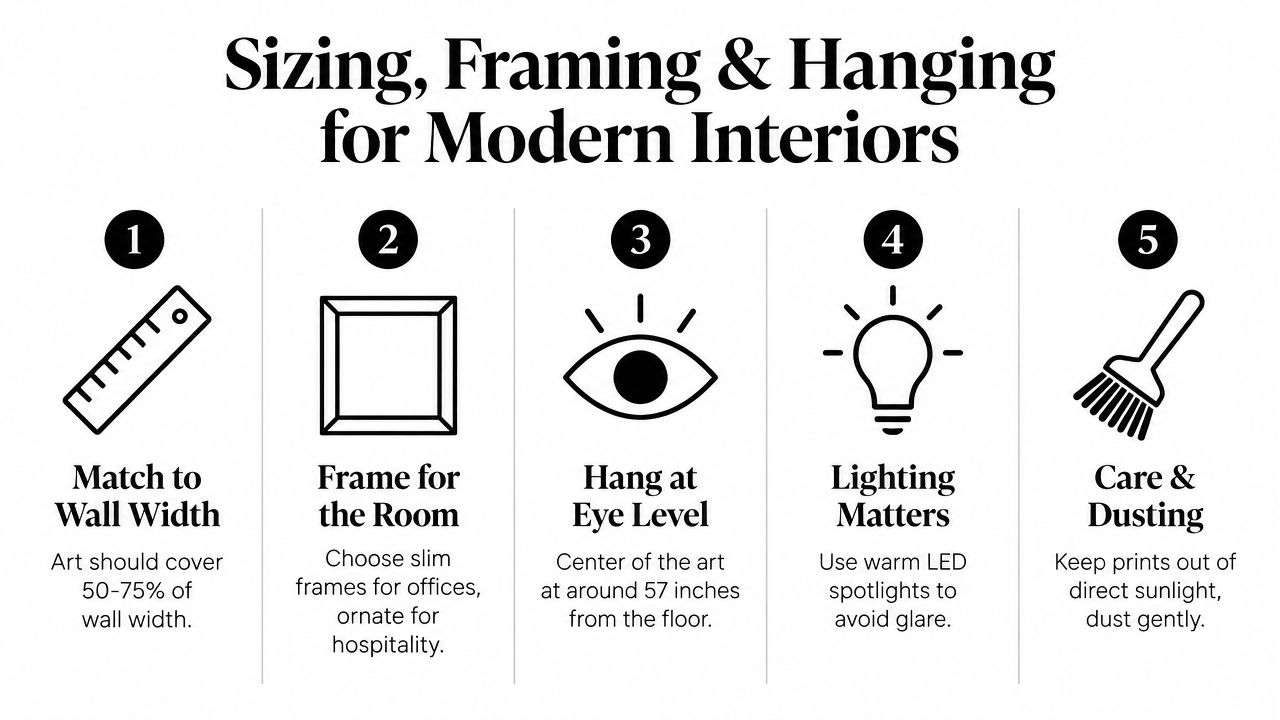
Above a sofa: Choose an oversized architectural scene or a bold ceiling detail. Canvas can keep the effect approachable, while a thin black frame gives the composition a cleaner modern edge.
In a home office: Use an intimate detail, such as the hands from The Creation of Adam, on paper with a slim frame and restrained mat. The tighter scale encourages close viewing without competing with a screen or bookshelf.
Along a hallway: Group small studies or related details in a measured sequence. Keep the spacing consistent and let the corridor provide the rhythm. A series works best when the prints share a frame finish or tonal treatment.
Traditional rooms can carry wider carved or ornate mouldings, especially when the surrounding furniture already has visual weight. Minimalist interiors usually benefit from a thin black, natural wood, or floating frame that lets the image supply the drama. Renters can use an adjustable hanging system or picture ledge, provided the hardware is rated for the artwork's weight.
Place the center of the artwork around 57 to 60 inches from the floor for an eye-level starting point, then adjust for seating, ceiling height, and nearby furniture. Picture lighting should illuminate the image evenly without creating a bright reflection across the surface. Warm LED fixtures are a sensible choice because they can create a comfortable viewing atmosphere when positioned carefully.
Paper prints need more environmental caution than canvas. Avoid kitchens, bathrooms, damp exterior walls, and direct sunlight. Use UV-protective glazing where available, dust frames with a soft cloth, and never wipe the printed surface with household cleaner.
For a precise installation, follow a practical guide on how to hang a picture straight. If you prefer a ready-to-hang canvas approach for contemporary rooms, compare canvas wall art for modern homes with your existing furniture and wall color.
Commercial buyers should also confirm that the artwork's license matches the display setting. A private home and a hospitality project don't always have the same requirements.
A good Michelangelo print purchase should survive two tests. It needs to make sense technically, and it needs to look intentional in the room. Use this checklist while you browse, and answer each prompt before adding the item to your cart.
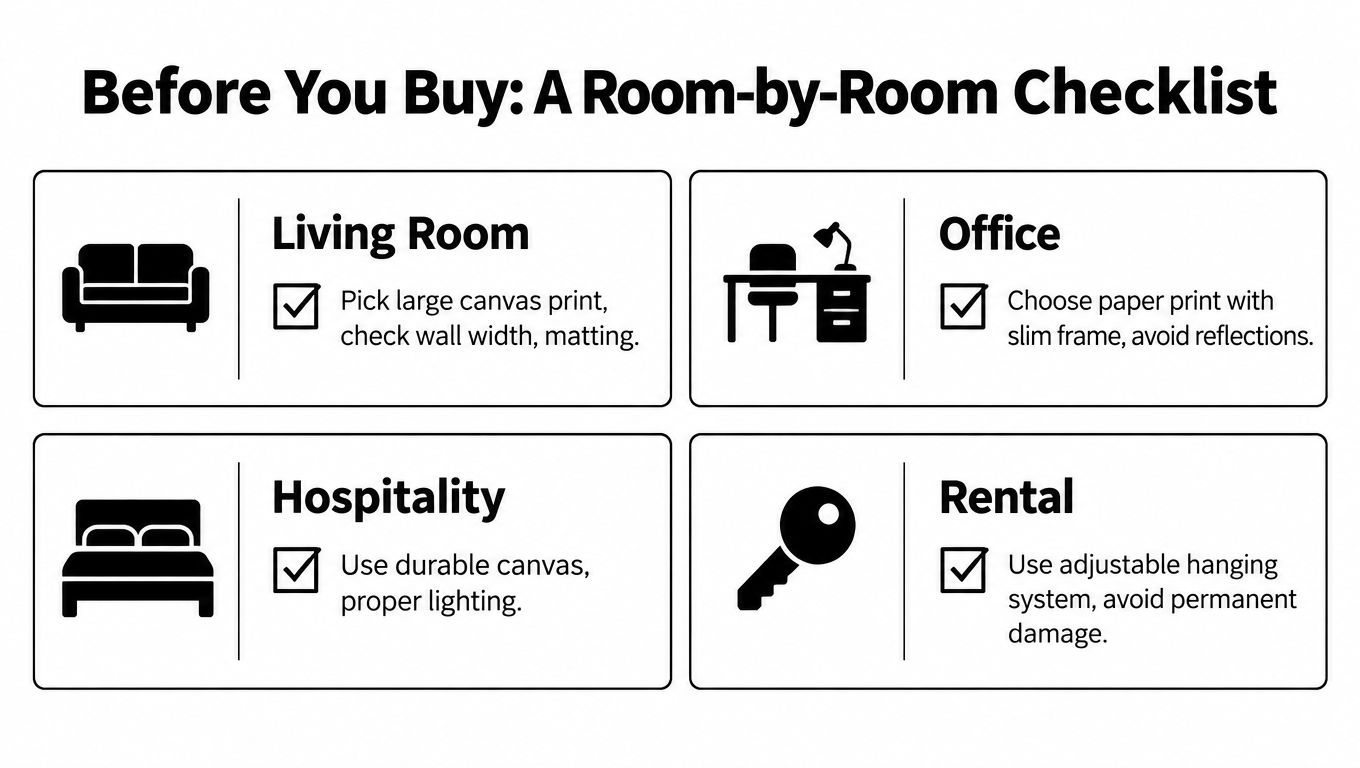
A living room usually benefits from a decisive choice. A large architectural scene can hold a broad wall, while a tightly cropped figure or hand detail can feel more contemporary and focused.
Paper often works beautifully in an office because a slim frame keeps the presentation precise. Canvas is better when the room needs warmth or when reflections make framed paper difficult.
Hospitality installations need more planning than a single home purchase. Keep the seller's license information, order details, and material specifications with the project records.
Before checkout, ask three questions: Does it complement the room's palette without matching every object? Does it anchor the wall at the right scale? Does it feel deliberate rather than impulsive? If the answer is no, save the item and keep shopping.
Then take three concrete steps. Measure the wall, shortlist two Michelangelo works, and order one test print before committing to a full wall set or coordinated display.
Jessie's Home offers artist-made canvas wall art and gallery-quality photo prints, including ready-to-hang pieces for living rooms, offices, bedrooms, and hospitality spaces. Visit Jessie's Home to compare formats and find a wall piece that fits your room, style, and installation plans.

Discover how black and white minimalist art transforms any room with calm, contrast, and timeless style, plus tips on prints, framing, and placement.
Discover how black and white minimalist art transforms any room with calm, contrast, and timeless style, plus tips on prints, framing, and placement.

Discover watercolor abstract art techniques, learn how prints differ from originals, and get styling tips for your home. A complete guide for wall art lovers.
Discover watercolor abstract art techniques, learn how prints differ from originals, and get styling tips for your home. A complete guide for wall art lovers.

Explore the beauty of modern landscape art and how to choose prints that transform your home. From trends to room-by-room styling tips, this guide covers it
Explore the beauty of modern landscape art and how to choose prints that transform your home. From trends to room-by-room styling tips, this guide covers it


