Your wishlist is empty.
Secure Payment
30 days return

You're standing in front of a blank wall with a tape measure in one hand and a browser full of oversized canvases in the other. The piece looks right until you imagine it over the sofa, then it looks huge, then too small, then suddenly like it could crash off the wall if you use the wrong hook. That's the problem with large abstract wall art: it's not just a styling choice, it's a size, surface, and hanging decision.
People get stuck because they treat big abstract art like a pure taste question. It isn't. The wall, the furniture, the frame, the backing, and the hardware all decide whether the piece looks intentional or makes the room feel sloppy. The good news is that this is a solvable problem if you stop guessing and start checking the basics.
The fear is usually simple. You don't want to buy something that overwhelms the room, and you definitely don't want to trust a giant canvas to a random anchor and hope for the best. That hesitation is rational, because big art changes the room more aggressively than a small print ever will.
You only own three real decisions here. First, how big the piece should be relative to the wall and the furniture beneath it. Second, what the piece is made of, because a stretched canvas behaves differently from acrylic-faced paper, metal, or wood. Third, how the thing gets onto the wall without tearing out drywall or making the whole install look crooked.
Practical rule: if a piece feels too risky to hang, the problem usually isn't the art itself. It's that the wall type and the hardware haven't been matched yet.
That's why a lot of people stall out. They focus on palette, texture, and trend, then discover they haven't thought about wall construction at all. If you want a ready-made starting point, look at Jessie's Home's abstract canvas wall art, because canvas is the format that gives the least grief when they're buying large.
Don't obsess over whether the piece “says enough” about you. That's a trap. A strong abstract composition can do its job, which is to give the room a focal point and make the wall feel finished.
What you should obsess over is practical fit.
Once you look at oversized abstract art this way, it stops feeling like a leap of faith. It becomes a measured decision, and measured decisions hang better.
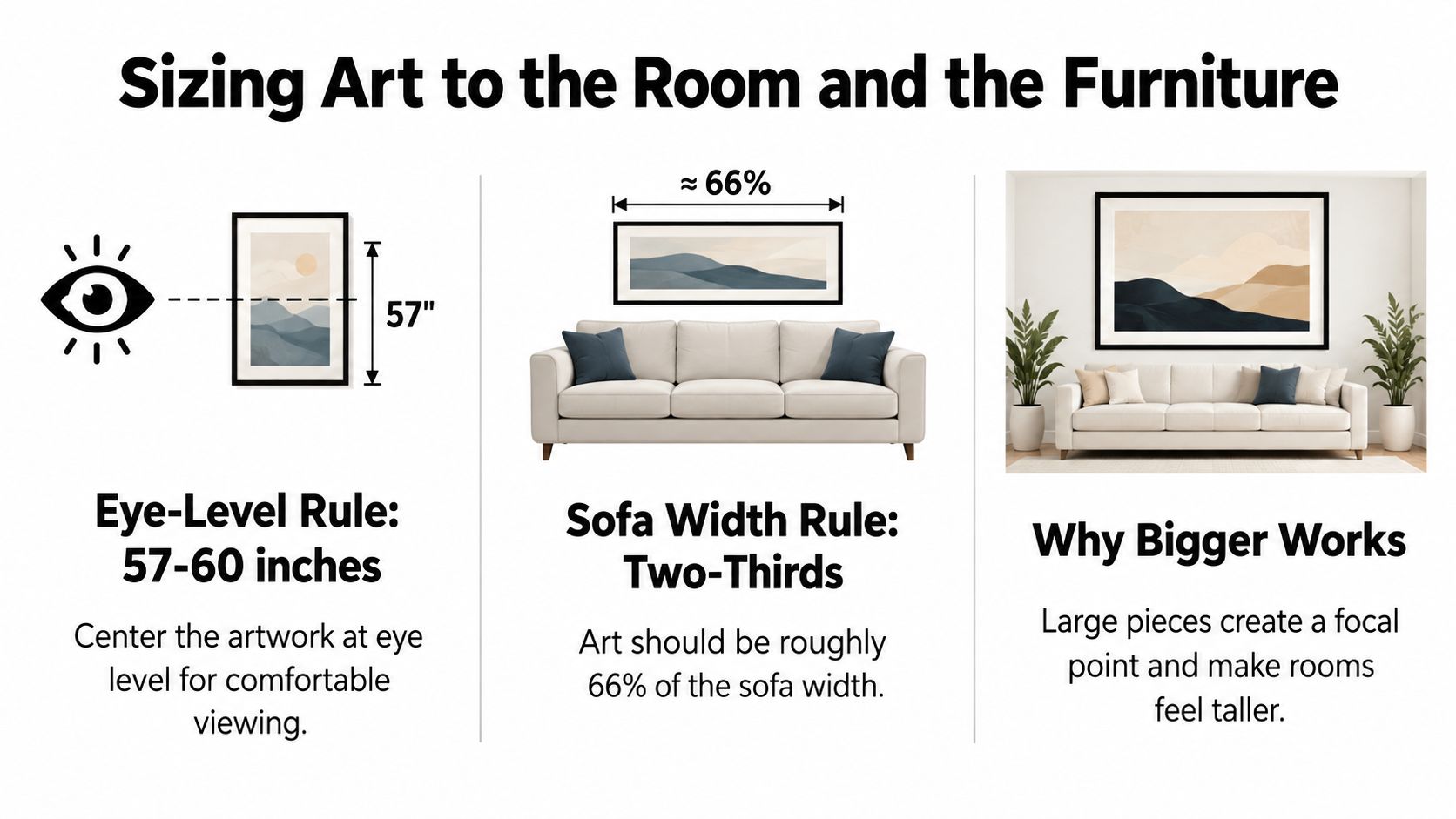
The easiest way to ruin big art is to size it to the wall alone. That makes the piece float. Size it to the furniture below it, and the whole room starts to read as one composition. A sofa, sideboard, bed, or desk should anchor the artwork, not compete with it.
If the wall is behind a sofa, the art should feel tied to the sofa's width instead of sitting like a separate object above it. The eye-level rule belongs here too, because art reads more naturally when its center lands around comfortable viewing height, not near the ceiling. If you're hanging over a longer piece of furniture, keep the gap visually consistent so the art feels related to the furniture, not detached from it.
For many living rooms, one large canvas beats a cluster of small pieces. A multi-panel arrangement works when the wall is wide and the furniture is substantial, but it fails fast when each panel starts looking like filler. In bedrooms, a single strong piece usually looks calmer than a busy arrangement over the bed.
Keep the art's center near eye level and the bottom edge close enough to the furniture that the two read as a pair.
| Wall or Furniture | Recommended Art Width | Gap Below Art |
|---|---|---|
| Sofa wall | About two-thirds of the sofa width | Roughly 6 to 10 inches above the back |
| Dining sideboard | Wider than the furniture's center section, not wider than the whole wall | Enough to feel connected, not crowded |
| Bed wall | Broad enough to span the headboard zone | Close enough to visually anchor the bed |
| Desk wall | Sized to the desk and chair footprint | High enough to avoid feeling cramped |
| Tall open wall | One oversized piece or a balanced pair | Varies, but keep the composition grounded |
The reason this works is simple. Large abstract pieces don't need a lot of visual explanation, but they do need proportion. If you choose a wall piece that respects the furniture below it, the room feels deliberate even before you add rugs, lamps, or side tables.
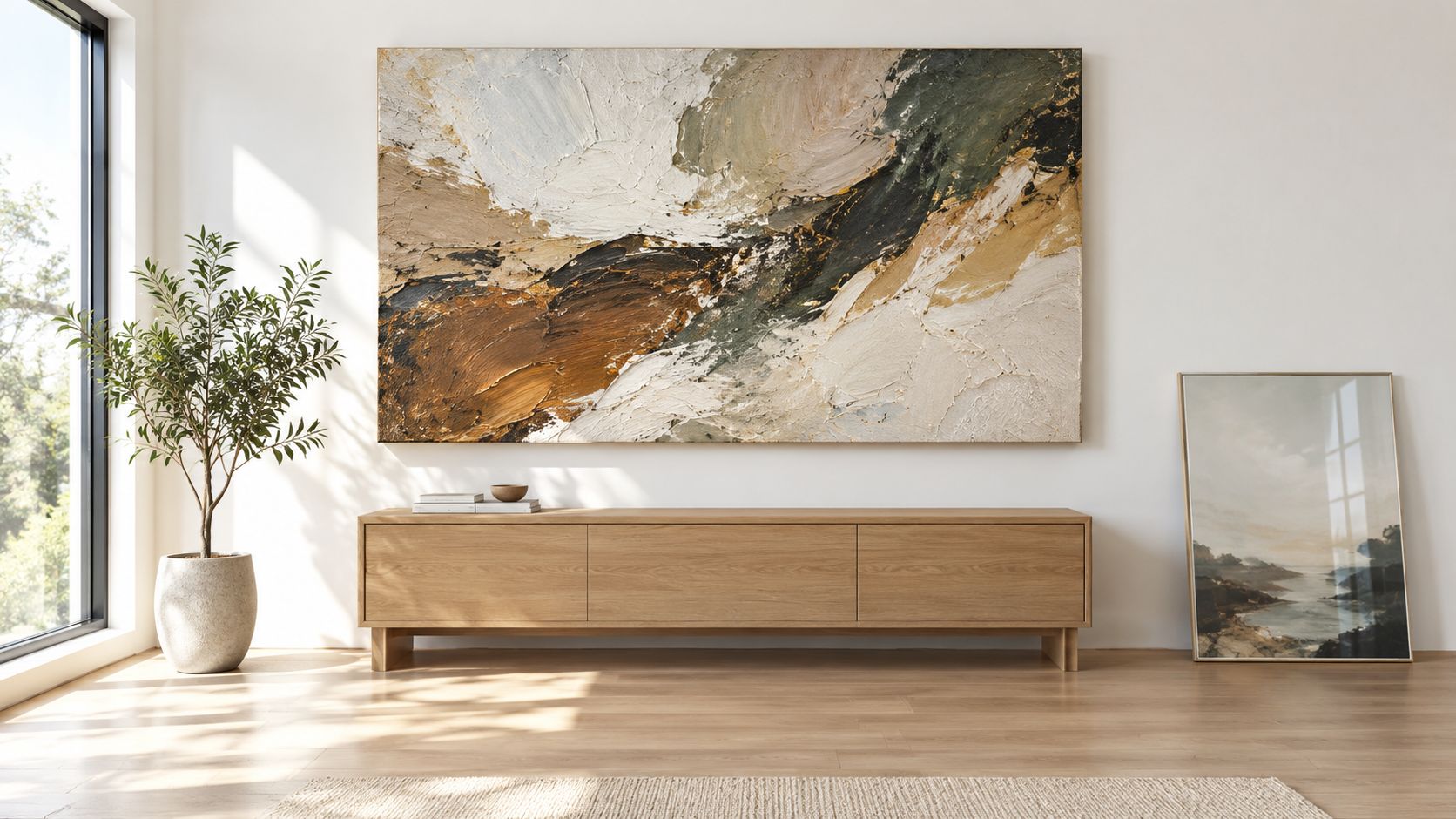
At large scale, material choice is a practical decision first and a style decision second. A big canvas is easier to live with because it stays relatively light for its size and does not demand a complicated frame. Rigid formats can look sharper in a polished room, but they ask more from the hardware and from the person doing the install.
Canvas is the safest default for oversized abstract work because it is flexible, familiar, and easier to mount. Gallery-wrapped canvas works well when you want clean edges and a finished look without a heavy frame. Paper prints behind acrylic can look crisp and polished, but glare and direct light become much bigger problems.
Metal and wood panels play a different role. They can look sharp and contemporary, but they change the hanging load and the wall contact points. If you want a clear side-by-side view before you commit, choosing between metal and canvas is a useful read.
Jessie's Home offers custom canvas wall art options that fit this use case neatly, especially if you want the piece to arrive ready to hang rather than sending it through a frame shop.
Matte surfaces calm bright rooms. Satin finishes keep some life in the surface without turning every lamp and window into a reflection problem. Protective coatings and UV-safe glazing matter most in rooms with strong daylight, because large color fields show fading and uneven exposure more clearly than small work.
Skip fragile surfaces that only look good in a mockup. Choose the material that can handle your actual room, your actual light, and the wall it has to live on.
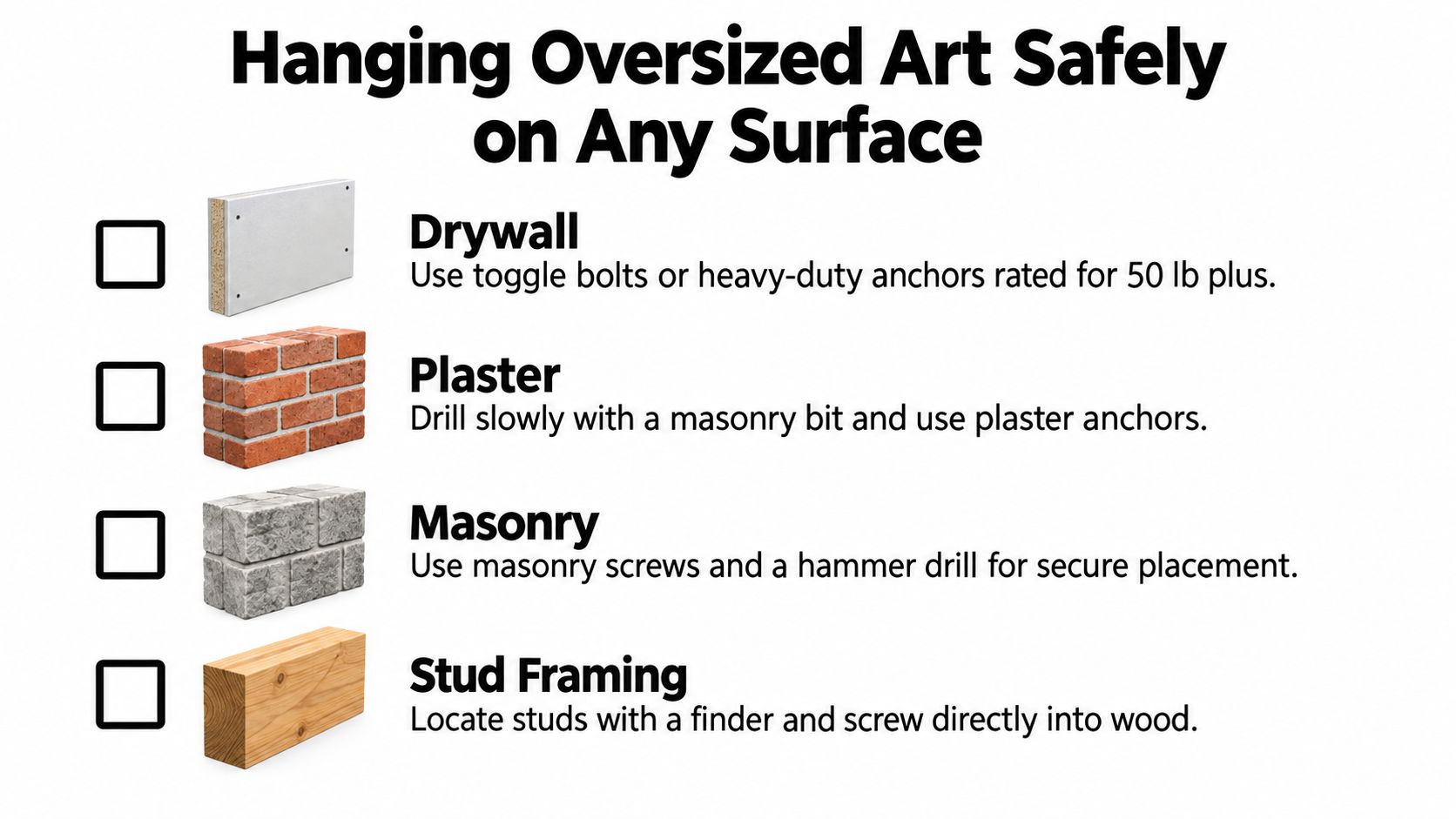
This is the part most avoid, and it's the one that matters most. If you don't know whether you're drilling into drywall, plaster, masonry, or a stud-backed wall, you're guessing with weight. Don't do that.
Drywall needs a different approach than brick or concrete. Conservation guidance warns that drywall alone shouldn't carry substantial frames, and larger works should use two attachment points rather than relying on a single wire. For very large pieces, professional installation is the safer call, especially when the load is awkward or the wall condition is questionable.
Use this as your quick read on hardware:
| Wall Type | Recommended Hardware | Two-Point Mount |
|---|---|---|
| Drywall | Heavy-duty anchors, toggles, or a French cleat for statement pieces | Yes |
| Plaster | Plaster-safe anchors and careful drilling | Yes |
| Masonry | Masonry screws or appropriate anchors for brick or concrete | Yes |
| Stud framing | Screws driven into studs | Yes |
Find the wall type first. Then locate studs if the structure allows it. Then choose hardware with a margin of safety, not a bare-minimum rating. If the artwork is large, use two attachment points so the weight doesn't hang from one weak spot.
If you're hesitating at the drill stage, that hesitation is useful. It usually means the install is getting beyond casual DIY and into professional territory.
Renters need to be extra careful because damage to the wall matters as much as the installation itself. Offices, clinics, and hospitality spaces have another layer of risk, because vibration and repeated traffic can loosen sloppy hardware over time. When the wall surface is unfamiliar, hire an installer instead of improvising.
The cleanest hanging job is the one nobody notices. The crooked, shifting, or overstrained one gets attention for all the wrong reasons.
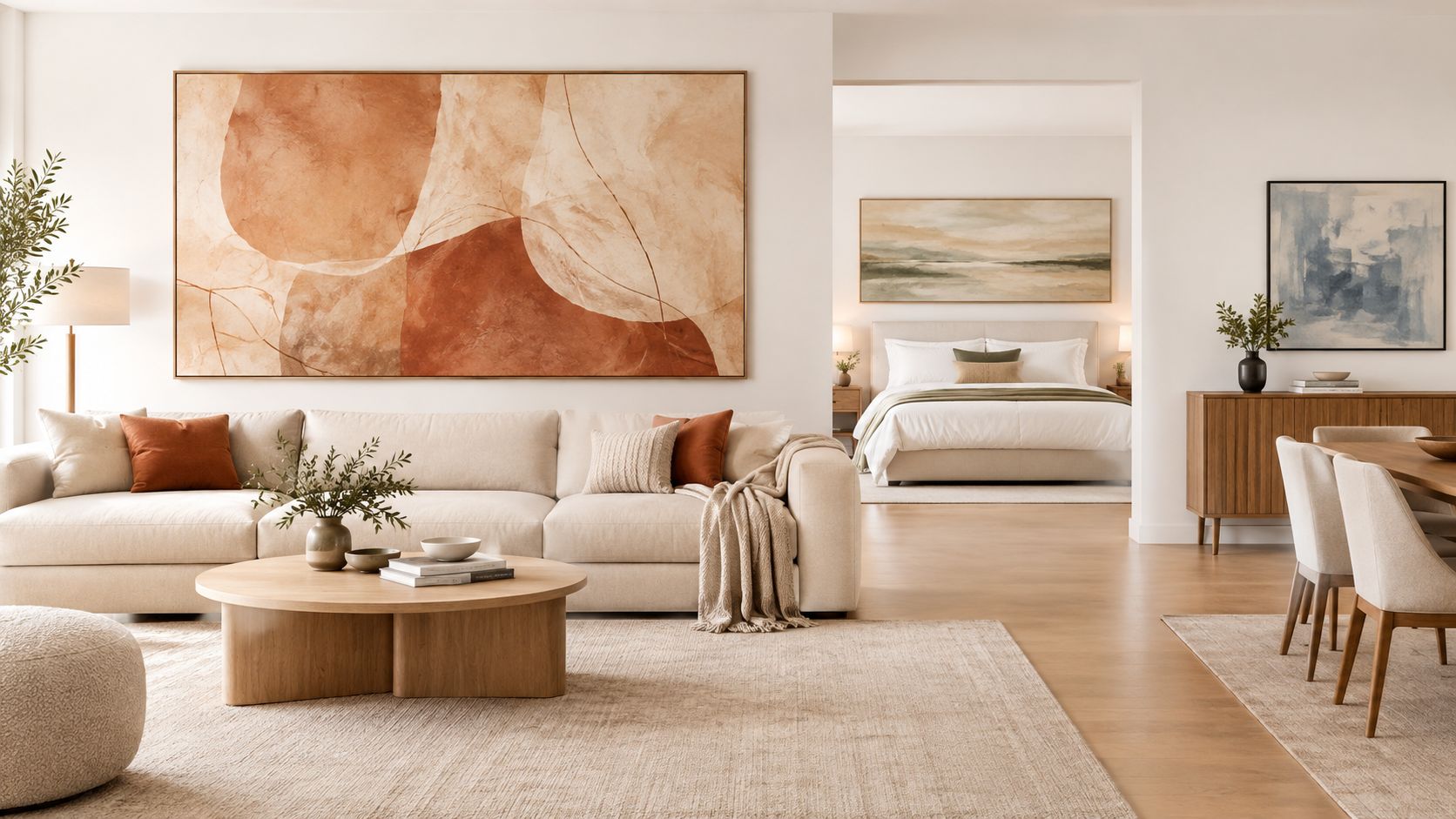
A large abstract piece reads differently depending on the room around it. The same canvas that feels grounded above a sofa can feel too exposed above a narrow console. That's not a flaw in the art. It's a scale issue.
A wide living room is the easiest win. Put the piece behind the sofa, keep the composition centered, and let the art connect the seating area visually. In a dining room, use a large piece above the sideboard so the wall doesn't feel like a leftover zone. Over a bed, a tall abstract piece can soften the headboard wall without making the room look busy.
Home offices are trickier. The art sits in the same sightline as screens, task lamps, and shelving, so a quieter composition usually works better than something hyperactive. Hospitality and clinic lobbies can handle bigger, bolder work because the art needs to hold a wall from farther away and under mixed lighting.
Don't crowd a wall with too many competing pieces. A big abstract canvas already does the heavy lifting, so mirrors, sconces, and shelves should support it, not fight it. Tall ceilings are another trap, because art can end up stranded halfway up the wall if it isn't scaled correctly.
A vertical abstract piece can save a bedroom or living room that needs height without clutter. A horizontal skyline-style abstract, such as a piece like Birmingham Sunset Skyline, can ground a longer wall when you need color and width to do the work. That's the kind of piece that makes a sofa wall or office wall feel finished without demanding more decor around it.
A social room can carry stronger contrast and bolder movement. A bedroom usually wants less visual agitation. An office needs clarity first, mood second. Pick the wall art that matches how the room gets used, then style around that choice instead of trying to force one composition into every room in the house.
Color psychology gets oversold all the time. A bold red abstract isn't automatically energizing in a helpful way, and a beige composition isn't automatically calm. What changes the experience is how the piece behaves under light, at different hours, in a specific room.
A piece can look balanced at noon and harsher under warm evening lamps. Seasonal sun shifts matter too, because the same wall can get a lot more exposure in one month than another. The Nebraska State Historical Society advises keeping framed works away from direct sunlight, fluorescent ultraviolet sources, exterior walls prone to moisture, water pipes, vents, and working fireplaces, which is exactly the kind of caution large color-field work deserves because fading or uneven exposure shows quickly across a broad surface. Keeping framed works away from direct sunlight and heat sources is the kind of boring advice that saves you from a disappointing wall later.
If you want to see how daylight changes a visual composition, see Image Studio's photography for a good reminder that lighting changes everything. The same is true with wall art. Bright rooms need art that can handle reflection and exposure without losing its punch.
Hanging too high is the classic failure. So is centering on the wall instead of the furniture, which makes the piece feel like it's floating in the room by itself. Ignoring the doorway sightline is another one, because that's often the first angle anyone sees when they enter.
Use this rule set and you'll avoid most of the damage:
If you want a faster path to color-forward work, Jessie's Home's colorful abstract canvas wall art gives you examples of how strong color can anchor a room without having to overload the rest of the decor. The trick is still the same. Match the art to the light before you match it to the pillows.
The whole process gets easier when you stop treating it like a decor gamble. Measure the wall, measure the furniture, check the wall type, and choose a material that won't make the installation harder than it needs to be. If those four pieces line up, the art usually works.
| Decision | What to Confirm | Done? |
|---|---|---|
| Size | Does it relate to the furniture beneath it? | |
| Material | Does the surface fit the room's light and use? | |
| Hardware | Does the wall type support the chosen mount? | |
| Placement | Does it sit at a comfortable viewing height? | |
| Safety | Do you need two people or a pro installer? |
The moment to pause is when the piece is heavy, the wall is unfamiliar, or the room demands a cleaner install than a quick DIY attempt can give you. That's not indecision. That's good judgment.
Will one large piece beat a gallery wall? Usually, yes, if the wall sits behind substantial furniture and you want the room to feel calm.
Should abstract art always be centered? No, it should be centered on the furniture relationship first, not the raw wall.
Can you use a bold piece in a bedroom? Yes, but keep the room light and the composition controlled.
The best oversized abstract work feels inevitable after it's hung. It doesn't look forced, and it doesn't look like an afterthought. It looks like the wall finally got the right job.
If you want art that's sized for real rooms and designed to hang without drama, Jessie's Home is built around that exact problem. Browse Jessie's Home for canvas and print options that make it easier to choose, mount, and live with large abstract art that fits your space.

Choose, size, and hang large abstract wall art with confidence. Practical tips on scale, materials, and placement for every room.
Choose, size, and hang large abstract wall art with confidence. Practical tips on scale, materials, and placement for every room.

Discover 7 spring wall art ideas with florals, pastels, and light compositions, plus quick tips to refresh your decor this season and style with confidence.
Discover 7 spring wall art ideas with florals, pastels, and light compositions, plus quick tips to refresh your decor this season and style with confidence.

Home gym wall decor - Turn a blank wall into daily motivation. Learn which materials hold up to sweat, how to size pieces for your space, and layout tricks
Home gym wall decor - Turn a blank wall into daily motivation. Learn which materials hold up to sweat, how to size pieces for your space, and layout tricks


