Your wishlist is empty.
Secure Payment
30 days return

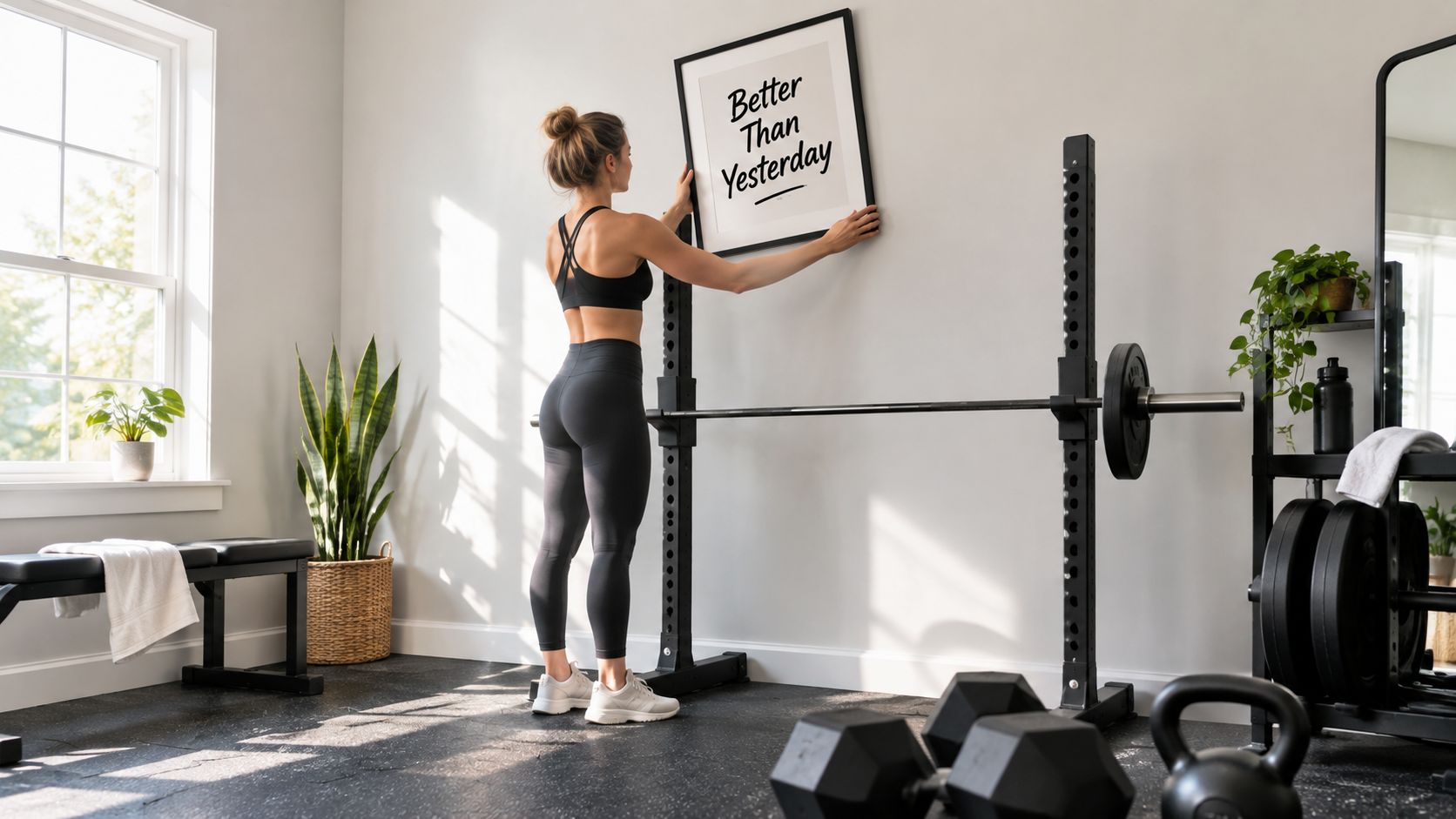
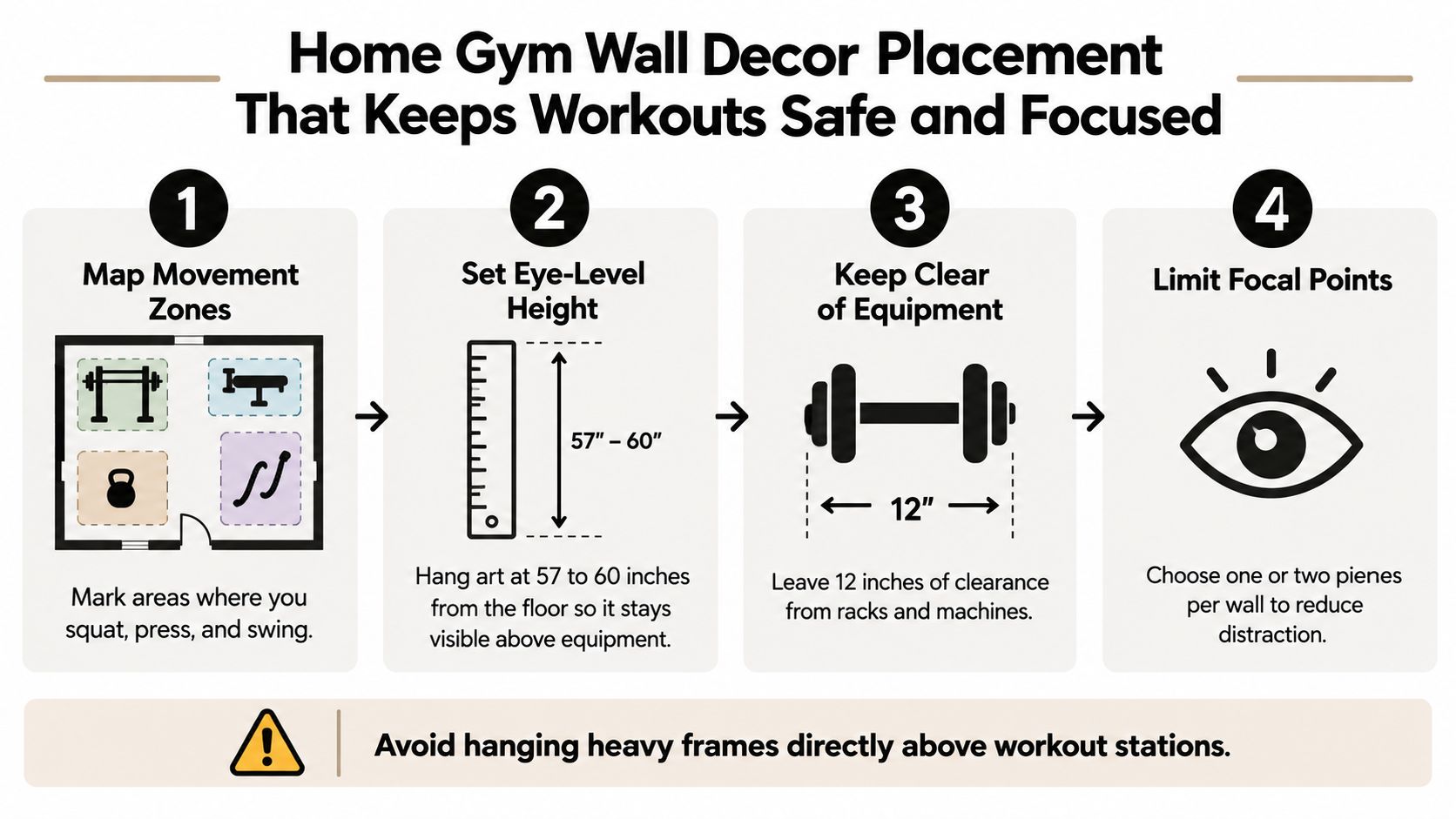
Center your main artwork at standing eye level, typically 57 to 60 inches from the floor, when you're facing the primary equipment zone. Adjust that height only when a treadmill, rack, bench, or seated position changes your natural viewing angle.
You're probably standing beside a treadmill or squat rack with a canvas in one hand, moving it up and down while the wall somehow still looks wrong. Too high, and the room feels disconnected. Too low, and the equipment appears to swallow the artwork. In a home gym, decoration has to work around movement, sweat, storage, mirrors, humidity, and equipment that can turn a clean wall into an impact zone.
The best home gym wall decor makes the room feel deliberate without competing with your workout. That means choosing materials that can be cleaned, sizing art for the actual viewing distance, and limiting focal points when the space is tight. A finished gym isn't necessarily a heavily decorated gym. Often, one well-positioned piece does more than a crowded gallery wall.
The wall above a treadmill looks like an obvious place for art until you stand on the belt and look forward. The console may block the lower portion, the ceiling light may create glare, and a large canvas placed too high can disappear from your normal sightline. The same problem appears above a power rack, where plates, pull-up bars, and storage compete for attention.
Start with one rule: place the center of the primary artwork near standing eye level, usually 57 to 60 inches from the floor. Face the machine or workout area where you'll spend the most time, then adjust only if your posture changes the view. A seated bike position, a low bench, or a treadmill console can justify a different center point.
Before measuring the frame, mark the equipment footprint on the floor. Include the space where your arms, barbell, resistance bands, and body travel, not just the machine's dimensions. This quickly shows which walls are available for decoration and which need to stay visually and physically clear.
Practical rule: Hang art where you naturally look between repetitions, not where an empty wall happens to be.
A home gym also benefits from the same planning discipline as the equipment itself. If you're still deciding on flooring, storage, ventilation, or machine placement, use a practical guide to building a home gym setup before committing to wall decor. The art should follow the room's function, not force the function around the art.
For a garage or basement, start with the wall that remains visible after storage is installed. A compact composition above a cabinet may work better than a large piece behind a rack. Renters can use lighter pieces and repositionable mounting, while homeowners can choose more substantial frames where clearance allows. Jessie's Home's garage wall art collection is one place to browse pieces by the kind of wall that often needs to balance storage and personality.
A quiet living room can tolerate delicate paper, untreated frames, and glass placed at eye level. A home gym can't always offer that protection. Sweat, temperature changes, cleaning, and an accidental dumbbell swing expose weak materials quickly.
Premium cotton-blend canvas with vibrant, fade-resistant inks and a protective UV coating offers a polished appearance while addressing some of the common stresses of an active room. Jessie's Home produces canvas wall art with those museum-standard finishes, hand-stretching pieces over solid wood frames. That construction can suit a visible feature wall, but it doesn't make any artwork immune to moisture or impact. Placement still matters.
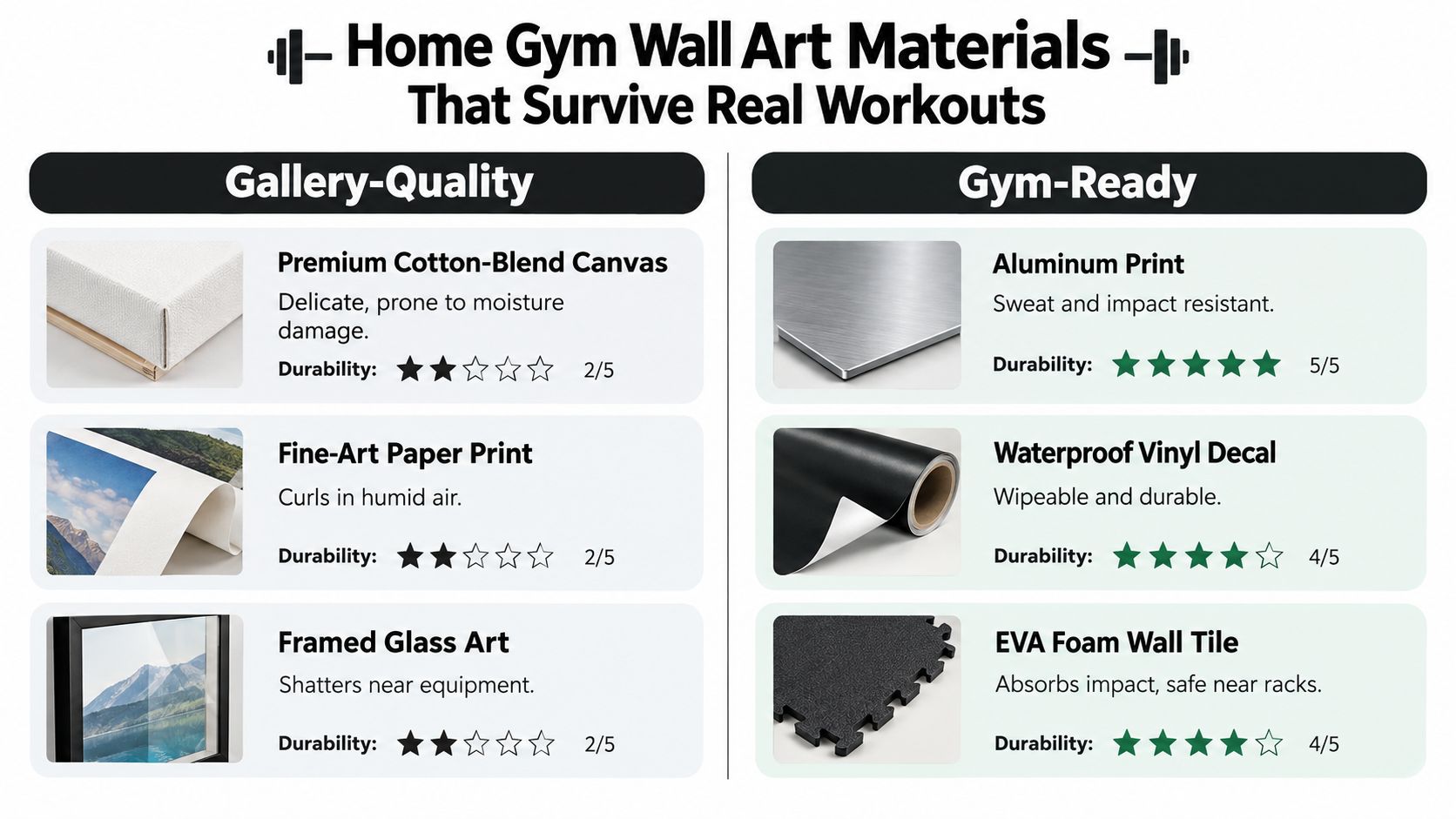
Unsealed paper tends to curl in humid air, particularly in basements where conditions change through the seasons. Glass can look crisp, but it introduces a breakage risk near free weights, benches, and crowded circulation paths. Lightweight posters and thin prints may be inexpensive, yet they often look temporary and can wrinkle during cleaning.
The right choice depends on the wall's exposure:
The global home fitness equipment market was valued at approximately USD 12.88 billion in 2025, while North America represented 37.46% of global revenue, according to Fortune Business Insights' home fitness equipment market overview. That figure describes equipment rather than decorative purchases, but it confirms that many households are building permanent workout environments where durable design decisions matter.
Cleanability is part of durability. A textured frame with deep grooves collects dust, while a glossy surface can show fingerprints and overhead reflections. Choose a finish you can wipe gently, keep artwork away from direct spray, and leave enough space around it to clean the wall without knocking the piece loose.
A small canvas can look lost beneath a shelf, while an oversized piece can dominate a room already filled with a rack, mirror, and cardio machine. The correct size depends on three things: the usable wall width, the distance from the main workout position, and the amount of visual competition nearby.
Measure the uninterrupted wall area first. Then measure from the point where you usually exercise to the wall. A piece viewed from farther away needs enough visual weight to remain legible, while artwork close to a bench or bike should be simpler and less crowded.
Use a vertical composition on a tall, narrow wall or beside a storage tower. A horizontal piece generally works better above a low cabinet, bench, or row of hooks. Square art can stabilize a small corner, but it may look awkward above a long treadmill unless paired with another strong horizontal element.
| Wall situation | Recommended size range | Best subject style |
|---|---|---|
| Narrow corner beside equipment | 18 to 24 inches wide | Vertical skyline, botanical form, or restrained abstract |
| Open wall above storage | 24 to 36 inches wide | Horizontal landscape, sports scene, or graphic movement |
| Clear feature wall | 36 to 48 inches wide | Oversized abstract, cityscape, or high-contrast athletic image |
| Equipment-dense wall | One vertical piece or a coordinated pair | Simple subject with strong shape and limited detail |
These ranges are starting points, not rigid formulas. Keep the artwork visually subordinate to safety equipment and mirrors. If a mirror occupies the best viewing wall, place the art on an adjacent wall or above storage rather than trying to divide the reflective surface.
Bold subjects work well when the room needs identity. A skyline can add direction and depth, an abstract movement can echo training energy, and sports imagery can provide personal meaning. The subject should remain readable at the distance where you train. Tiny text and intricate detail disappear quickly when a treadmill, rack, or bench sits between you and the wall.
Art should fill the available visual field, not every available inch of wall.
A home gym is a moving environment. You squat, press, swing, stretch, step backward, and turn while carrying equipment. Wall decor belongs in the spaces that remain outside those movements, even when those spaces aren't the most obvious decorative locations.
Start by identifying high-clearance walls. These are walls beside storage, behind a seated bike, or outside the path of a barbell and adjustable bench. Medium-use walls can hold a focal canvas if the piece is securely mounted and doesn't interfere with mirrors or form checks. Low-clearance zones near rack uprights, cable paths, punching bags, and free-weight drops should remain free of fragile or heavy decor.
About one-quarter of home-gym users work in spaces of roughly 10 by 10 feet, while nearly 63% of home gyms are in garages and just under one-quarter are in basements, according to Garage Gym Experiment's 2025 home-gym survey results. Those conditions make clearance and conversion especially important. A garage may become a storage area, and a spare room may need to serve as an office or guest room after training ends.
For precise installation, especially with a larger canvas or an uneven wall, Giorgi Bros. picture hanging advice can help you mark the position and hardware points before drilling. Renters can use lighter art, removable mounting systems rated for the piece's weight, or placement above a freestanding storage unit. Don't rely on adhesive alone for anything that could fall onto a workout station.
Motivational posters are easy to add and difficult to edit. One quote becomes three, then a flag, a medal display, a mirror, and a collection of small prints. In a compact room, the result can feel less energizing and more like visual noise.
Exercise already demands attention. You need to monitor foot position, breathing, balance, machine controls, and the movement of other people in the room. Busy compositions compete with mirrors and equipment, especially when reflective surfaces multiply bright colors and high-contrast graphics.
Strong reds and saturated oranges can create energy, but they may feel aggressive in a room that already runs warm. Public-health design guidance cited in a 2024 rapid review notes that red may increase perceived heat and blood pressure, while the review identified 46 facilitators and 33 barriers affecting accessibility and usability in fitness and recreational facilities, as discussed in the review published by Taylor & Francis. The wider lesson is practical: decor should support different activities, including intense training and recovery.
Try a simple edit. Stand at the room entrance and count the elements that demand immediate attention. If your eyes jump between multiple quotes, a mirror, a television, and several colorful prints, remove or relocate the least useful pieces. Keep one visual anchor for high-energy training and reserve calmer surfaces for stretching, breathing, or mobility work.
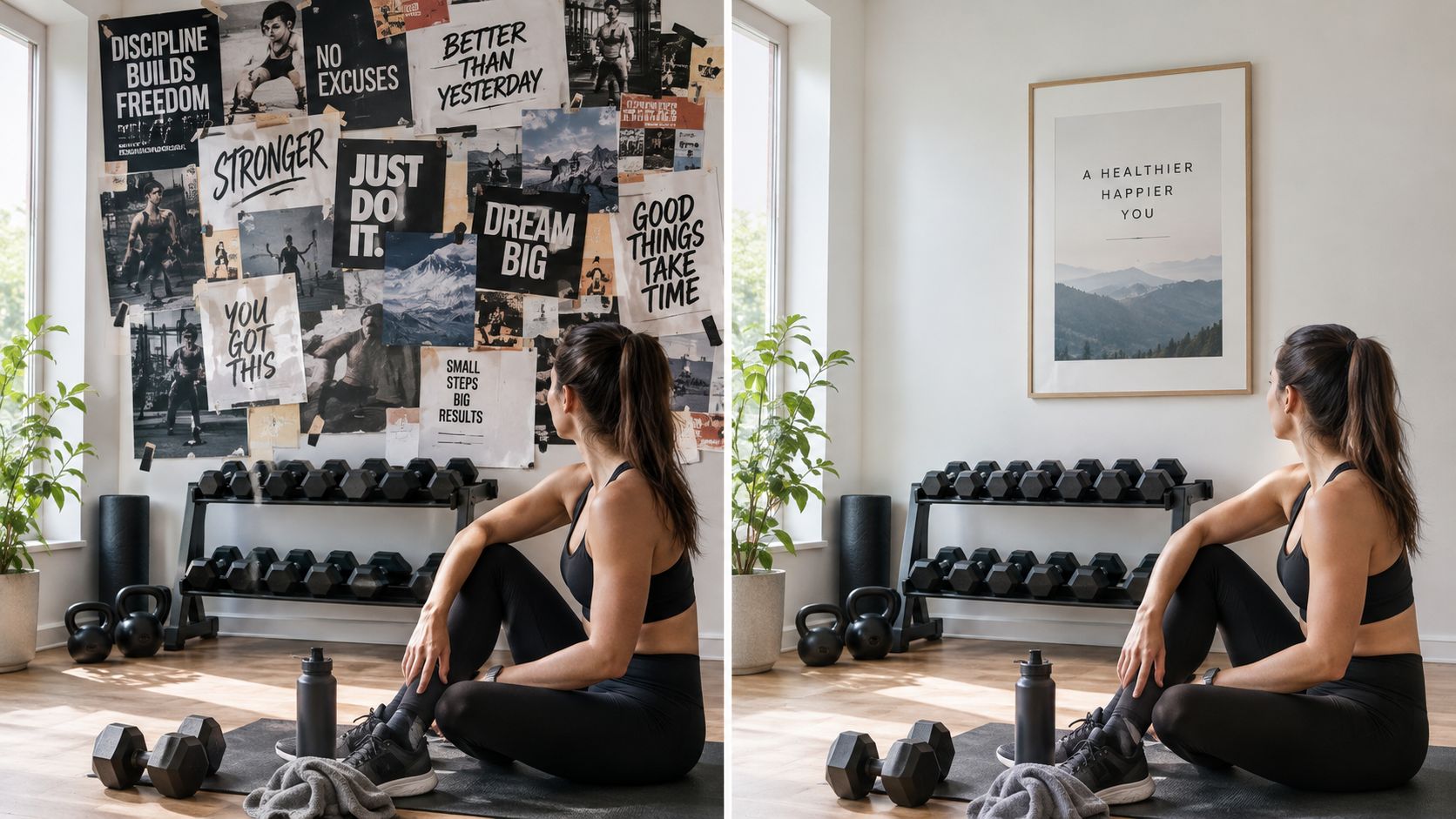
A restrained composition doesn't mean a bland room. It means the artwork has enough surrounding space to register as intentional. For a multipurpose room, choose art that can remain appropriate when the treadmill folds away or the weights move into storage. Jessie's Home also offers home office wall art, which can suit a room that shifts between training and desk work without making either use feel temporary.
Sports art earns its place in a gym when the room has enough quiet wall area to let the subject breathe. A Brooklyn Nets impressionistic basketball canvas, for example, can anchor a feature wall in a sports-focused gym or game room. Its movement and team identity provide motivation, while gold, blue, and orange accents can connect the artwork to towels, storage bins, or a bench without requiring every surface to match.
The placement matters more than the team theme. Put the canvas on a wall visible from the main training position, leave clear space around it, and avoid placing it behind a rack where plates and uprights break up the image. If the room already has a large mirror, use the adjacent wall so the artwork and reflection don't compete.
A bold Anchorman pop art canvas has a different job. It can bring humor and personality to a media room, home bar, or eclectic gym corner, but it works best as a single statement. Surrounding it with several unrelated posters turns the room into a collection of references rather than a designed space.
Cardiovascular equipment accounted for an estimated 55.25% of the U.S. home fitness equipment market in 2022, according to Fortune Business Insights' U.S. home fitness equipment market analysis. Treadmills, bikes, and rowers occupy substantial visual and physical space, so the wall art should add contrast and identity rather than try to compete with the machine.
Use the home gym wall art collection as a starting point when you want subjects selected for workout spaces. Compare each piece against the room's equipment color, mirror placement, and available clearance. A sports canvas belongs near a training zone when it reinforces the room's purpose. A personality-driven pop-art piece may work better on the wall that transitions the gym into the rest of the home.
A good purchase order prevents most decorating mistakes. Don't begin with the image that catches your eye online. Begin with the wall that can safely hold art, then select a piece that can withstand the room and fit the sightline.
Select a cleanable, sealed surface for humid or high-traffic areas. Avoid glass near free weights and fragile paper in damp basements. If a wall sits outside all impact paths, a gallery-quality cotton-blend canvas can provide the finished look many homeowners want without introducing unnecessary visual weight.
Mark the proposed artwork with painter's tape. Stand where you train, sit on the bike, and lie on the mat. Check whether the shape remains visible above equipment and whether the piece feels balanced beside a mirror, cabinet, or rack.
Choose the subject last. Let a skyline, abstract, basketball scene, or pop-art portrait reflect the people using the room, but keep the composition focused. One or two deliberate pieces usually create more usable motivation than a crowded wall of slogans.
Apply the same checklist whether you're decorating a garage conversion, basement corner, or spare-bedroom gym. Safe clearance, durable construction, correct scale, and a clear sightline come before trends.
Jessie's Home offers artist-made canvas wall art and gallery-quality photo prints in styles including Abstract, Skyline, Pop Art, and Minimalist, with ready-to-hang options for home gyms and multipurpose rooms. Browse Jessie's Home to choose a piece that fits your equipment layout, viewing height, and preferred level of visual energy.

Choose, size, and hang large abstract wall art with confidence. Practical tips on scale, materials, and placement for every room.
Choose, size, and hang large abstract wall art with confidence. Practical tips on scale, materials, and placement for every room.

Discover 7 spring wall art ideas with florals, pastels, and light compositions, plus quick tips to refresh your decor this season and style with confidence.
Discover 7 spring wall art ideas with florals, pastels, and light compositions, plus quick tips to refresh your decor this season and style with confidence.

Home gym wall decor - Turn a blank wall into daily motivation. Learn which materials hold up to sweat, how to size pieces for your space, and layout tricks
Home gym wall decor - Turn a blank wall into daily motivation. Learn which materials hold up to sweat, how to size pieces for your space, and layout tricks


