Your wishlist is empty.
Secure Payment
30 days return

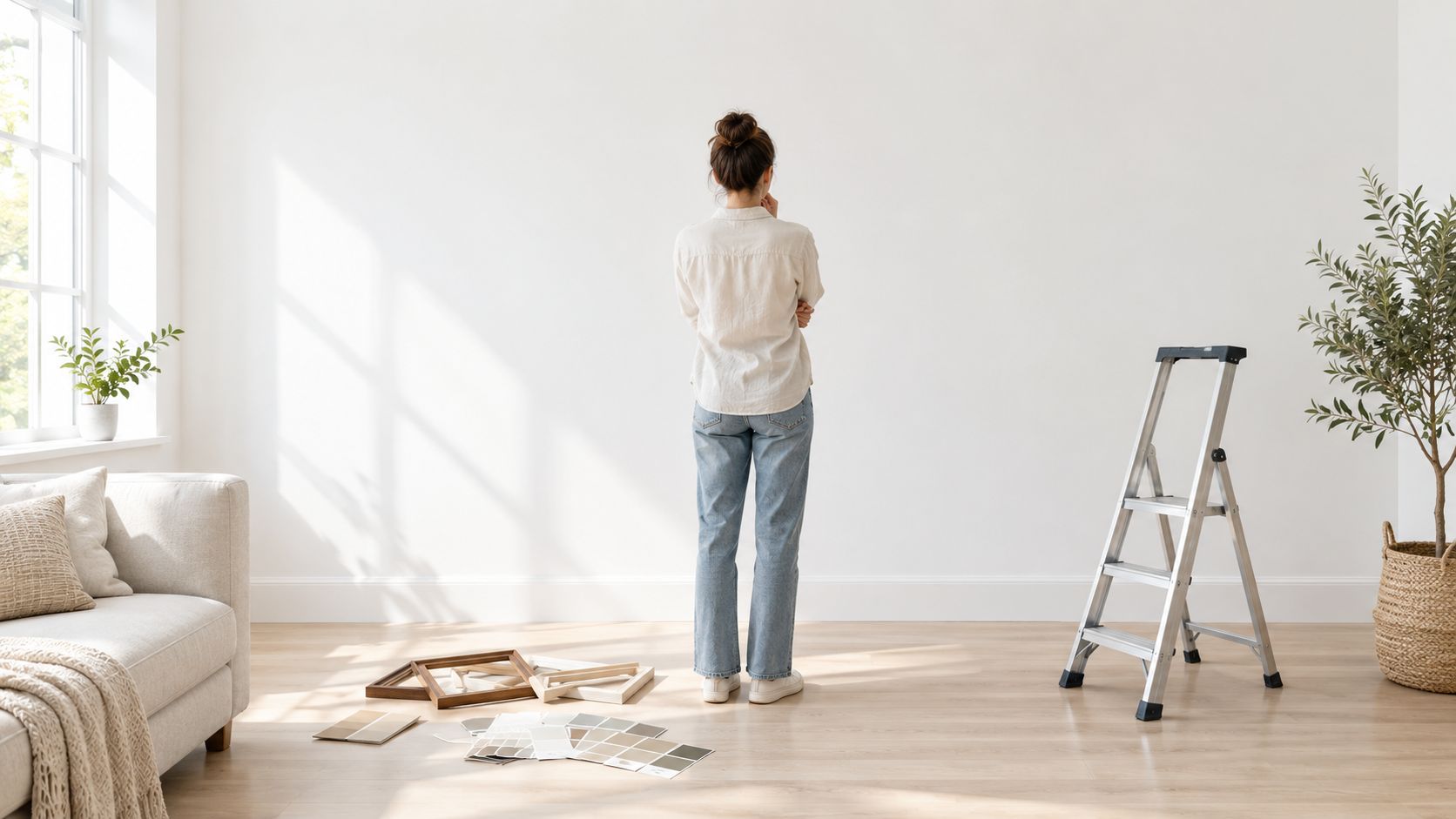
You're standing in front of a blank wall with paint cans at your feet, frame samples leaning against the baseboard, and no clear idea what would make the room feel finished. Scenic views seem predictable. Abstracts feel like a gamble. Family photos are personal, but perhaps not the mood you want here. Then you notice a bird print and realize it solves several problems at once.
Birds bring movement without disorder, color without overwhelming a room, and a natural subject that feels decorative rather than overly literal. A perched wren can make a bedroom feel gentle. A graphic crane can give a minimalist living room a clean focal point. A vivid parrot can energize a dining area without turning it into a theme room.
The right piece depends on subject, palette, scale, and finish, not on whether your home looks rustic. Birds wall art belongs in contemporary apartments, Scandinavian bedrooms, colorful kitchens, offices, restaurants, and traditional studies. You can browse related animal subjects in Jessie's Home's animals canvas wall art collection, but the key design decision starts with the room you already have.
A blank wall usually needs one of two things: a strong anchor or a quiet layer. Bird imagery can do either. That flexibility is why it works in rooms where a large floral, cityscape, or dramatic abstract might feel too forceful.
Birds also occupy a useful middle ground between realism and symbolism. You recognize the subject immediately, but the image doesn't dictate a story. A single heron can suggest stillness without making the room feel like a lakeside cabin. A flock in flight can add direction above a sofa while keeping the composition light. Even a stylized silhouette can provide structure without competing with furniture.
Color changes the emotional temperature of bird wall art more than the species does. Blue, green, and muted violet compositions tend to feel calmer and visually receding, which makes them sensible choices for bedrooms, offices, and reading corners. Red-orange birds and warmer compositions feel more active and visually present, so they suit dining rooms, kitchens, and social spaces. This color relationship is discussed in Rossetti Art's guide to how wall art shapes mood at home.
That doesn't mean you need to match a blue room with blue birds. It means you should decide whether the wall needs to settle the room or wake it up. A low-saturation print can soften a room with hard flooring and modern furniture. A jewel-toned macaw can keep a neutral space from becoming anonymous.
Practical rule: Choose the bird art for the feeling you want when you enter the room, not just for the species you happen to like.
Birds have a long visual history, but they don't belong to one decorating season. The current design conversation is moving bird motifs beyond spring displays and rustic wildlife decor toward modern, playful, biophilic accents, including monochrome compositions, jewel tones, stylized fauna, and earthy neutrals. Homes & Gardens' coverage of the bird motif trend points toward a broader design language in which birds work as year-round decorative elements.
That shift matters for buyers who want nature-inspired art without literal nest prints or lodge imagery. Pick the style and scale first, then let the bird become part of the room's architecture. The result can feel calm, graphic, collected, or exuberant, depending on how you handle those choices.
Birds have never been confined to one artistic purpose. They appeared in ancient decorative traditions, religious manuscripts, scientific studies, domestic textiles, and formal still lifes because they sit between nature, knowledge, and ornament.
Artists used birds to signal power, freedom, fertility, spiritual meaning, or simple visual pleasure. Medieval manuscript artists gave them symbolic roles and decorative energy. Later natural-history artists focused on anatomy, plumage, and classification. Dutch still-life painters treated birds as evidence of abundance and hunting culture, while Japanese printmakers flattened forms and used bold compositions that still influence graphic interiors.
The subject kept changing because birds offered endless visual variety. Long-legged herons create vertical rhythm. Small songbirds bring intimacy. Raptors suggest drama. Tropical species provide saturated color. A bird can be rendered as a precise study, a loose watercolor, a geometric silhouette, or a near-abstract sweep of paint without losing its identity.
European ornithological illustration developed through important early works, including Frederick II's c. 1245 treatise on hunting with birds and Pierre Belon's 1555 natural-history bird book, both noted in the University of Chicago Press history of bird imagery. Those traditions helped establish birds as enduring subjects for illustration and wall decoration across Europe and beyond.
The long arc reaches a striking modern scale in Jane Kim's mural at Cornell's Lab of Ornithology. Completed in 2015, the mural covers a 70-by-40-foot wall and 2,800 square feet, showing 243 modern bird families, five extinct modern bird families, 21 extinct evolutionary species, and one black caiman, according to Cornell University's account of the mural. Its importance isn't only its size. It shows how bird imagery can operate as education, public art, and interior decoration at the same time.
That inherited range explains why modern bird art feels established rather than manufactured. Today's style families aren't starting from scratch. They're selecting from a visual language people have trusted for centuries.
Start by deciding what you want the art to communicate about the room. Bird wall art can feel scholarly, relaxed, graphic, playful, exotic, or subtly luxurious. The species matters, but the treatment matters more.
Detailed bird studies bring study-room gravitas. They suit traditional homes, libraries, offices with wood furniture, and rooms that already use leather, brass, or deep paint colors. A carefully rendered owl or raptor feels purposeful, especially in a dark frame with a generous mat.
This style also works for buyers who want the subject to feel credible and timeless. It says you appreciate observation and detail, not just decoration. Avoid pairing an intensely realistic print with several competing patterns. Give it visual breathing room.
Watercolor birds feel softer and less formal. Their translucent washes suit bedrooms, nurseries, reading nooks, and coastal interiors where the goal is ease rather than drama. A loose heron in pale blue-gray can add height to a room without making the wall feel busy.
Painterly work also hides small palette differences well. It can connect a rug, throw, and wall color without matching any of them exactly. For a broader selection of expressive styles, Jessie's Home's illustrative canvas wall art collection is a useful place to compare how simplified forms and painterly treatments change the mood.
Black-and-white bird outlines read architectural and modern. They belong in Scandinavian, mid-century, contemporary, and compact urban spaces where a clean gesture works better than a richly detailed scene.
A single line-drawn crane can echo the angles of a slim console or pendant light. A row of small silhouettes can create rhythm along a hallway. Keep the frame thin and let the negative space do its job.
Birds combined with leaves, stems, diagrams, or vintage labeling create a library or herbal-manual atmosphere. They're especially effective in dining rooms, entryways, and traditional kitchens because the composition feels collected rather than themed.
If wallpaper is also part of your plan, use bird art as the quieter layer. A stylish room wallpaper guide from Tony Painting can help you think through feature-wall color, pattern scale, and how much visual competition the artwork can handle.
Folk-art birds bring warmth and personality. Their imperfect shapes and painted color blocks suit kitchens, playrooms, creative studios, and relaxed family spaces. They say the owner values charm over polish.
Tropical and exotic species do the opposite. Saturated parrots, toucans, and flamingos push a room toward coastal, maximalist, or hospitality styling. Use them when the room can support color. If the furniture is already loud, choose one strong bird composition rather than a wall full of unrelated prints.
A bird canvas can carry a living room, settle a bedroom, or make a narrow hallway feel intentional. Choose the subject and scale for the room you have, not for a seasonal theme. Bird art works year-round when its colors, proportions, and sense of movement match the furniture around it.
The living room deserves the boldest decision. Above a sofa, choose one large horizontal bird canvas showing flight, a broad scene with birds, or a repeated sequence of perched forms. One oversized work usually gives an open layout a clearer center than two medium pieces that leave an awkward gap or compete with nearby shelves.
For a calmer room, use cool hues and a bird with a long, elegant profile. For a social room, choose warmer plumage or a composition with more directional movement. A mirror can sit on an adjacent wall, but keep it away from a highly detailed bird image unless the reflection adds something intentional. For more living-room pairing ideas, browse this living room wall art collection.
Bedrooms benefit from restrained subjects. Wrens, owls, and single herons work because their forms are recognizable without creating visual noise. Hang the piece opposite the bed when possible, so the first view of the room feels anchored rather than accidental.
Muted blues, softened greens, and dusty neutrals are reliable choices. Pair the canvas with linen bedding, woven textures, or a wood nightstand. Skip highly saturated tropical arrangements if you want the room to feel restful.
Songbirds in ochre, rust, cream, or brown echo candlelight, wood furniture, and natural table linens. Place the image above a sideboard or on the wall opposite the table, where guests can see it without turning around.
Dining rooms also suit botanical or collected compositions, provided the artwork supports the table rather than competing with it. A medium or wide canvas gives the room presence without crowding plates, lighting, or serving furniture.
Entryways reward vertical compositions. A perched bird with a tall botanical stem guides the eye upward and makes a narrow wall feel deliberate. In a hallway, several small coordinated works can create a gallery effect without overwhelming the wall plane. Smaller works also suit compact areas such as bathrooms, where a group can feel more balanced than one undersized canvas.
Home offices need a focused subject. Choose one bird, one clear silhouette, and a palette that settles the space. Kitchens and bathrooms require more care. Use sealed surfaces, moisture-resistant backing, and suitable glazing or protective finishes where steam, splashes, or frequent cleaning are unavoidable.
| Room | Recommended Subject | Palette | Ideal Scale |
|---|---|---|---|
| Living room | Birds in flight or a broad heron composition | Balanced neutrals or controlled jewel tones | Large horizontal statement |
| Bedroom | Single wren, owl, or heron | Muted blue, green, violet, or soft neutral | Medium to large, depending on the wall |
| Dining room | Warm-toned songbirds | Ochre, rust, cream, and brown | Medium or wide canvas |
| Entryway | Perched single bird with vertical foliage | Light neutrals or a deliberate accent color | Tall vertical piece |
| Home office | Focused single subject | Low-saturation cool hues | Medium, with generous breathing room |
| Bathroom or kitchen | Small coordinated bird studies | Palette tied to tile and cabinetry | Small grouped works |
A bird print can look striking online and still fail on your wall. Check the wall, the furniture beneath it, and the available light before choosing a species or style. Format determines whether the artwork feels intentional or awkward.
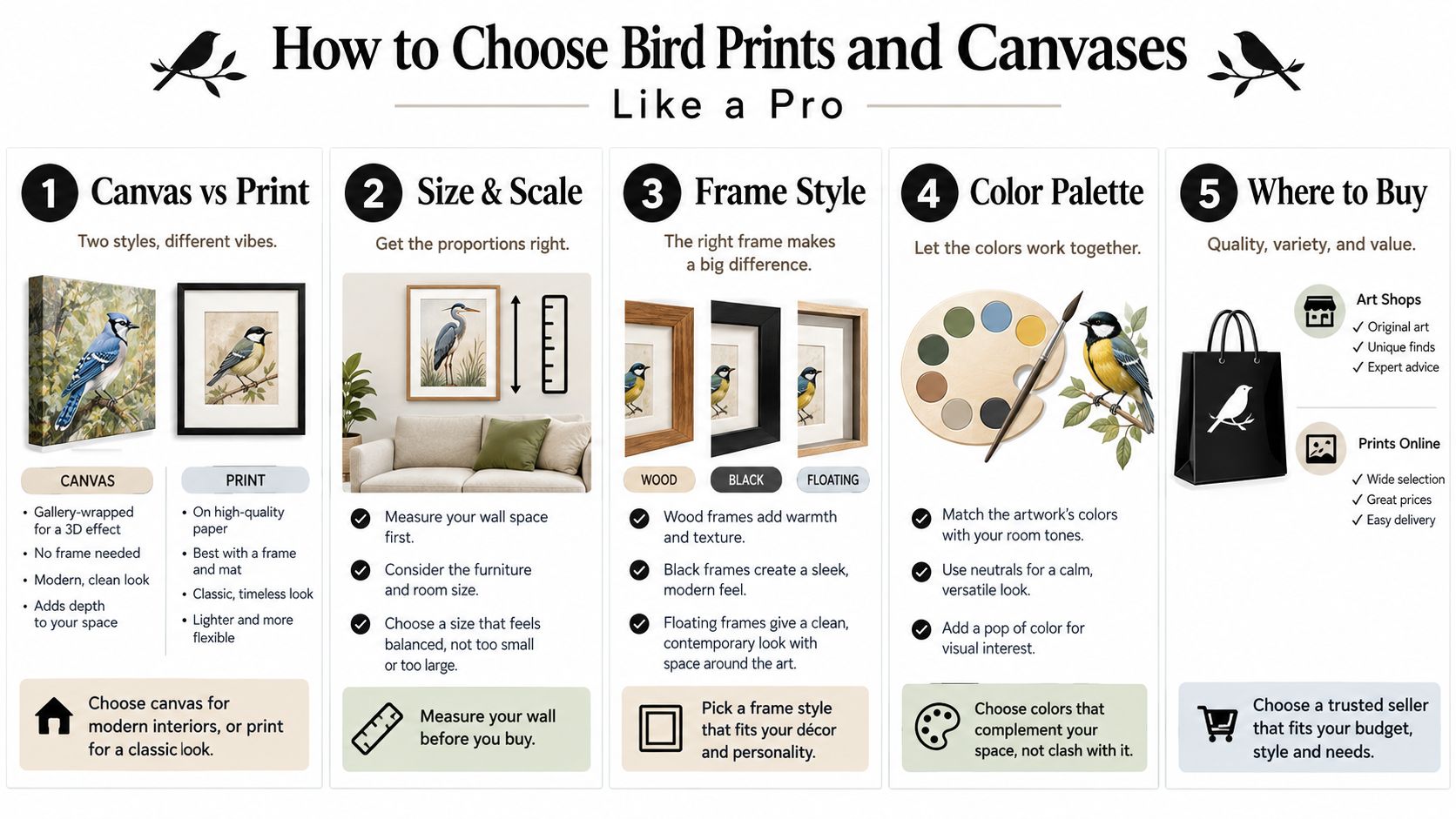
Stretched canvas brings depth to modern interiors, relaxed rooms, and spaces that need substantial art without glass glare. Its wrapped edge also looks finished from the side, which matters when the piece hangs where people pass close by.
Framed paper prints offer a more traditional presentation and coordinate easily with existing photography or a gallery wall. They suit studies, dining rooms, and collected interiors. Fine feather detail needs a sharp reproduction. Giclée printing on archival cotton or linen stock can preserve delicate tonal changes, while a basic inkjet print is a poor choice for a bright, sunlit wall.
Measure the wall and the furniture below it before browsing. Above a sofa, console, or bed, choose artwork that visually spans roughly two-thirds of the furniture width, unless the plan calls for a narrow vertical statement.
Room style should guide the bird and its scale. A broad heron or flying flock suits a large contemporary living room. A single wren or owl works better in a calm bedroom, while a detailed study can anchor a traditional dining room. These choices keep bird art relevant throughout the year instead of tying it to a spring or rustic theme.
An empty corner can handle a tall canvas or a floor-to-ceiling arrangement. A hallway usually needs a compact work or a controlled sequence. Large-format examples might include a statement piece in the 38 by 48 inch range or a tall format around 18.5 by 84.6 inches, depending on the wall and furniture. Such proportions appear in displays such as Hu2's display guidance, but treat them as illustrative formats, not fixed rules.
Check the wall hardware before buying a large piece. The hanging system must carry the actual weight. In a west-facing room, UV-protective glazing helps protect framed paper from direct light. Bathrooms need moisture-resistant backing, and kitchens need a finish that tolerates careful cleaning.
Quality check: Zoom into the listing image. Pixelation, thin stretcher bars, careless edge wrapping, and vague material descriptions are reasons to keep looking.
Jessie's Home offers artist-made canvas wall art and gallery-quality photo prints on premium cotton-blend canvas, with fade-resistant inks, solid wood frames, and a protective UV coating. Use those specifications as a comparison checklist rather than accepting any retailer's claims without checking the details.
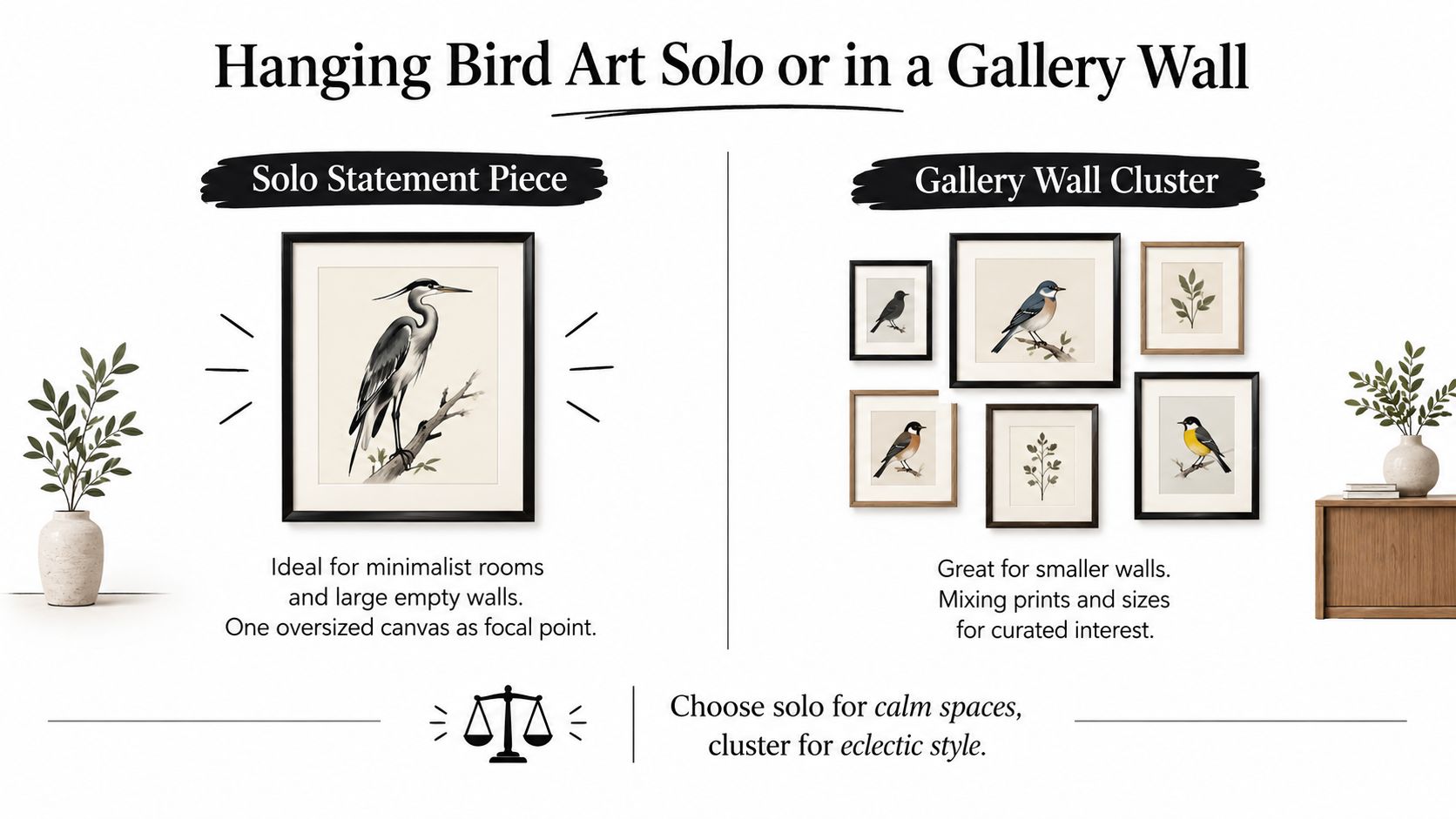
A solo statement piece and a gallery wall solve different problems. Don't choose between them based on which arrangement looks more impressive online. Choose based on how much visual information the room can comfortably hold.
One oversized canvas wins in a minimalist room, above a large sofa, over a bed, or on a broad empty wall that needs a clear center. The chosen bird has to carry the emotional weight of the room. A single crane in flight, a quiet owl portrait, or a tall heron can do that when the composition has enough negative space.
Solo art is also the safer choice when the room already has strong furniture lines, patterned rugs, textured wallpaper, or sculptural lighting. One confident image gives the room direction without adding another collection of small decisions.
A gallery wall works when you want to tell a story through mixed species, sketches, vintage studies, and varied proportions. It suits eclectic rooms, compact walls, stair landings, and spaces where the art should feel collected over time.
Use one dominant anchor and flank it with smaller supporting works. Keep the mat colors consistent even if the images come from different artists. Leave roughly five to eight centimeters between frames, align the bottoms where possible, and let the overall outline remain slightly organic rather than forcing every bird into a rigid grid.
A ready-made trio can help if you want coordinated repetition without sourcing every frame separately. For example, Indian River Furniture's feathered trio set of canvas paintings shows how repeated bird-related imagery can create a unified arrangement.
This video offers another visual reference for deciding between a single focal piece and a grouped display.
Avoid hanging the group too high, mixing unrelated frame finishes without a reason, or scattering small pieces evenly across a large wall. Birds already have organic movement, so a little asymmetry usually looks more natural. Pick solo for calm confidence, and clusters for narrative depth.
Bird wall art isn't a spring fling. A pale watercolor may feel seasonal, but a charcoal raven, a mid-century heron, or a graphic parakeet can work throughout the year. The calendar doesn't decide whether the piece belongs. The room's palette, lighting, and furniture do.
It also isn't limited to farmhouse or cottagecore interiors. Graphic silhouettes fit contemporary spaces. Monochrome bird canvases suit moody studies. Bright folk-art birds can enliven a kitchen or playroom without turning the room into a country catalog.
Nor does bird art need to be realistic. A simplified line, block-color shape, or expressive brushstroke can communicate more design confidence than a technically precise image. Birds have appeared in decorative arts across cultures and periods, so the subject carries depth rather than trend fatigue.
Ignore seasonal merchandising and choose the work that fits your wall color, furniture lines, and light. If a bird piece looks right in July and October, it deserves the wall.
Choose the subject and scale first. Then match the style to the room's mood. Realistic studies suit traditional rooms and library walls. Graphic birds belong in modern spaces. Botanical pairings work well in entryways and dining rooms, while soft painterly birds settle bedrooms and reading corners.
Anchor a large canvas at eye level and give smaller prints breathing room. A narrow wall usually benefits from one oversized vertical piece rather than a crowded cluster. Skip seasonal choices, cheap prints that warp, and frames that fight the room's trim or hardware.
Hold one candidate against the wall before you commit. Leave it there for a day, watch it in morning and evening light, and notice whether the bird still feels right when you're not actively admiring it. If it does, reach for the hammer.
Jessie's Home offers artist-made canvas wall art and gallery-quality prints, including nature-inspired and botanical pieces that can bring bird imagery into living rooms, bedrooms, offices, and hospitality spaces. Browse the Jessie's Home collection to find a ready-to-hang work that fits your room's palette, style, and scale.

Discover how black and white minimalist art transforms any room with calm, contrast, and timeless style, plus tips on prints, framing, and placement.
Discover how black and white minimalist art transforms any room with calm, contrast, and timeless style, plus tips on prints, framing, and placement.

Discover watercolor abstract art techniques, learn how prints differ from originals, and get styling tips for your home. A complete guide for wall art lovers.
Discover watercolor abstract art techniques, learn how prints differ from originals, and get styling tips for your home. A complete guide for wall art lovers.

Explore the beauty of modern landscape art and how to choose prints that transform your home. From trends to room-by-room styling tips, this guide covers it
Explore the beauty of modern landscape art and how to choose prints that transform your home. From trends to room-by-room styling tips, this guide covers it


