Your wishlist is empty.
Secure Payment
30 days return


You're standing in the living room with a cat canvas in one hand and a blank wall in front of you. The cat is curled into a comma on the sofa, completely uninterested in your decorating crisis, while you're wondering whether the artwork will make the room feel personal or look like a novelty shop.
The right piece can do both jobs beautifully. It can give the room warmth, echo the personality of the animal who lives there, and still sit comfortably beside scenery, abstract work, books, and textiles. The trick is to choose art with cat as part of a complete room plan, not as an isolated theme.
This guide takes that practical view. It covers the visual history behind feline imagery, the styles worth considering, room-by-room placement, cat-friendly hanging decisions, and ways to make the artwork readable to your cat without sacrificing your own taste. If you're mainly here for cat wall art itself, our cat canvas wall art gathers the feline pieces in one place, and the sections below will help you pick the one that fits your wall.
Cats have an unusual advantage as decorative subjects. They can look formal in a dark, sculptural portrait, playful in a bright graphic print, calm in a watercolor, or observant in a domestic scene. A single animal can support several moods without forcing the room into one fixed style.
That flexibility gives feline artwork more staying power than a seasonal novelty. A black cat silhouette can work with warm wood and vintage furniture, while a softly painted tabby can settle into a bedroom filled with linen and muted color. The subject carries recognition, but the treatment determines whether the room feels polished, whimsical, moody, or serene.
Design rule: Let the cat provide personality, but let the medium, scale, and palette determine the room's level of sophistication.
Consider the wall opposite your sofa. A small, overly cute print may disappear there, while a large canvas with generous negative space can anchor the entire seating area. In a hallway, a narrow portrait creates a moment of surprise. In a home office, a contemplative cat beside a window can add softness without competing with the desk.
The practical question matters just as much. A beautiful canvas placed beside a shelf used as a launchpad may become a target for claws, fur, or a determined midnight climb. A frame mounted loosely above a favorite perch isn't a style decision, it's a safety problem.
That's why good cat-inclusive decorating asks two questions at once: Does this artwork suit the room, and can it live safely with the cat? Once those questions become part of the selection process, feline wall art stops being an afterthought. It becomes a considered design choice with emotional warmth, visual range, and a clear place in the home.
A cat can shift from household helper to sacred figure, then back to a companion curled on a cushion. That movement explains why art with cat remains flexible across rooms and centuries.
The Smithsonian Institution documents feline representations in Egyptian art from the Naqada III Period, approximately 3300–3100 BCE, and describes a 2,600-year tradition of depicting cats in religious, royal, and everyday settings.
The earliest widely cited domestic-cat image in Egyptian art dates to about 1950 BCE. It appears in a painted limestone tomb scene, where a cat confronts a field rat. The image links feline beauty with practical value, since cats helped protect food stores. Later artists connected cats especially with Bastet, a goddess associated with protection, fertility, and childbirth.

Egyptian feline imagery appeared in sculpture, painting, jewelry, and votive objects. During the Late Period, approximately 664–332 BCE, cat mummification expanded substantially. Some mummies contained real cat bones, while others were intentionally empty, showing that these objects served religious purposes beyond preserving an individual animal.
The same Smithsonian account records extensive production of cat mummies during this period. The figures show the scale of the practice: excavations at Saqqara's Bubasteum found 200 cat mummies in one tomb and another 184 in a later excavation.
Modern Western art shifted the subject toward intimacy, observation, and domestic life. The National Endowment for the Arts identifies cat works by Édouard Manet, Auguste Renoir, Paul Gauguin, and Henri de Toulouse-Lautrec across drawing, painting, printmaking, photography, and decorative arts.
Manet's A Cat Curled Up, Sleeping, from about 1861, focuses on quiet observation. Renoir's Woman with a Cat, from approximately 1875, places the animal within portraiture and social identity. An anonymous needlepoint rug with cats and toys, from around 1880, and Winter: Cat on a Cushion, a six-color lithograph from 1909, show feline imagery moving from museum collections into household decoration and reproducible prints.
Today's canvas continues that lineage. Choose a piece for its visual relationship to the room, then check whether its placement can withstand a real cat's climbing, rubbing, and resting habits. A cat portrait has earned a place on serious walls, but the right wall must work for the animal as well as the artwork.
A bright room with a quiet cat calls for a different artwork than a dark study with a climber racing across the furniture. Choose the visual treatment first, then check whether its colors, scale, and surface can live comfortably with your cat's habits.
Watercolor portraits suit bedrooms, reading corners, and light-filled interiors. Soft edges, diluted color, and visible paper texture give the subject a gentle, observant presence. Choose one when the room already includes linen, pale wood, or quiet botanical accents. Keep the frame away from a launch point so the delicate paper and glass stay protected.
Painterly oils add weight and presence. Visible brushwork can make a black cat dramatic against a deep background or give a long-haired animal a classical quality. Oils pair well with traditional furniture, collected interiors, and rooms that support darker tones. A substantial frame also handles the visual weight better than a thin, casual mount. Lounge Wall Art with a Black Cat and Martini shows the idea well: a black cat curled asleep in a deep green velvet armchair, a martini glass beside it, all in loose, visible brushwork with a warm, lamplit glow.
Minimalist line drawings are the cleanest choice for modern homes. One continuous contour, a few whisker marks, or a black-ink profile works with white walls, light oak, and restrained furniture. Scale decides whether the result feels deliberate. A tiny drawing on a broad wall looks accidental, while a larger piece gives the simplicity enough authority.
Pop Art cats are direct, energetic, and color-forward. Saturated blocks, repeated faces, and unexpected backgrounds suit creative offices, playrooms, kitchens, and eclectic living rooms. Keep nearby accessories quieter, and avoid placing the work beside a busy cat shelf or scratching station. The art needs visual space, and the cat needs a clear route. Funny Cat Wall Art Overflowing a Tiny Box is a good example of the playful end: a fluffy ginger cat spilling out of a cardboard box far too small for it, set against teal and lilac.
Side by side, those two pieces show how much the treatment changes the same subject. One is a moody lounge corner, the other a joke you'll smile at every morning.
Black-and-white photography creates an editorial mood. A close-up paw, alert profile, or sleeping cat feels refined when printed large and framed with restraint. This style pairs with monochrome furniture, metal accents, and textured upholstery. Use a protective finish if the piece will hang near a rubbing route.
Vintage-inspired illustrations add charm without requiring a fully traditional room. Aged paper tones, botanical borders, and natural-history influences work with antiques, cottage details, and collected gallery walls. Contemporary abstracts use ears, a spine, or a gaze as compositional cues while the rest dissolves into color and geometry. Choose abstraction when the room should feel art-led rather than pet-led.
Shopping by category (animal, wildlife, abstract) makes it easier to choose by atmosphere instead of sorting through unrelated images. Choose realism for recognition, graphic work for energy, and abstraction for a quieter feline reference that still survives a cat-inclusive room.
Placement decides whether a cat canvas feels integrated or stranded. Use the room's furniture and movement patterns as your starting point, then account for the animal's routes through the space.
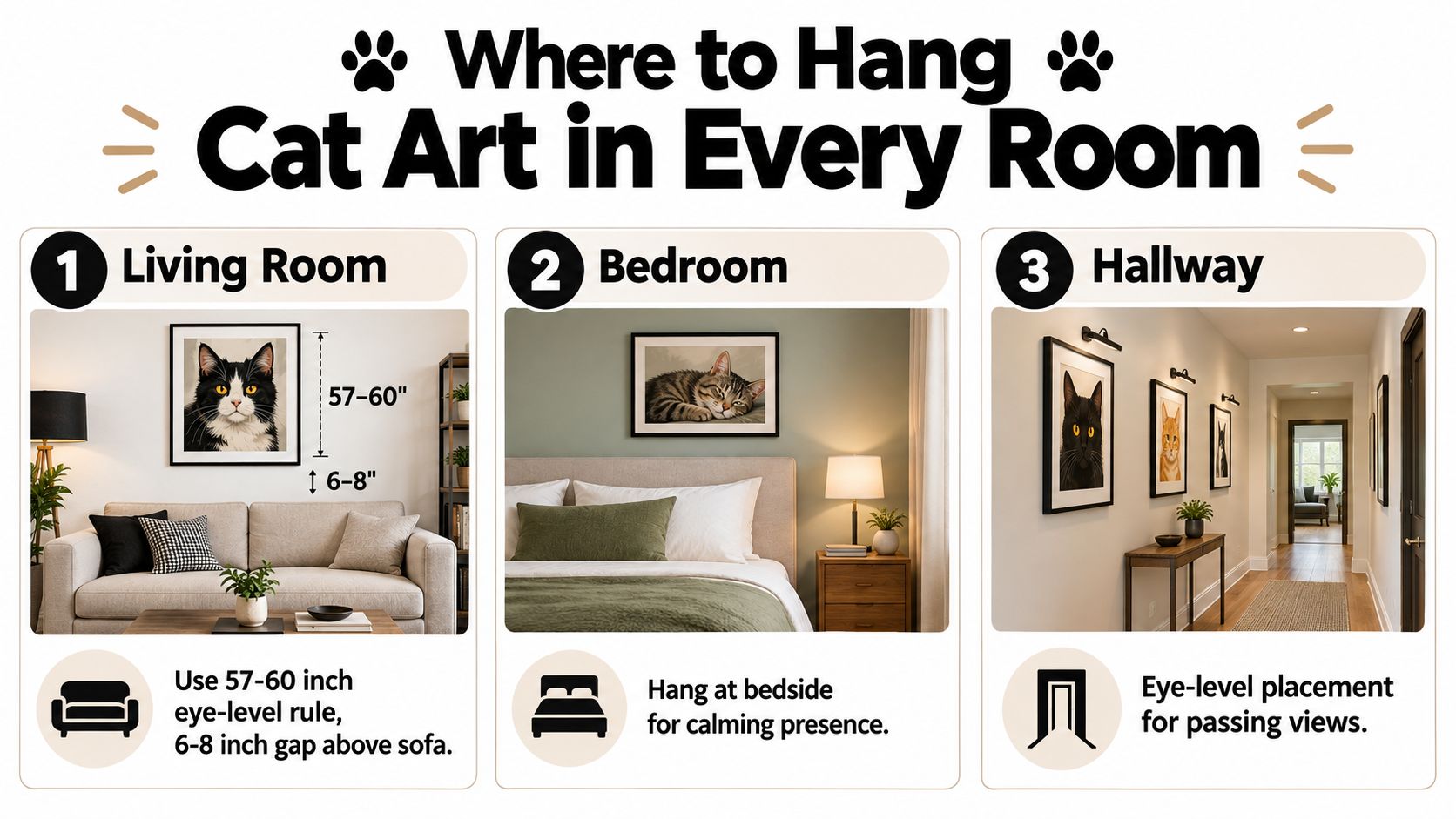
For a main seating wall, place the center of the artwork around 57–60 inches from the floor. Above a sofa, keep the lower edge approximately 6–8 inches above the back, so the piece relates to the furniture instead of floating above it. Our guide on how high to hang wall art above a sofa walks through the measurements step by step.
A large feline portrait should face into the room, not toward a narrow passage where people and cats constantly brush past it. Avoid mounting directly beside a cat highway, climbing shelf, or tall scratching post. A canvas doesn't need to be unreachable, but it shouldn't become part of the route.
Center a calming piece above the headboard, with the lower anchor slightly closer to the furniture than you'd use in a living room. Watercolors, muted portraits, and cats shown resting work better here than high-contrast Pop Art.
Keep cords, loose frame parts, and nearby launch surfaces out of reach. If your cat jumps onto the headboard, choose a securely mounted piece with no projecting corners. For sizing over different bed widths, see our guide to wall art above the bed.
Classic Black and White Cat fits that brief nicely. A black and white cat lies stretched out on a porch swing among floral cushions, with soft green leaves behind, and the long landscape format sits naturally above a headboard. It's a resting cat, painted gently, which is exactly the mood a bedroom wants.

Use smaller artwork inside existing cabinetry sightlines, or build a compact gallery arrangement near the dining table. Graphic cats, vintage illustrations, and food-adjacent still-life compositions can make the area feel intentional without crowding it.
Avoid placing canvas beside the stove, sink splash zone, or a shelf where the cat already climbs. Steam, grease, and repeated contact shorten the life of decorative finishes.
Hang art away from direct steam and splashing. A small framed print can work on a dry wall outside the shower's immediate path, but canvas needs sensible ventilation and a surface that won't stay damp.
Keep bathroom doors and litter areas in mind. Artwork shouldn't block access to a quiet retreat or encourage the cat to jump onto unstable storage. Our guide to artwork for bathroom walls covers humidity and placement in more detail.
Humor works especially well here. Cat Bathroom Wall Art with a Grumpy Tabby shows a tabby perched on the rim of a pink tub beside a dripping tap, looking thoroughly unimpressed, against loose blocks of teal, yellow, and coral. Our bathroom wall art has more pieces in the same spirit.

A cat portrait behind the desk gives video calls and the room itself a personal focal point. Place it at relaxed seated eye level, then check that the monitor, lamp, and chair don't obscure the composition.
Don't use the wall above a cat tree as your backdrop. The tree may shift, shed against the artwork, or tempt the cat to reach toward the frame.
Use standing eye height for the first impression. A vertical portrait at the end of a hallway can create a strong destination, while a series of smaller pieces works along a wider passage.
Keep corners rounded or protected where people and pets turn quickly. Measure the wall before choosing the format. A narrow hall usually suits a portrait canvas around 16×24 or 20×30 inches, and our hallway wall art shows how vertical pieces carry a passage.
A cat crossing the room reads your artwork through contrast, shape, and broad color areas before it registers fine detail. Comparative psychophysics research found that cats were more contrast-sensitive than humans at low spatial frequencies below approximately 0.5 cycles per degree, while humans performed better at higher spatial frequencies. Cats also showed about 0.74 log units greater absolute sensitivity than humans at spatial frequencies of 0.125 cycles per degree or lower.
Choose art with a clear visual structure. A dark silhouette against a light ground gives a cat more to notice than a photorealistic portrait built from tiny tonal shifts. Broad whisker arcs, separated color fields, and strong luminance contrast work better than gray-on-gray detail.
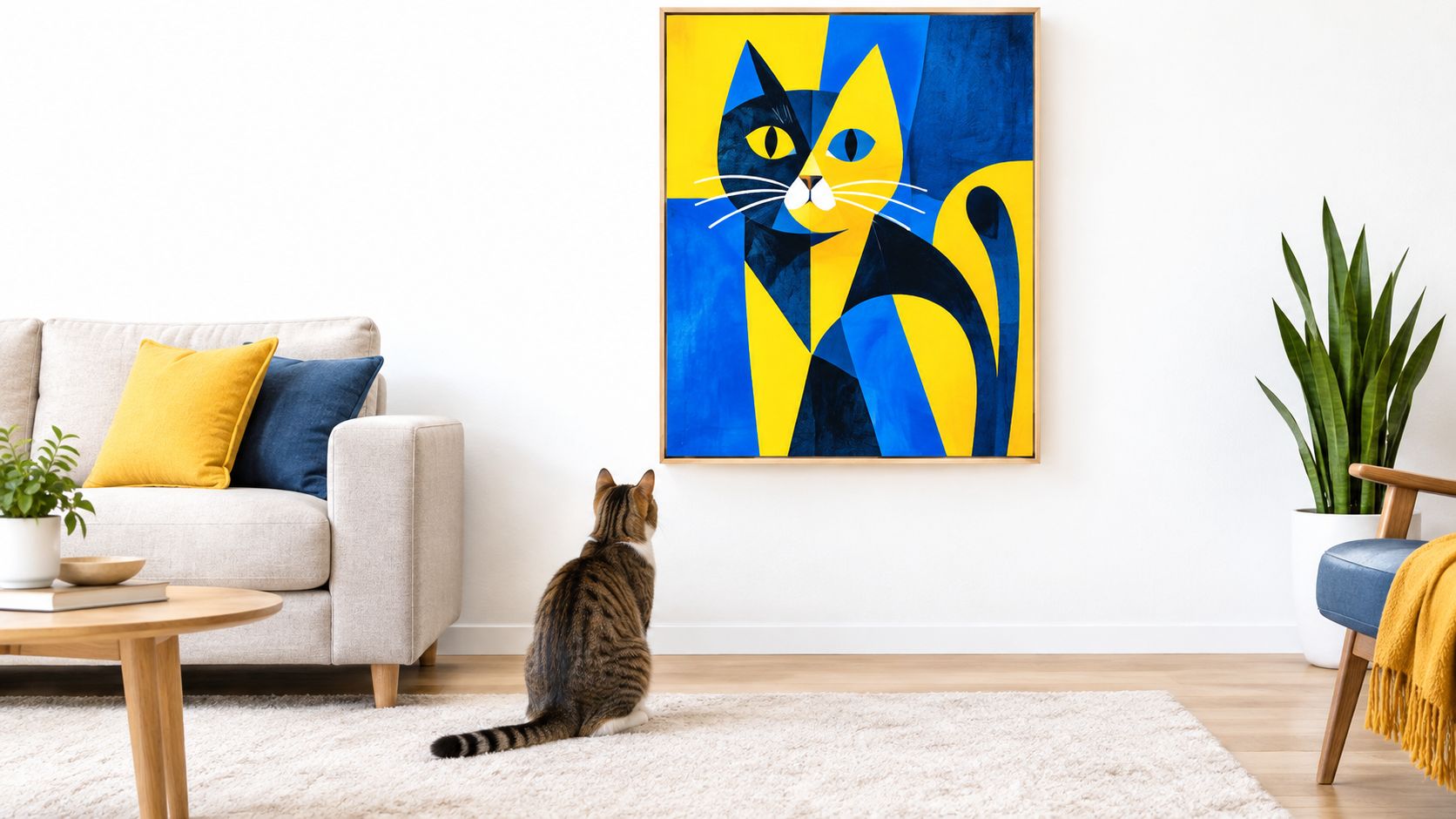
Black Cat and Snake Plant Under a Mustard Sun is a textbook case. A black cat sits upright beside a potted snake plant, under a flat mustard sun, on a plain cream ground. Your cat gets one strong dark shape to notice, and you get a calm mid-century piece that sits happily next to warm wood.

The same comparative study reports feline cone sensitivity peaks near approximately 454 nm and 561 nm in bright conditions, with low-light sensitivity centered near 497 nm. Your room does not need to become a blue-green showroom. Blue-green accents and clear light-dark separation give cats stronger visual cues than subtle red-green distinctions.
Let human taste lead the palette. Keep the colors restrained, then give the composition one readable feature, such as a dark ear shape, bright eye area, or saturated blue-green background. Fine texture can reward your viewing distance, while larger forms remain easier for your cat to distinguish.
Lighting changes the artwork after sunset. Layer ambient, task, and accent light the way lighting designers do. Aim the light across the piece rather than straight at it, and avoid glare on glass or reflections that flatten the image.
Context shapes emotional interpretation too. The setting around a painted cat changes how we read it. A sunlit reading nook suggests ease, while an urban background suggests alertness. Tabby Cat Painting with Two Potted Cacti leans all the way into ease: a striped tabby curled up asleep on a zigzag rug in coral, teal, and purple, with two potted cacti keeping watch. For an office, review home office wall art and choose a setting that suits the room's mood.

Cat art works best when it has a defined job in the room. Decide whether the piece will anchor the space, join a gallery conversation, or repeat a smaller accent already present elsewhere.
Give a large statement cat room to breathe. Hang it on a relatively quiet wall, then repeat one or two colors in a cushion, throw, frame, or vase. Avoid matching every accessory to the cat's eyes or coat. That approach makes the room feel staged instead of considered.
A gallery wall should broaden the story around the feline subject. Pair a cat portrait with a botanical study, architectural photograph, nature scene, or abstract shape. Vary the image types, then connect them through frame finish, spacing, or palette. Our gallery wall ideas for living rooms show layouts that work well around one lead piece.
Odd-numbered groupings usually feel more relaxed than rigid symmetry. Vary the scale deliberately: let the main feline canvas lead, then place smaller works at roughly two-thirds of its visual weight. Keep negative space around the group so the wall does not become a dense block of competing images.
| Room Focus | Cat Art Role | Best Mix-With Subjects | Palette Tip |
|---|---|---|---|
| Living room | Statement anchor | Abstracts, scenic vistas, textured textiles | Hang 57–60 inches to center, then echo one canvas color in ceramics |
| Bedroom | Quiet supporting piece | Botanicals, soft photography, line drawings | Keep contrast gentle and backgrounds calm |
| Office | Personality marker | Maps, architecture, graphic prints | Use one accent color against a neutral base |
| Entryway | Visual greeting | Small mirrors, botanical studies, vintage prints | Match frame tones rather than every image |
The easiest fix for “too many cats” is reducing the supporting decor, not removing the piece you love. Use plain walls, natural materials, and one or two non-feline subjects to create contrast.
A small cat piece can repeat the idea without taking over. In a kitchen, a 12×18 canvas like Chubby Kitten Stuck in a Yellow Mug, a wide-eyed tabby kitten wedged into a yellow coffee mug on pink and blue, reads as a wink rather than a theme. Place a minimalist cat beside a botanical print and a small nature scene, then connect them with black frames. The cat stays recognizable, while the room reads as an art collection rather than a pet display.

Choose a collection that spans abstract, scenic, botanical, and wildlife work when you want flexibility. Our modern canvas wall art offers a useful starting point for building that mix without forcing every selection into a separate visual universe.
The safest placement is not necessarily the highest wall. It's the wall that sits outside the cat's established routes, away from shelves, window perches, and furniture that can become a launchpad.
Mount a canvas with hardware suited to the wall, and use anchors where necessary. Check the frame after installation by applying gentle downward and sideways pressure. If it shifts, the cat will eventually find the weakness.
Practical rule: Never hang valuable artwork on the assumption that your cat “probably won't jump there.”
Keep artwork separated from cat highways and shelving. The exact distance depends on the room, but the principle is firm: don't create a bridge from a perch to the frame. Avoid deep ledges under the artwork, projecting hooks, and furniture that can be dragged into position.
Look for sealed backs, smooth frame edges, and protective surface treatments. Every Jessie's Home piece arrives ready to hang, but secure installation remains your responsibility, especially on a wall a cat can reach.
Dust the surface with a clean, soft brush or microfiber cloth held lightly against the canvas. Don't scrub a textured surface, spray cleaner directly onto it, or pull at loose fur with adhesive tape. Inspect corners and hanging points during regular room cleaning, especially if your cat has already shown interest in the wall.
If an accident involves litter or urine near the artwork, handle the surrounding textile and odor source separately rather than applying household chemicals to the canvas. Treat the rug or soft furnishing with an enzyme cleaner made for pet urine, and keep those products well away from the art.
Rotate pieces only when the replacement wall is equally secure. A cat-friendly room should offer climbing, scratching, and retreat zones that don't depend on decorative walls. Give the cat a better route, and the artwork is less likely to become part of the furniture.
If you make art as well as hang it, a cat adds a few rules to the studio. Cats investigate every surface, then groom whatever ends up on their paws and fur, so anything wet or toxic within reach is a real risk rather than a mess.
If your cat does get paint on its fur, don't use solvents to clean it. Call your vet for advice before you try anything at home.
Hanging the piece too high makes the artwork feel disconnected from the sofa or bed. Lower it until the center relates to seated or standing eye level, then preserve the furniture gap instead of trusting a random nail position.
Choosing the wrong scale leaves a large wall looking unfinished or makes a narrow wall feel crowded. Measure the furniture below it first. A substantial sofa usually needs a substantial anchor, while a small hallway calls for a vertical format or a restrained grouping.
Treating cat art as a novelty limits your choices. A whimsical Halloween cat can be perfect in a seasonal entryway, but a painterly portrait, abstract feline, or black-and-white photograph can carry the subject into a more permanent interior. Choose the emotional tone first, then decide how literal the cat should be.
Funny Bathroom Prints Cat Claims the Sink shows how a playful piece can still earn a permanent spot. A black cat sits settled in a pedestal sink while two little ghosts drift past on purple. It's at home in a powder room all year, and it feels especially right in October.

Some buyers place statement artwork in a low-traffic room because they worry it will dominate the main space. That wastes the opportunity. Put the strongest piece where you spend time, then balance it with negative space and non-feline companions.
Skipping secure mounting is the most avoidable mistake. Cats climb unpredictably, furniture moves, and a frame that seems stable today may shift after repeated contact. Use appropriate hardware, inspect it periodically, and keep launch surfaces away from the wall.
Start with one piece you want to see every day. You don't need a perfectly coordinated cat gallery. You need a well-scaled artwork, a sensible wall, and enough restraint around it for the room and the cat to remain comfortable.
Measure the furniture first. Above a sofa or bed, aim for art about two-thirds of its width, so a 72-inch sofa takes a landscape canvas around 48×32 inches and a queen bed suits roughly 42×28. A cat portrait on its own wall, with no furniture below, usually needs at least 24×36 to hold the space. Narrow walls and hallways call for portrait formats such as 16×24 or 20×30.
Most canvas wall art is cotton or poly-cotton canvas stretched over wooden bars. The image is either painted directly, usually in acrylic or oil, or printed with inks made to resist fading, and the surface is often finished with a protective coating. Frames, when there are any, are typically wood. For a home with a cat, the build matters less than the mounting, so prioritize solid hardware.
In a home with a cat, fur is the main issue. Every couple of weeks, lift it off with a dry, soft paintbrush or a microfiber cloth, working gently from the top down, and wipe the top edge of the frame, where fur and dust collect. Skip lint rollers and sprays on the canvas face, and vacuum the wall and floor below so loose fur doesn't drift back up.
Jessie's Home offers artist-made canvas wall art from more than 500 artists in 7 countries, across feline, abstract, scenic, botanical, wildlife, and other styles. Every piece comes in sizes from 12×18 to 40×60 inches, with no frame or a black, white, or natural wood frame, and arrives ready to hang. Visit Jessie's Home to choose a cat-inspired work that suits your room, then pair it with secure placement and the non-feline pieces that make the space feel like home.

11 Texas decor ideas built around wall art: Hill Country bluebonnets, longhorns, desert, coast and city skylines, plus colors and sizes by room.
11 Texas decor ideas built around wall art: Hill Country bluebonnets, longhorns, desert, coast and city skylines, plus colors and sizes by room.

Nashville gifts in wall art, matched to the person, plus Tennessee decor ideas by room, from Nashville skylines to Smoky Mountain ridges.
Nashville gifts in wall art, matched to the person, plus Tennessee decor ideas by room, from Nashville skylines to Smoky Mountain ridges.

Soft pastel, lavender and gold or retro: how to choose solar system art, how big the planets really are, which canvas size fits above a sofa, bed or crib, and...
Soft pastel, lavender and gold or retro: how to choose solar system art, how big the planets really are, which canvas size fits above a sofa, bed or crib, and...


