Your wishlist is empty.
Secure Payment
30 days return

You're halfway through a gift search, it's late, and the cart contains yet another art-themed mug. Then you remember the recipient's home: carefully chosen prints, a sculptural lamp, a sofa that somehow makes the entire room look edited. A novelty object won't feel thoughtful there. It'll feel like you ran out of ideas.
The best unique gifts for art lovers aren't necessarily rare, expensive, or eccentric. They're specific. They suit the recipient's taste, work with a real wall, and carry the right amount of meaning for a housewarming, wedding, relocation, or milestone. That means thinking like a decorator before you shop, then checking the format, materials, presentation, and delivery details with the same care you'd give the artwork itself.
If you're starting with a flexible gift card, you can treat someone to Astro West and let a highly selective recipient choose the piece. If you'd rather choose the art yourself, use the guide below to narrow the field without turning the purchase into a design thesis.
The mug usually appears after you search “gifts for art lovers” and discover that most lists are built around the word art, not around the person who has to live with the gift. There are art socks, art puzzles, art scarves, art books, and objects printed with famous paintings. Some are charming. None solve the central problem: your recipient already has a point of view.
A friend with a gallery wall doesn't need another object that announces its theme. They need something that can join the room without shouting. A sibling moving into a new apartment may want a piece that gives the space identity. A couple celebrating a wedding might appreciate art connected to a place, season, or shared memory, but they still need to like looking at it every day.
That's why I treat art gifts as interior-design decisions, not novelty purchases. Before opening a shopping tab, ask three questions:
The distinction matters because art has a long afterlife. A consumable gift disappears. A wall piece remains part of the recipient's daily environment, which makes a good match feel unusually personal and a poor match impossible to ignore.
My rule: If you can't name the room, palette, and emotional reason behind the gift, you're not ready to buy the art.
For a straightforward starting point, compare the proportions and color stories in canvas wall art collections rather than browsing endless novelty merchandise. You'll quickly see whether your idea belongs above a sofa, beside a reading chair, or nowhere near the recipient's home.
Unique doesn't mean strange. It means the gift could only have been chosen for that person. A mass-produced object can feel personal if it reflects a known preference, while a supposedly one-of-a-kind piece can feel careless if it clashes with the recipient's home and taste.
Three tests help separate thoughtful specificity from decorative guesswork.
Start with the visual language the recipient already collects. Do they favor restrained geometry, expressive brushwork, old-world botanical studies, cinematic photography, or bright pop color? You don't need to identify an exact art movement. You need to notice patterns.
A friend with a sunlit reading nook, pale wood, and dried grasses might love a signed-style botanical print with generous negative space. Someone who has just moved into a loft with dark furniture and concrete surfaces may be better suited to a moody abstract canvas than a delicate piece of scenery. The gift feels unique because it echoes an existing sensibility instead of introducing a random theme.
The global market offers useful context here. The 2026 Art Basel and UBS Global Art Market Report coverage estimated worldwide art sales at USD 59.6 billion in 2025, up 4% year on year after two declining years. Its collecting survey drew on 3,100 high-net-worth respondents across 10 countries and regions, showing that art appreciation and collecting operate within a broad international market, not a narrow niche. The practical takeaway for gift buyers is simple: art-minded recipients often notice curation, finish, and provenance. They're less impressed by something merely labeled “art-inspired.”
A gift has to respect the room's existing decisions. Consider wall width, nearby furniture, visual density, and lighting before you fall for an image online. A vivid work may look excellent on a white product page and overwhelming above a patterned sofa.
A wedding, relocation, or first-home gift calls for more staying power than a casual token. Location-based art can connect to a beloved city. A scenic piece can mark a place the recipient returns to. An abstract work can commemorate a new chapter without forcing a literal story.
You can browse unique decor for your home to study how distinctive objects work alongside furniture, lighting, and texture. Don't copy a showroom. Use it to understand the difference between a memorable accent and visual clutter.
Don't begin by searching for “beautiful art.” Begin by inspecting the recipient's home, even if you have to do it through photographs.
Look at what they've already chosen. A minimal-modern home often has clean lines, limited color, and breathing room around each object. A maximal-eclectic space can handle layered patterns, unusual subjects, and stronger contrast. Classic-traditional rooms tend to reward symmetry and refined framing, while nature-organic rooms pair naturally with botanical, coastal, and outdoor imagery. A photography-forward loft may call for black-and-white architecture, portraits, or city scenes.
Notice what's missing, too. If every wall is full, a tabletop piece or a smaller work may be more considerate than another large composition. If the walls are bare because the recipient hasn't found the right art, a finished canvas can remove the framing problem entirely.
You don't need a professional floor plan. Ask for a quick photo with a tape measure beside the wall, or measure discreetly when you visit. The area above a sofa or bed usually needs enough visual presence to relate to the furniture below it. A tiny print in a wide empty space tends to look accidental, even when the artwork itself is excellent.
Also check the light. Warm bulbs can deepen earth tones and soften cool grays. Strong daylight can make saturated colors feel more intense. Direct sunlight is especially important because conservation guidance recommends keeping framed works away from it and using UV-filtering glazing to reduce deterioration, as outlined in conservation framing standards.
A few combinations are reliably useful:
A curated collection such as canvas wall art for modern homes can make this process easier when the recipient's taste already leans contemporary. The important part isn't choosing from a fashionable category. It's making the art look as though it belongs in the recipient's life, not as though it arrived from a generic gift guide.
The safest format depends on how well you know the recipient's taste and how much work you expect them to do after opening the gift. Personalized art offers the greatest emotional specificity, but it also gives you the most ways to get things wrong. A custom pet portrait, travel image, or personal reference can be wonderful when the subject is unmistakably meaningful. It can feel awkward when the artist's interpretation misses the person's preferred style.
Ready-to-hang canvas occupies the comfortable middle. The artwork arrives prepared for display, so the recipient doesn't need to choose a frame immediately. That makes it particularly practical for housewarmings, relocations, and newly furnished rooms. Canvas also tends to feel substantial without requiring the visual formality of a traditional frame.
Gallery-quality paper prints suit a different recipient. They're a strong choice for collectors who already frame intentionally and enjoy selecting mat color, glazing, and moulding. They also let the art remain the center of attention, but they transfer several decisions and expenses to the giftee. If you're unsure whether they prefer black, natural wood, white, or no frame at all, don't make them solve that puzzle on Christmas morning.
| Format | Buyer Confidence Needed | Recipient Effort | Best Occasion | Budget Range |
|---|---|---|---|---|
| Personalized art | High, you know their story and visual taste well | Moderate to high, especially if framing is separate | Milestone, wedding, pet tribute, or meaningful relocation | Custom pricing varies |
| Ready-to-hang canvas | Moderate, you understand the room and broad style | Low, it can go directly on the wall | Housewarming, birthday, office move, or new home | Mid-range |
| Gallery-quality paper print | High, you understand their framing preferences | High, framing and placement remain their responsibility | Collector gift, art event memento, or design-conscious occasion | Entry to mid-range, plus framing |
If personalization feels right, review custom canvas wall art with the recipient's actual story in mind, not just the possibility of adding a name or date. The less you know about their taste, the more finished the format should be. A well-chosen ready-to-hang canvas beats a technically advanced print that sits in a tube because nobody knows how to frame it.
A gift can have a beautiful image and still disappoint the moment it comes out of the packaging. Thin paper curls. Weak canvas sags. Cheap frames arrive with gaps, unstable corners, or hardware that makes the piece sit crooked on the wall. Those flaws don't merely affect performance. They change what the gift communicates.
Museum-style construction is a value judgment, not empty marketing language. Preservation guidance recommends archival, lignin-free mat boards, reversible mounting, sealed backings, and UV-filtering glazing because ultraviolet light causes serious damage and ordinary glass offers less protection. For works on paper, pH-neutral or slightly alkaline boards help create a more stable display environment, while sensitive materials may require very low light levels. The relevant framing guidance from Larson-Juhl explains why those components matter over time.

For canvas, look for tight corner wraps, solid stretcher bars, an even surface, and a protective coating that helps resist everyday scuffs. A sound frame should stay square during handling and ordinary indoor display. For paper, check the substrate weight, archival status, and whether the seller expects the buyer to frame it immediately.
Light management also matters in real homes. Conservation sources recommend separating artwork from glazing with adequate frame depth, protecting sensitive work from direct light, and using UV-filtering glass or acrylic. Those choices reduce the chance of fading, yellowing, or embrittlement in bright rooms, sunrooms, kitchens, and hospitality settings.
Ask the seller four direct questions before buying:
I'd rather give a smaller, well-built piece than a large bargain print that looks tired after a short period. Solid construction makes the gift feel intended to stay, which is exactly what an art lover wants from something entering their home.
Art gifts need more logistical attention than a sweater. A crease in a print, a dented corner, or a parcel delivered to the wrong address can turn a thoughtful choice into an awkward repair project.
For presentation, skip the oversized gift bag. Wrap a canvas flat in kraft paper with a ribbon, leaving the hanging hardware accessible if the piece is ready to display. For a smaller print, use a shallow keepsake box with tissue and a handwritten note explaining the connection. “I chose this because the blue reminded me of your coastal kitchen” says far more than “Happy birthday” on a tag.

Order canvases 2 to 3 weeks before major holidays so production, transit, and any replacement window don't collide with the celebration. That timing recommendation is practical rather than a guarantee, because production schedules vary by seller and season.
Confirm that the package includes rigid backing, corner protection, and cushioning that keeps the surface away from impact points. Check the shipping address twice, especially when the gift is going directly to the recipient. Tracking matters because you don't want a signature-required parcel sitting outside, or your carefully wrapped present arriving at your own door.
Carry framed art upright, supported from underneath, and keep it away from loose objects in the car. Don't leave it in a hot vehicle. Let the recipient unwrap it on a clear surface, then help them decide whether it should be hung immediately or stored safely until the room is ready.
Unwrapping etiquette: Open the package over a clean table, save the invoice separately, and photograph any damage before discarding the packaging.
The gift should arrive looking calm, intentional, and ready for its next home. Good shipping preparation is part of the design decision, not an administrative afterthought.
You don't need to inspect every art marketplace on the internet. You need enough information to make one defensible choice.
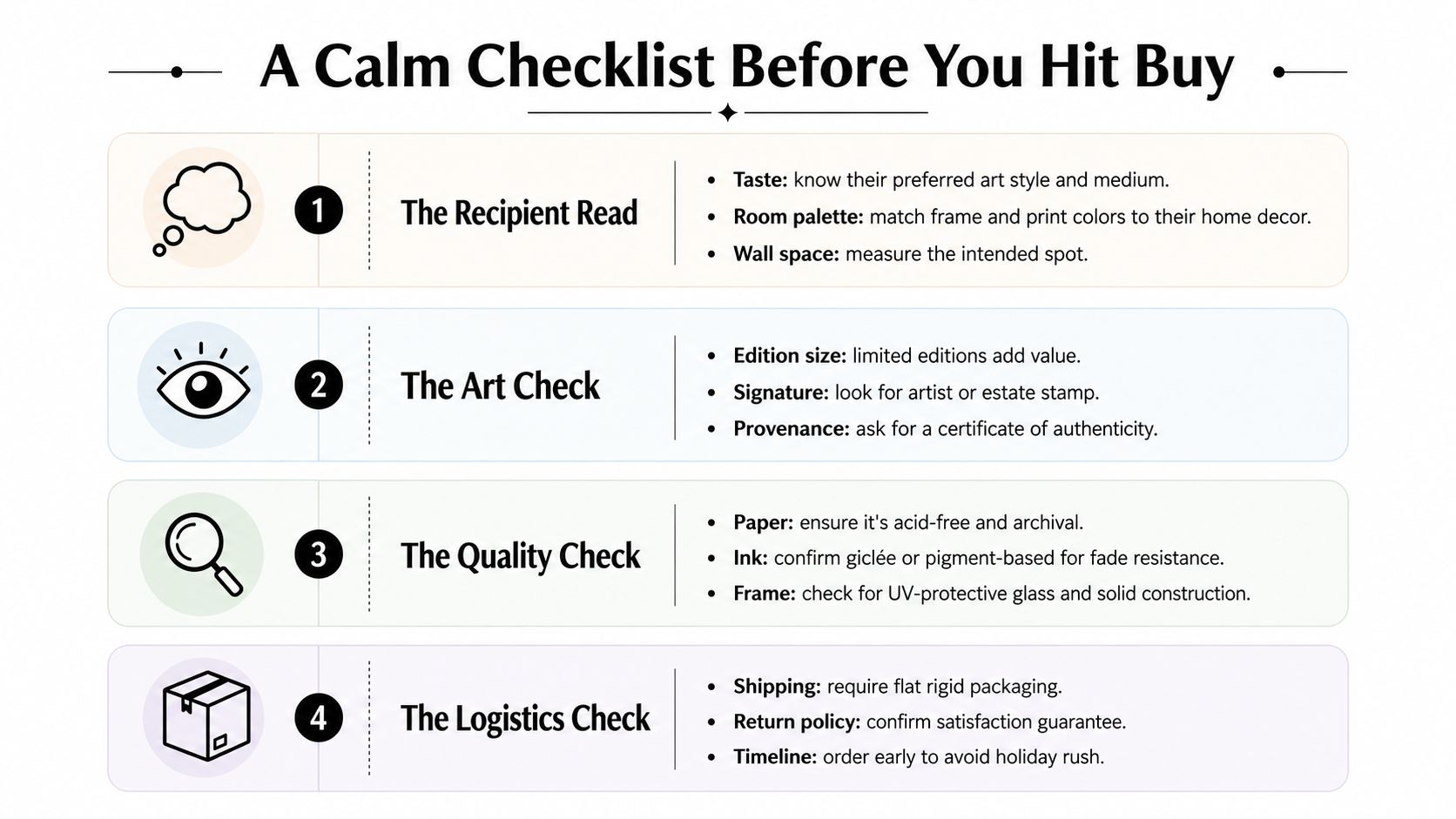
A housewarming usually favors display-ready art that helps a room feel settled. A wedding or milestone can support a location, scene, or personalized reference with emotional weight. A casual holiday exchange gives you more freedom to choose a smaller or playful work, but it still needs to suit the recipient.
Choose personalized art only when you know the person's story and visual preferences thoroughly. Choose ready-to-hang canvas when you want low recipient effort and broad room flexibility. Choose a gallery print when the giftee is a confident framer who'll enjoy completing the presentation.
The decision that matters: A well-matched print that arrives on time is better than an overthought original that creates a framing problem.
The aim isn't perfection. It's a thoughtful match between a person, a room, and a moment. Treat the purchase as a decor decision for someone specific, and the result will feel personal without becoming precious.
Jessie's Home offers artist-made canvas wall art and gallery-quality photo prints across abstract, skyline, botanical, minimalist, and other styles, with display-ready formats for real rooms. Visit Jessie's Home to choose a piece that fits your recipient's space, taste, and occasion instead of settling for another generic art-themed gift.

Discover how black and white minimalist art transforms any room with calm, contrast, and timeless style, plus tips on prints, framing, and placement.
Discover how black and white minimalist art transforms any room with calm, contrast, and timeless style, plus tips on prints, framing, and placement.

Discover watercolor abstract art techniques, learn how prints differ from originals, and get styling tips for your home. A complete guide for wall art lovers.
Discover watercolor abstract art techniques, learn how prints differ from originals, and get styling tips for your home. A complete guide for wall art lovers.

Explore the beauty of modern landscape art and how to choose prints that transform your home. From trends to room-by-room styling tips, this guide covers it
Explore the beauty of modern landscape art and how to choose prints that transform your home. From trends to room-by-room styling tips, this guide covers it


