Your wishlist is empty.
Secure Payment
30 days return


You're probably here because a lily painting caught you off guard.
Maybe it was a soft white bloom in an old museum frame. Maybe it was a hazy pond scene that made your shoulders drop the second you saw it. Maybe you're shopping for art right now and wondering why lily paintings can feel either timeless or hopelessly grandmotherly, with very little in between.
That tension is exactly why lilies matter. In art, they've never been just flowers. They carry religion, grief, beauty, status, memory, and atmosphere. They also happen to look fantastic above a sofa when you choose the right kind.
You spot a lily painting in a shop, then spot another in a museum, then another in a hotel hallway. Different rooms, different centuries, same flower. That repetition is the clue. Artists have kept returning to lilies for so long that the image now feels familiar before we even know why.
The history is unusually deep. Lilies have one of the longest documented visual histories in art, with early known representations appearing around 1580 B.C. in Minoan Crete, as noted by the Lilium Species Foundation's history of lilies across cultures. In other words, the flower did not drift into painting as a passing decorative favorite. It entered early and stayed.
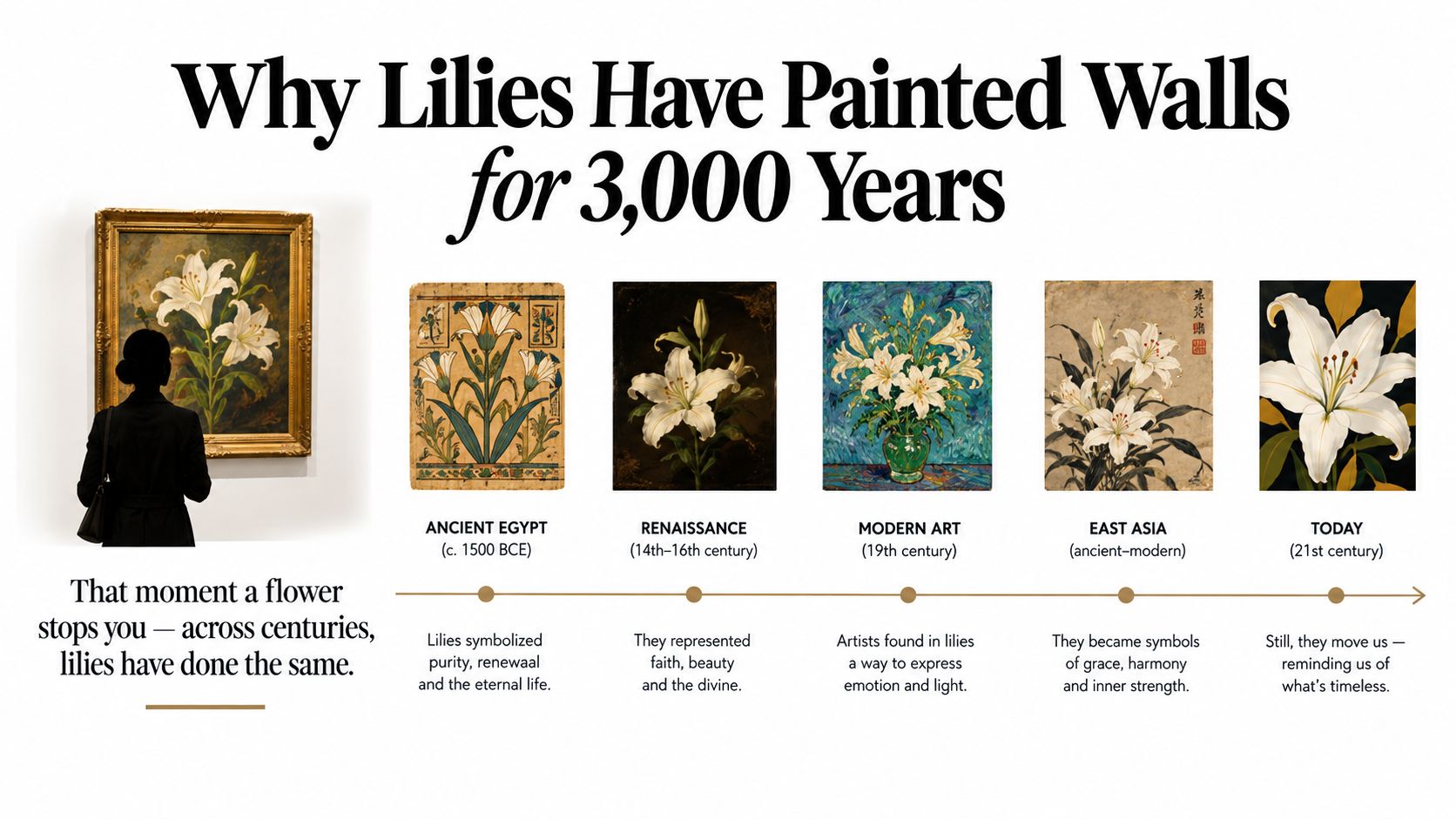
In ancient art, lilies often appear where beauty and ritual meet. A wall painting or carved surface could use a flower to do more than please the eye. It could mark a space as ordered, ceremonial, or connected to the divine.
Centuries later, Christian painters gave the lily an even steadier role. In Annunciation scenes, the white lily became a visual cue viewers could read quickly, much like a familiar symbol on a map. The convention lasted for centuries across medieval and Renaissance painting, a continuity discussed in Oxford scholarship on the lily in Christian iconography.
That long run matters for a modern viewer. We may not recognize every theological detail, but repeated images leave traces. A flower that appeared on chapel walls, manuscript pages, altarpieces, and later domestic paintings starts to carry a built-in sense of importance.
Lilies lasted because they are visually flexible. They can look formal and heraldic in a gold-ground panel, hushed in a Dutch interior, extravagant in a still life, or almost abstract in a modern canvas. Few flowers can move that easily between devotion, decoration, grief, luxury, and pure attention to color.
They also have a shape artists love to use. The trumpet bloom reads clearly from across a room. The stem gives structure. The petals catch light in ways that let painters show crisp contour or soft atmosphere, depending on the style.
A useful way to think about it is this: some motifs survive because they mean one thing very clearly. Lilies survive because they can mean several things without losing their identity.
This is the part art history often skips. If a flower has stayed in painting for three millennia, it arrives on your wall with more range than a generic botanical print. A lily painting can bring calm, ceremony, luminosity, melancholy, or freshness, depending on the artist and the room.
That is why one lily canvas feels right over a sofa and another belongs in a dining room or bedroom instead. You are not only choosing a flower. You are choosing which chapter of its long visual life you want to live with. Browsing a wide floral canvas wall art collection side by side makes those chapters surprisingly easy to spot.
A lily in a painting works a bit like a lamp in a room. It gives light, but it also changes the mood of everything around it. That is why the same flower can feel devotional in an altarpiece, mournful in a still life, or fresh in a bedroom painting.
The familiar reading is purity. In Western Christian art, the white lily, especially Lilium candidum, became closely associated with the Virgin Mary. In Annunciation images, painters used it as a clear sign of chastity, virginity, and the mystery of the Incarnation, as the same Oxford scholarship explains in detail.
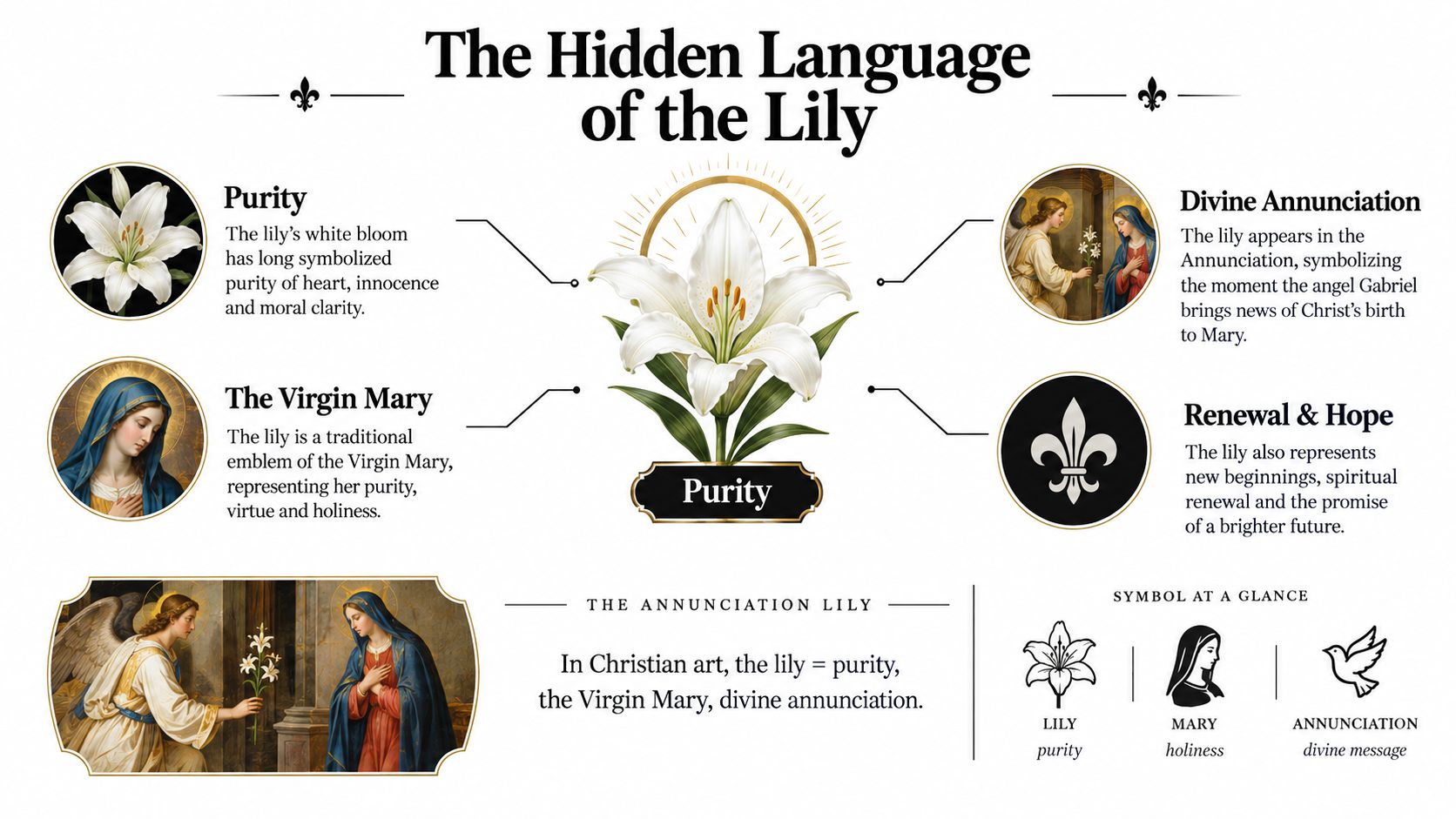
In an Annunciation painting, the lily is rarely there to fill empty space. It helps set the terms of the scene.
A vase on a lectern, a stem held by Gabriel, or a bloom placed near Mary tells the viewer to read the room with care. The flower points toward purity, but it can also signal Mary's role in bearing Christ. Medieval and early Renaissance viewers were trained to catch that layered meaning quickly, much the way we instantly read a wedding ring or a black armband now.
That is why a Botticelli or Jan van Eyck interior can look decorative to us and densely legible to earlier viewers. The lily was part of the grammar.
Here's a quick way to read it:
That third point still works in a modern home. Easter Wall Decor with a Single White Lily is about as pared back as a lily painting gets: one stem, one open white trumpet, a closed bud and soft gray-green leaves, floating on a pale, chalky ground. No vase, no table, no story around it. The quiet does the talking, which is exactly what the old painters were after.

Purity is only one chapter in the lily's visual life.
Depending on the setting, lilies can suggest motherhood, grief, sanctity, resurrection, restraint, or solemn beauty. In a devotional panel, the flower may feel almost doctrinal. In a later still life, the same bloom can read as fragile, sensual, or short-lived. Context changes the meaning as surely as lighting changes a room.
The white trumpet lily that fills churches every spring is usually Lilium longiflorum, the Easter lily, and it carries the resurrection meaning straight into seasonal decorating. If you're planning a faith-centered wall, this guide to Christian wall art for the living room covers sizes and placement, and the Christian canvas wall art collection gathers pieces with that same reverent feel.
That flexibility matters if you are choosing art for your home, because you are not only picking a flower. You are choosing the version of the flower's history that will live on your wall.
Three questions make the choice easier:
Once you can read the lily this way, styling becomes much simpler. You stop shopping for “a floral” and start choosing between serenity, ceremony, tenderness, and quiet drama.
Stand in front of a Monet water lily canvas and something odd happens. You stop looking for a flower and start noticing air, light, and the slow drift of water.
That change is Monet's real contribution. Earlier lily images often asked viewers to read the bloom the way you read a symbol in a sentence. Monet treated the pond more like a field of sensation, where petals, reflections, clouds, and ripples all share the canvas. The flower is still there, but it no longer behaves like an emblem pinned in place.
From the end of the 1890s until his death in 1926, Monet returned to the Water Lilies theme again and again, painting the pond in his own garden at Giverny and producing a vast body of related paintings and decorative panels. Repetition mattered here. He was not making a single successful floral picture and leaving it at that. He kept testing how far a familiar subject could dissolve into color, atmosphere, and scale.
A simple comparison helps. In many earlier flower paintings, the bloom works like a noun. Clear, named, and placed before you. In Monet, the lily starts acting more like weather. It spreads mood across the surface and changes depending on distance, light, and the viewer's patience.
Scale helped make that point. The Musée de l'Orangerie in Paris preserves Monet's cycle of eight large Nymphéas murals, installed in two oval rooms that opened to the public in 1927, shortly after his death. They work as immersive environments rather than ordinary framed pictures. He wanted the viewer surrounded, almost buoyed, by the painting.
Design note: Lily art feels current when it fills a room with atmosphere instead of asking the room to serve the picture.
That is why Monet matters so much to decorating, not just art history. A surprising amount of floral wall art now follows his logic: cropped views, softened edges, floating forms, mirrored light, and a composition that feels open rather than arranged. If you are drawn to pieces that calm a bedroom, loosen up a dining area, or give a living room a little visual depth, Impressionist canvas wall art is often a better starting point than a formal botanical print.
You can see that logic in Misty Lily Pond at Sunrise for the Bedroom. Pink water lilies drift across lavender-blue water, a hazy line of trees sits on the far bank, and a low gold sun spills a soft streak of light toward you. It's one of our artists' paintings, not a Monet, but it borrows his idea that the light on the water is the real subject.

Monet made the lily modern by making it immersive. He turned a flower into an environment, which is exactly why it still works so well on a wall at home.
You spot a pale flower in a painting, label it a lily, and move on. Art history is full of mistakes that start that way.
The problem is not botanical snobbery. It is meaning. A Madonna lily, a waterlily, and a lotus can look close enough to confuse a casual viewer, especially when an artist simplifies the petals, but they belong to different visual traditions and carry different ideas with them.
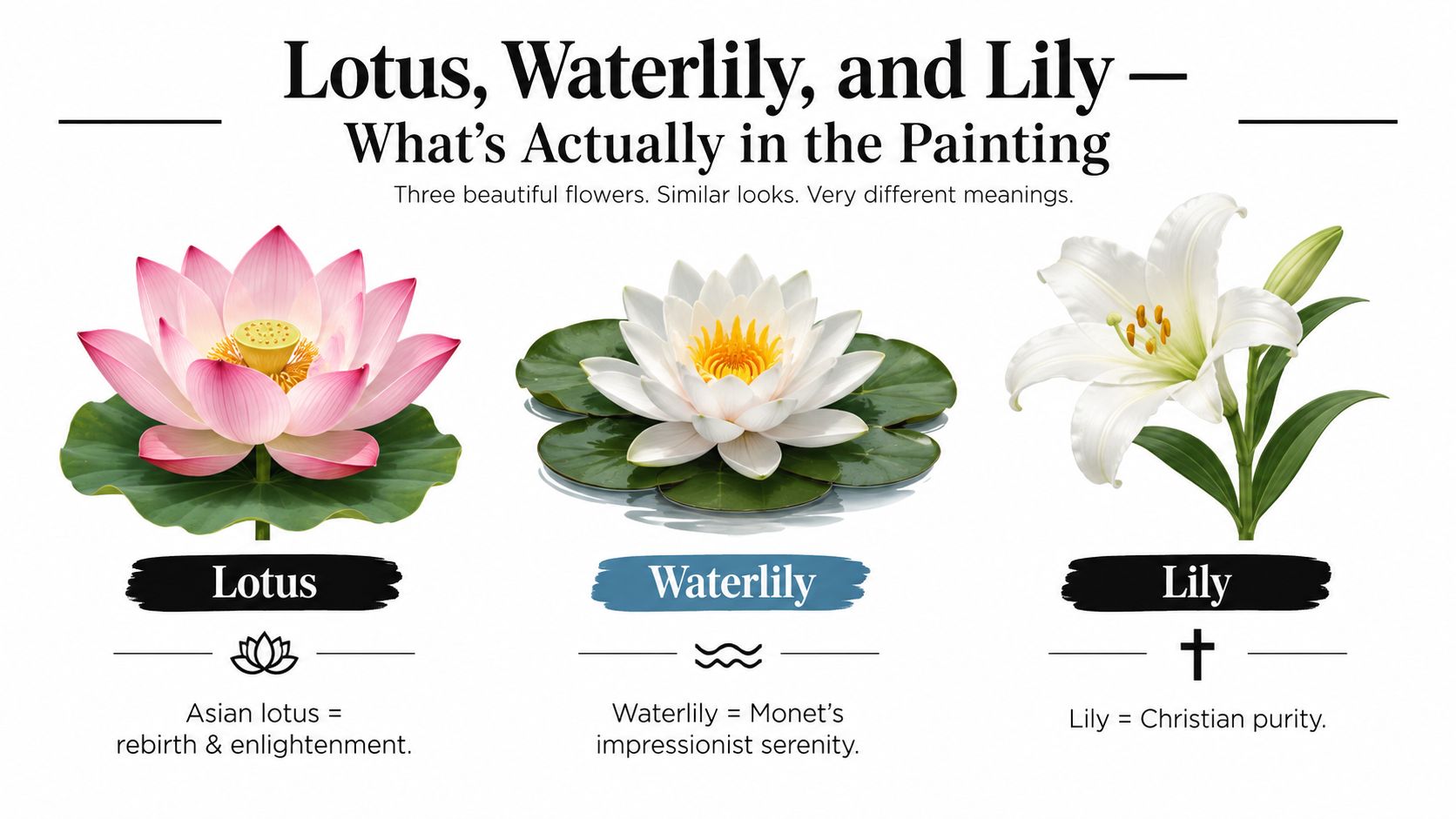
Artists often stylize flowers until they read more like symbols than specimens. That is one reason the white bloom in a Christian painting gets mentally filed with the floating blossom in an Asian screen or a pond painting. The petals seem to rhyme, so viewers assume the meaning does too.
It does not.
In many Asian traditions, lotus and waterlily imagery is tied to birth, rebirth, and enlightenment, the flower rising clean out of muddy water. In European Christian art, the white lily commonly signals purity and Marian meaning. Same pale petals, very different conversations.
That distinction matters in a museum, and it matters at home. If you buy a painting because you want a calm, meditative mood, a floating water flower will usually do a different job on the wall than an upright Annunciation lily with all its devotional baggage.
| Flower | Usual setting in art | Common reading |
|---|---|---|
| Lotus | Water, especially in Asian visual traditions | Rebirth, enlightenment, spiritual emergence |
| Waterlily | Floating on pond surfaces, often in modern Impressionist painting | Sensory calm, reflection, atmosphere |
| Madonna lily | Upright stem in interiors or sacred scenes | Purity, Marian symbolism, Incarnation |
A Botticelli Annunciation and a Monet pond scene may both give you pale petals. They are speaking different visual languages.
Here's a fun one: the flower most people picture first when they hear “lily painting” often isn't a lily at all. Calla lilies belong to the arum family, not the true lily genus Lilium, and botanically the waterlily isn't a lily either. True lilies are the Madonna lily, the Easter lily, the tiger lily, and their relatives, with six petal-like tepals and a cluster of long stamens.
None of that makes a calla any less paintable. Its single sculptural curl is a gift to artists, and Georgia O'Keeffe painted callas many times in the 1920s, cropping in so close that the flower turns into pure form. In decorating terms, callas read cleaner and more modern than trumpet lilies, which is why you'll see them in so many contemporary still lifes.
Use the setting as your first clue. It works a bit like identifying a piece of furniture from silhouette before you inspect the joinery.
Small difference, big consequence.
Call a lotus a lily, and you flatten the picture's whole worldview. Name the flower more carefully, and the image opens up. You also make better decorating choices, because now you are choosing not just a flower, but a mood, a history, and the kind of presence you want on your wall.
Sometimes the calmest choice has barely any flower in it. Lily Pad Wall Art Floating on Quiet Water is mostly pale gray water and mist, with a small cluster of sage green pads resting off to one side. It's the waterlily idea boiled down to stillness, and it sits beautifully above a sofa in a Japandi or minimalist room.

The subject matters, but technique is what makes one lily painting feel hushed and another feel bold.
Artists can paint the same flower and create completely different emotional weather. That difference usually comes down to framing, background, palette, and how much breathing room the bloom gets.
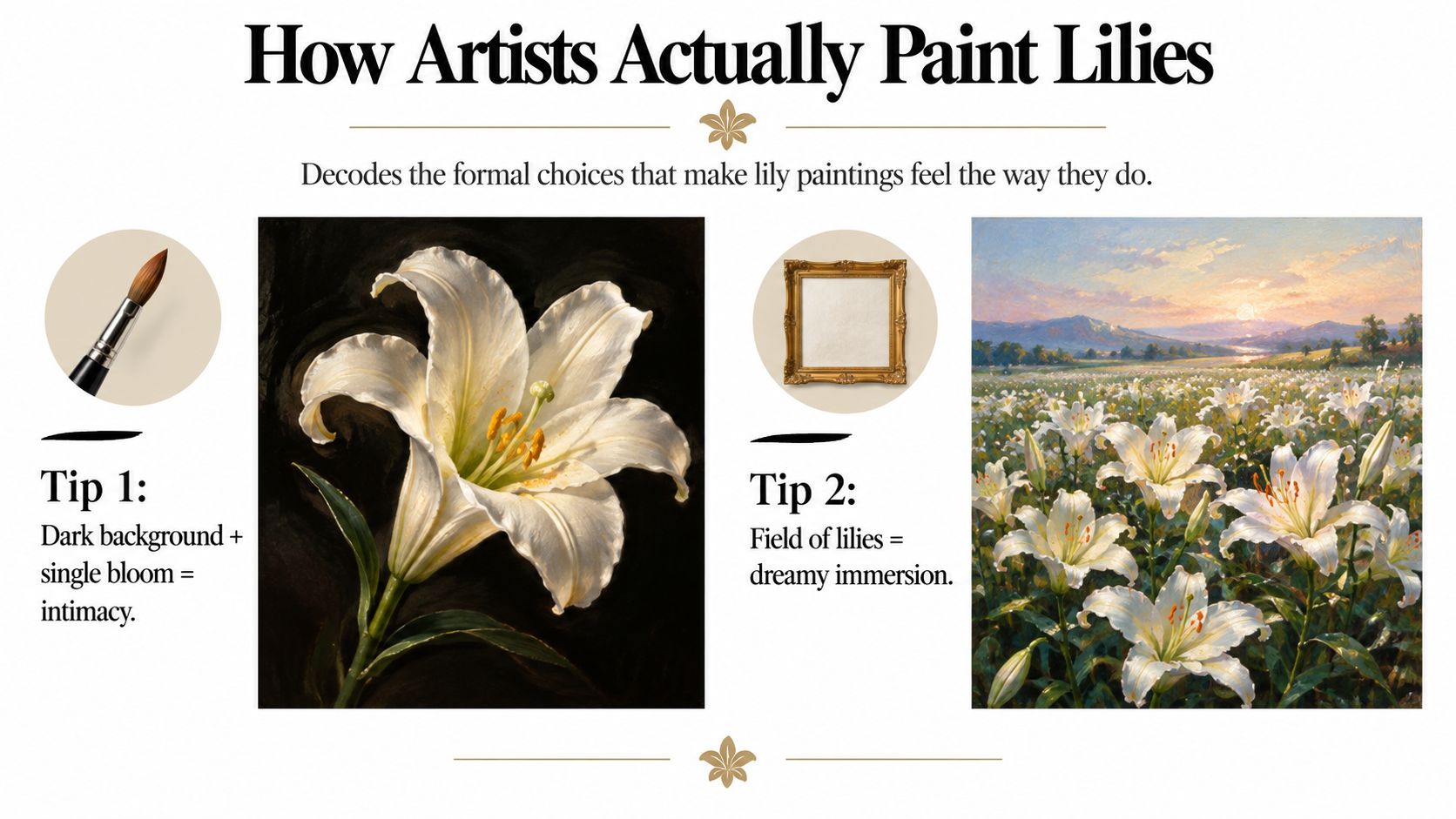
A lone trumpet lily on a dark ground tends to feel intimate. It can even feel devotional, whether the artist intended that or not. Your eye has one job, and the painting gives the flower a kind of stage light.
A field of lilies does the opposite. It disperses attention. Instead of admiring one specimen, you drift through the image. That's why broad waterlily compositions often feel restful in living rooms. They don't pin your eye down.
Georgia O'Keeffe understood the power of the close crop. When an artist moves in on petals, stamens, and folds, the flower stops behaving like décor and starts behaving like form. If that oversized, up-close look appeals to you, there's more on styling it in this piece on how to style a big flower painting.
Color changes the historical feel of floral art faster than almost anything else.
Put two of our artists' lily paintings next to each other and you can see the whole list at work. Dark Botanical Wall Art of Orange Lilies sets fiery tiger lilies against deep teal and violet, laid on thick with a palette knife, so the blooms practically glow. Elegant Calla Lilies in a Teal Vase for the Bathroom goes the other way: cream callas in a teal vase on a soft blue-green ground, cool and very calm.
Fantin-Latour is useful here as a mental reference. His flower pieces often feel creamy, still, and inward. A minimalist line drawing of a lily does something else entirely. It strips away volume and keeps only gesture.
Look for this: If the negative space around the flower feels generous, the painting will usually read calmer and more modern at home.
When you're trying to decode a piece you already own, or one you're considering, don't start with symbolism. Start with the painterly choices.
Those questions work whether you're looking at an old museum painting, a photographic floral canvas, or a stripped-down modern canvas. The flower is only half the story. The other half is how the artist makes you look at it.
People often hesitate. They adore lilies in art, yet fear that the moment they bring one home, the room will tip into tea-room territory.
It doesn't have to. The trick is to style the type of lily image, not just the flower itself. A misty waterlily panel behaves differently from a sharp botanical study or a graphic black-and-white bloom.
Lily art works best when it echoes something already present. That might be the gray in a rug, the cream in linen curtains, the olive in a chair, or the black in your lighting hardware.
If the piece repeats a note the room already knows, it looks intentional. If it introduces an entirely new emotional language, it can feel borrowed from somewhere else.
A neutral still life makes that easy. Modern Neutral Floral Calla Lilies in Stoneware shows white callas in an earthy stoneware jug, painted in thick, buttery strokes over loose blocks of cream, stone gray, muted blue and a little terracotta. Any one of those tones is probably already somewhere in your room, which is why it settles in so quickly.

A floral piece doesn't need to match the room. It does need to make sense inside it.
If you want a broad starting point, canvas wall art for modern homes is a useful category because it lets you compare floral work against cleaner, less traditional interiors.
For a living room, scale matters first. Large waterlily-inspired canvases often work well above a low sofa because they create a horizontal sweep rather than a fussy focal point. Over a 72-inch sofa, a 48×32 landscape canvas covers about two-thirds of the width, which is the proportion that looks settled. You want presence, not clutter.
In a bedroom, softer and smaller usually wins. A pair of quieter lily studies above nightstands, say two 16×24 portrait canvases, can feel more intimate than one oversized bloom staring directly at the bed. The bedroom wall art collection is a good place to find gentle pieces that pair well.
Dragonfly Wall Art Over Water Lilies and Reeds is the kind of piece that works there. Pale pink water lilies float on soft blue-gray water among sage green pads and tall reeds, with a tiny dragonfly hovering above them. The palette is soft enough for a bedroom and the tall format fits beside a bed or above a nightstand.

Dining rooms can handle more attitude. A darker background, sharper contrast, or a more graphic floral silhouette can earn its keep.
A few reliable pairings:
Gold frames can still look fresh. On matte walls, especially plastery whites, olive, charcoal, or soft clay tones, a slim gold frame can warm up floral art without making it feel old.
Dark backgrounds are also less risky than people think. In bright rooms, they ground the space. They can make white petals look crisp instead of sugary.
And botanical art isn't reserved for traditional homes. In a modern room, a floral can act as the softening note that keeps everything from looking too severe. People don't settle into rooms because every object is trendy. They settle in because the room feels emotionally coherent.
Before you buy, do this once and save yourself a lot of wall regret:
Then hang it with the center about 57 to 60 inches from the floor, or, if it goes over seating, with the bottom edge 6 to 8 inches above the back of the sofa. Those two numbers solve most lily-on-the-wall problems before they start.
Lily art has an unfair reputation. People hear “lily” and picture something sweet, polite, and slightly dusty.
But a lily can be enormous, stark, cropped, shadowy, or almost abstract. It can behave like statement art.
A macro floral photograph can feel architectural. A black-and-white line drawing can feel crisp and urban. An abstracted bloom with acid color or inky edges can hold its own against modern furniture, concrete floors, or clean-lined oak.
Black and White Still Life Painting Calla Lilies proves the point. It's all charcoal, silver, and white: tall callas in a clear glass vase, set against streaky, rain-gray palette-knife strokes. Put it in a room with black hardware and pale oak and nobody will call it grandmotherly.

That's why it helps to browse lily-adjacent work inside a broader botanical canvas wall art collection. You stop thinking only in terms of “flower art” and start noticing scale, contrast, and attitude.
Use this when you're close to buying:
Buy the lily piece that sharpens the room you already have, not the fantasy room you might one day create.
Keep the process simple.
Measure the wall. Take a daylight photo of the room. Save three reference images you keep returning to. Tape the outline of your favorite size on the wall and live with it for a day or two. Then make the decision.
If you're torn between a symbolic white bloom and a more atmospheric floral, use your own home as the tie-breaker. Sacred calm, modern haze, graphic punch, quiet romance. They're all valid. The right one is the one that feels like an extension of how you live. And once it's up, this guide to canvas floral prints has simple care and display tips to keep it looking fresh.
If you're ready to move from inspiration to the actual wall, Jessie's Home offers artist-made canvas wall art from more than 500 artists, with lilies painted in many of the ways this article describes, from misty ponds to moody tiger lilies and quiet calla still lifes. Every piece arrives ready to hang, so you can choose a lily piece that feels informed, personal, and right at home.

11 Texas decor ideas built around wall art: Hill Country bluebonnets, longhorns, desert, coast and city skylines, plus colors and sizes by room.
11 Texas decor ideas built around wall art: Hill Country bluebonnets, longhorns, desert, coast and city skylines, plus colors and sizes by room.

Nashville gifts in wall art, matched to the person, plus Tennessee decor ideas by room, from Nashville skylines to Smoky Mountain ridges.
Nashville gifts in wall art, matched to the person, plus Tennessee decor ideas by room, from Nashville skylines to Smoky Mountain ridges.

Soft pastel, lavender and gold or retro: how to choose solar system art, how big the planets really are, which canvas size fits above a sofa, bed or crib, and...
Soft pastel, lavender and gold or retro: how to choose solar system art, how big the planets really are, which canvas size fits above a sofa, bed or crib, and...


